
Treated, repaired, assembled, fake — know the terms
These words are not interchangeable. A treatment changes a real specimen's appearance — dye, heat, irradiation or coating. A repair re-joins a genuine crystal that broke, while a restoration fills or rebuilds missing material. An assembled or "composite" piece glues unrelated crystals together to fake a better specimen. A fake is something sold as a natural mineral that isn't one at all.
None of these is automatically dishonest — repairs and treatments are normal in the trade. The problem is only when they are not disclosed.
Dyed and coated stones
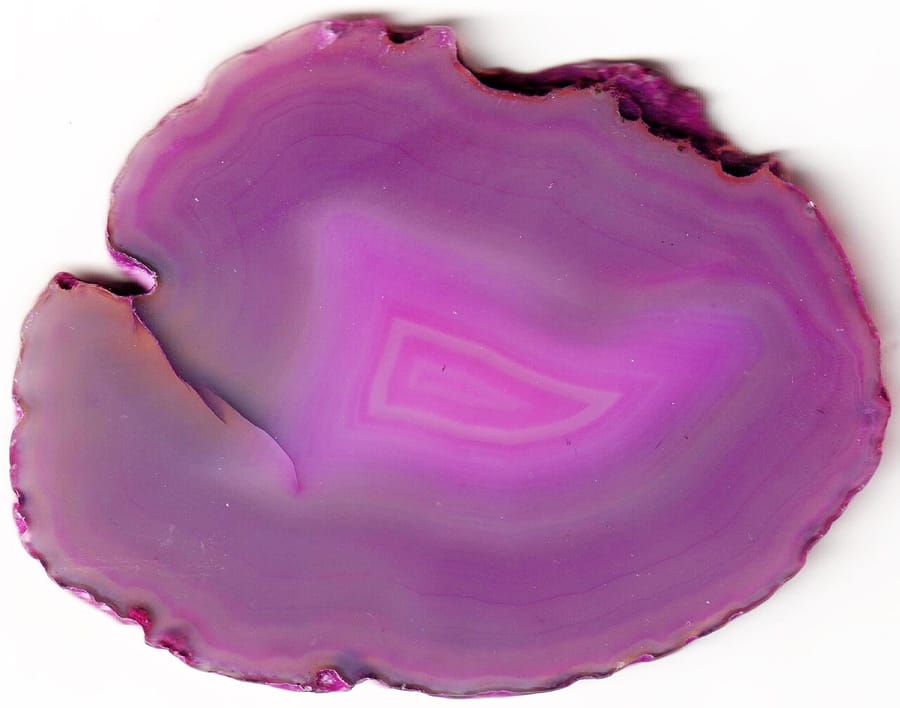
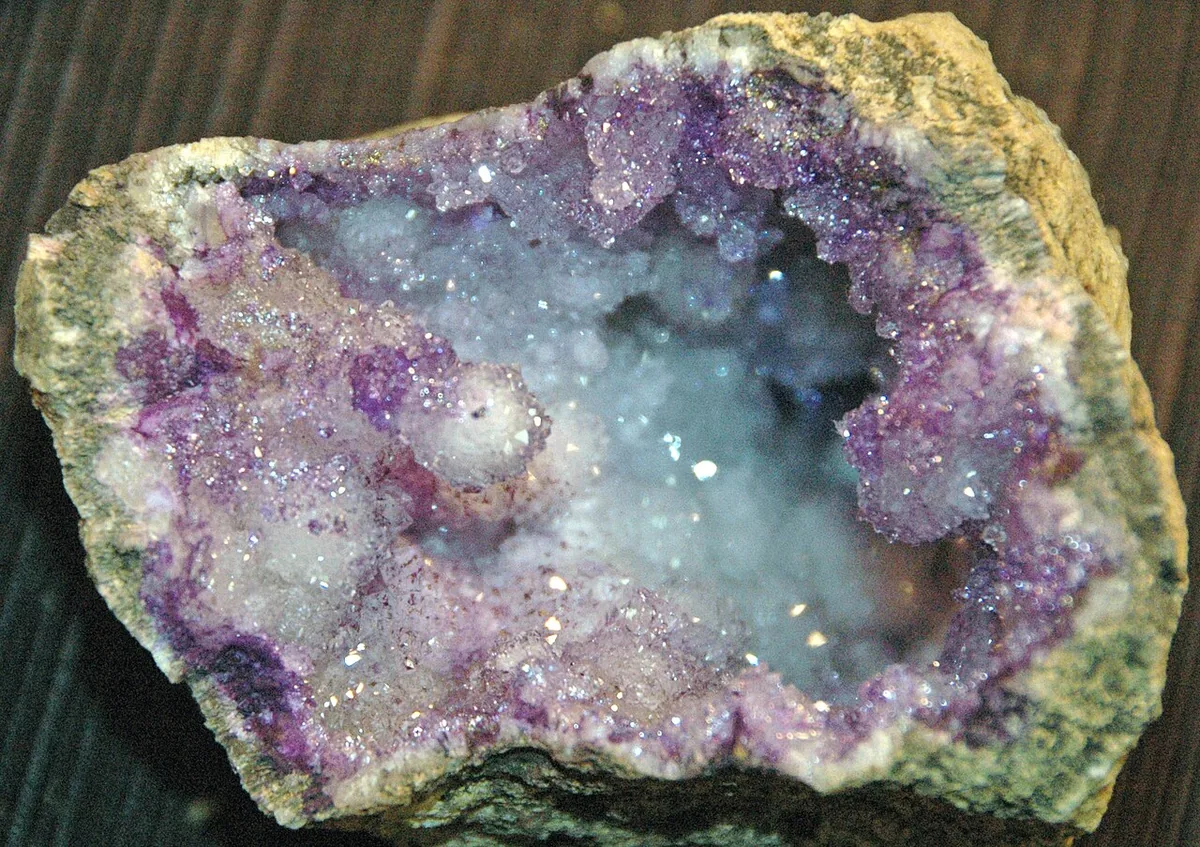
Dyeing is the oldest trick: pale agate, howlite and quartz are soaked in colored dye and sold as something rarer — blue howlite as "turquoise," or dyed quartz druse as "amethyst." Tell-tale signs are color pooling in cracks, unnaturally even or garish hues, and color that rubs off on a damp cotton swab.
Coatings are newer: "aura," "flame" and "rainbow" quartz are real quartz coated with a microscopically thin layer of vaporized metal, giving an iridescent metallic sheen no natural quartz has.
Heat, irradiation and lab-grown material
Heat and radiation change color invisibly. Most "citrine" on the market is heat-treated amethyst; much blue topaz is irradiated and heated colorless topaz; some smoky quartz is irradiated. These are real minerals with altered color, and reputable sellers disclose them.
Fully synthetic material is different again: lab-grown quartz and the rainbow "bismuth" hopper crystals seen in shops are man-made, not natural specimens — the bismuth is smelted in a workshop, not mined.
Repairs, fills and assembled clusters
Shine a UV light and use a 10x loupe along crystal junctions: glue often fluoresces, traps bubbles, or shows a faint seam, color break or luster mismatch where two pieces meet. Be suspicious of a "perfect" cluster whose every crystal points ideally toward the camera, or a single crystal sitting too neatly upright on a sand-blasted base.
Cleaved minerals are the usual candidates for repair — Chinese fluorite cubes, for example, separate cleanly and are sometimes re-glued. See our natural vs. treated and Chinese fluorite guides.
Fake localities and "too good" deals
Sometimes the specimen is genuine but the label is not. Watch for matrix that doesn't match the claimed locality, famous-locality labels on common material, and prices that are far below what a real example would cost. If a deal looks too good for the locality stated, the locality is usually the part that's wrong.
Manufactured items also circulate as "minerals": glued pyrite suns, reconstructed fossils, and resin or glass castings of crystals. When in doubt, weight, temperature and a loupe usually expose them.
How to protect yourself
Buy from sellers who describe condition honestly and answer direct questions: ask plainly whether a piece is repaired, restored, treated or assembled, and how the locality is known. A good seller won't mind.
Carry a 10x loupe and a small UV light, view specimens in good light, and learn what your favorite species naturally looks like — the more real material you handle, the faster fakes jump out. See how we describe and verify our own pieces in how we source.
Frequently asked questions
How can I tell if a crystal is dyed?
Look for color pooling in cracks, unnaturally even or garish color, and dye that transfers to a damp cotton swab. Dyed stones usually show color on the surface rather than crystallized through the mineral.
What is aura or rainbow quartz?
It is natural quartz coated with an ultra-thin layer of vaporized metal (such as gold or titanium) to give an iridescent metallic sheen. The crystal is real but the color is a man-made coating, not natural.
Are repaired specimens worth buying?
Yes — repair and restoration are normal in the trade and a well-disclosed repair can still be a fine, fairly priced specimen. The key is that it is disclosed and priced accordingly.
Is 'bismuth crystal' a natural mineral?
No. The rainbow hopper bismuth crystals sold in shops are man-made, grown by melting and cooling refined bismuth metal. Natural bismuth exists but looks nothing like them.