
How a Fluorite Phantom Forms
Crystals rarely grow in one smooth, uninterrupted push. In a hydrothermal vein the mineral-bearing fluids come and go, temperatures rise and fall, and the chemistry of the solution shifts over time. A fluorite phantom is the fingerprint of one of those interruptions.
The sequence is simple. A fluorite crystal grows to a certain size and its faces stop advancing. During the pause, a whisper-thin layer of a different mineral settles onto those faces. When conditions swing back in favour, fresh fluorite grows over the top, burying that layer. The buried surface keeps the exact geometry of the crystal at that moment, so what you see inside the finished cube is a true snapshot of its younger self.
Phantoms tend to appear where growth happens in episodic bursts:
- A drop in temperature that briefly halts deposition
- A change in fluid chemistry or a new mineral entering the system
- A quiet interval when fine dust or clay settles in the pocket
- Repeated cycles, which can stack several phantoms one inside another
Because the whole process is geological, a phantom cannot be added later. It is locked in from the moment the crystal grew.
What a Phantom Looks Like Inside Fluorite
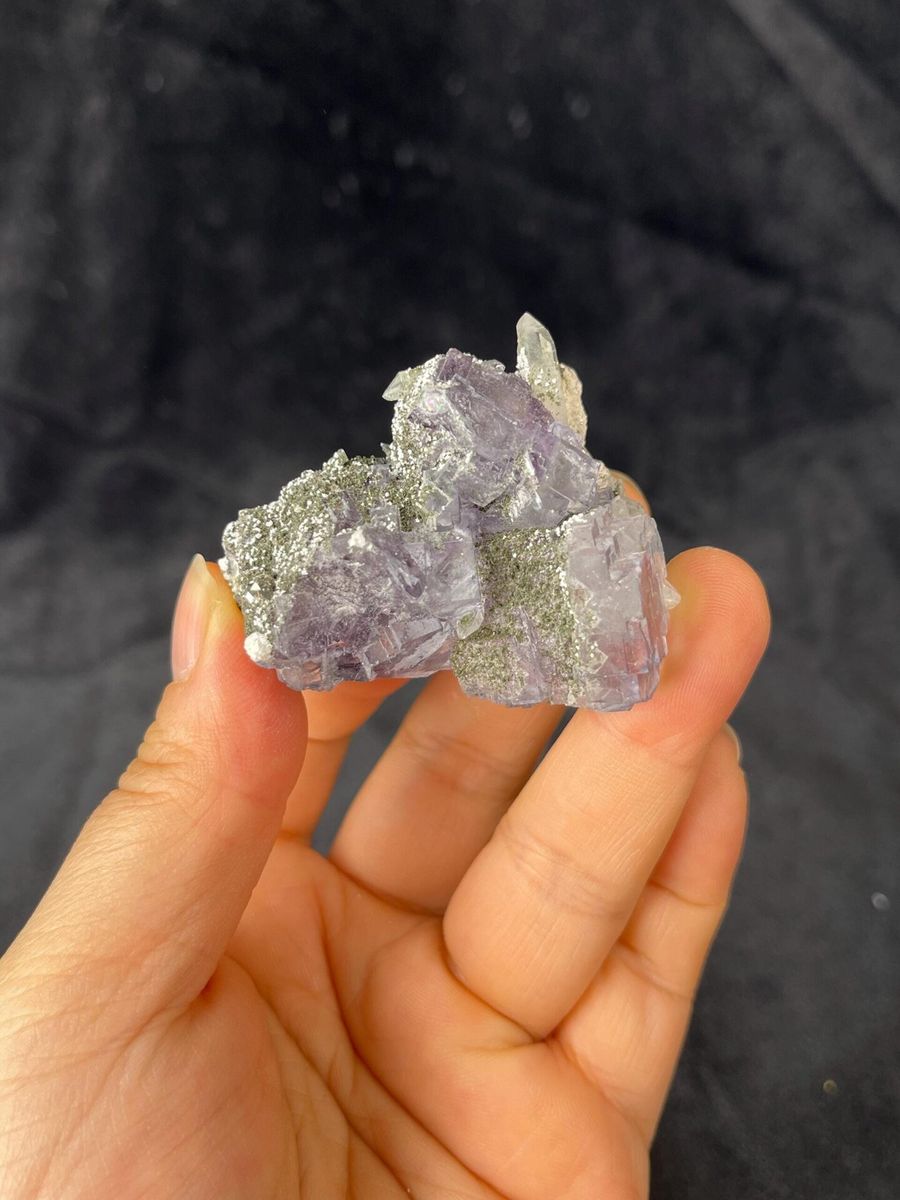
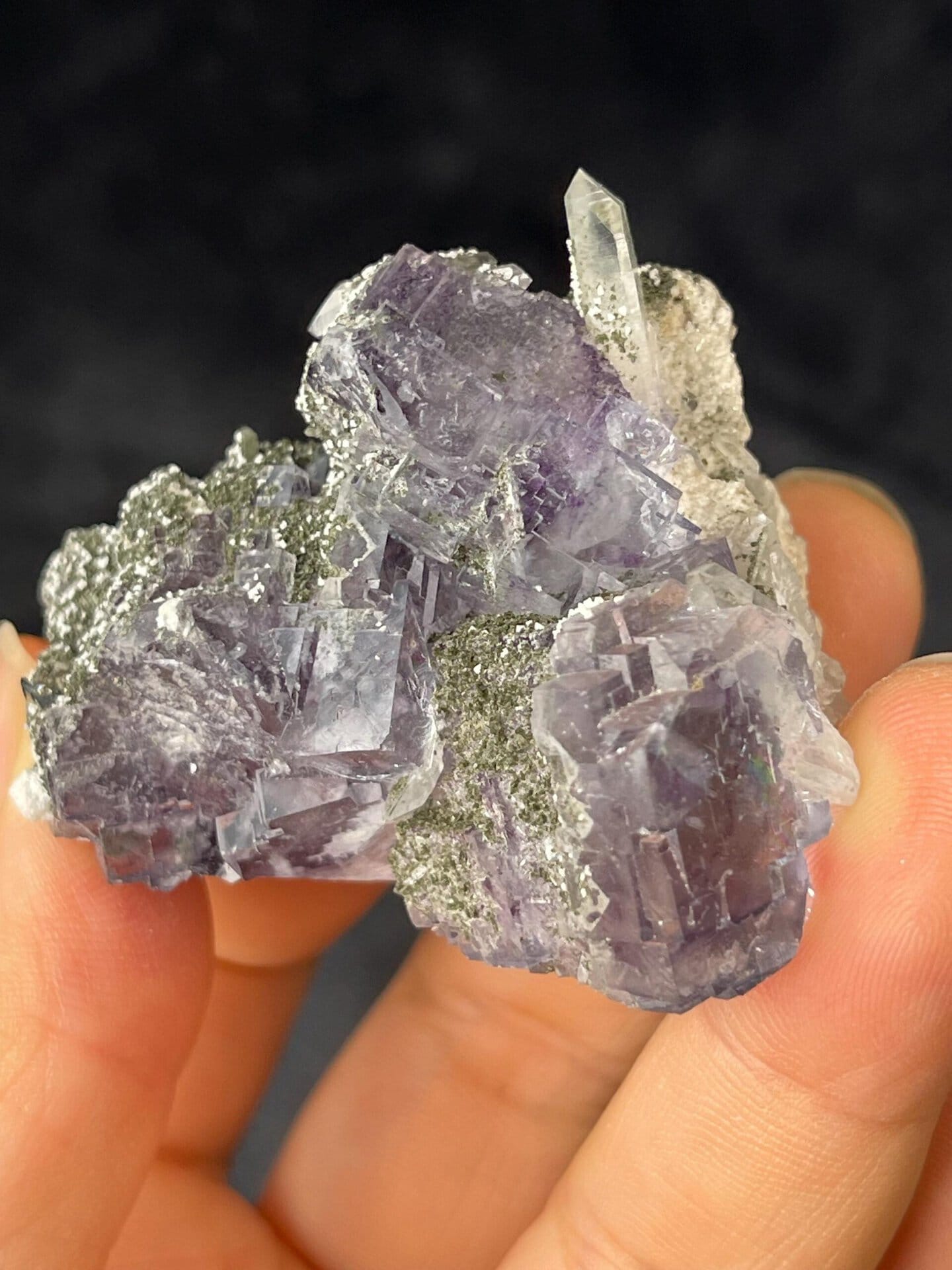
In fluorite, a phantom usually reads as a smaller cube nested inside a larger one, or as a darker core surrounded by paler, clearer material. On the Yaogangxian specimen shown here, each lilac cube carries a deeper violet centre, with an olive-green mineral dust picking out the edges. That green coating is exactly the kind of layer that becomes a green phantom if the crystal grows over it.
The colour of a phantom depends on what settled during the pause:
- A green haze often comes from chlorite
- A reddish or rusty veil usually points to hematite or iron oxides
- A soft white mist tends to be clay or feldspar dust
- A shift in trace elements alone can leave a purely colour-zoned phantom, with no visible foreign mineral at all
The most striking fluorite phantoms combine a translucent host with a sharply defined interior outline, so the ghost cube seems to hang in clear space. Turning the piece slowly under a single light is the best way to bring a faint phantom into view.
Phantom, Inclusion, or Cleavage: How to Tell Them Apart
Collectors sometimes mix up three different things that all live inside a crystal. Telling them apart is straightforward once you know what to look for.
- A phantom follows the geometry of the crystal. It echoes the cube or octahedron of the host as a faint, complete outline, because it is a former growth surface of that same crystal.
- An inclusion is trapped foreign material, such as a needle, a blob, or a cluster of another mineral. It sits wherever it happened to land and bears no relation to the crystal's shape.
- Cleavage is a break, not a growth feature. Fluorite cleaves cleanly along its octahedral planes, and internal cleavage shows up as flat, mirror-like surfaces that often flash a rainbow when the light catches them.
A quick test: if the ghostly shape mirrors the outside of the crystal, it is a phantom. If it is a flat plane that reflects light like a tiny window, it is cleavage. If it is a random foreign object, it is an inclusion. Many fine fluorites show all three at once.
Chinese Fluorite Phantoms: Yaogangxian and Inner Mongolia
Some of the world's most collectible phantom fluorites come from China. Yaogangxian in Hunan, long famous for its purple cubes on wolframite and quartz, regularly produces crystals with violet cores and green-dusted growth zones, precisely the interrupted-growth story that makes a phantom.
More recently, Inner Mongolia has drawn attention for phantom material. The Yindu mine in Hexigten Banner, near Chifeng, produces cubes with dense purple phantom cores set in bluish-green fluorite, and many collectors now describe it as a locality to watch, with colours more saturated than Yaogangxian even if the crystals are often a little less transparent. The larger Huanggang mine in the same region also yields strongly zoned fluorite.
None of this is unique to China; phantoms occur in fluorite worldwide. But the Chinese localities happen to combine strong colour, good crystal form, and the episodic growth that phantoms need, which is why so many of the phantom fluorites collectors covet carry a Chinese label.
Are Phantom Fluorites Rarer or More Valuable?
A phantom can add real value, but it is not a magic multiplier. What collectors pay for is the same thing that makes any fluorite desirable: colour, transparency, crystal form, condition, and locality. A phantom enhances a piece when it is sharp, well-centred, and clearly visible through a translucent host, because it turns the specimen into a small window on the crystal's own history.
A faint or muddled phantom, or one buried in cloudy material, adds little. And a phantom will not rescue a damaged or dull specimen. Our advice is the same as always: buy the piece that genuinely appeals to you in the hand, and treat a good phantom as a welcome bonus rather than the whole reason to buy.
Because a phantom is a natural growth feature, it also doubles as quiet reassurance that a crystal grew the way nature intended, which is one more reason we enjoy pointing them out.
Frequently asked questions
Are fluorite phantoms natural or man-made?
They are entirely natural. A phantom is a record of the crystal's own interrupted growth, formed deep in the earth. It is not a dye, coating, or any other treatment, and it cannot be added to a crystal after the fact.
How can I tell a phantom from an inclusion?
A phantom follows the geometry of the host crystal, showing up as a faint ghost cube or octahedron that mirrors the outside shape. An inclusion is trapped foreign material that sits wherever it landed and bears no relation to the crystal's form.
Do phantoms make a fluorite more valuable?
They can, when the phantom is sharp, well-centred, and clearly visible through translucent material. Even so, colour, transparency, crystal form, and condition remain the main drivers of value, so a phantom is best seen as a bonus rather than the whole story.
Where do the best fluorite phantoms come from?
Phantoms occur in fluorite worldwide, but China is especially known for them. Yaogangxian in Hunan and the Yindu and Huanggang mines in Inner Mongolia all produce strongly zoned, phantom-bearing fluorite prized by collectors.