
Apatite
Curated by Maggie Liu · Updated:
Apatite is a phosphate mineral prized by collectors for its exceptional color range, with several world-class Chinese localities.
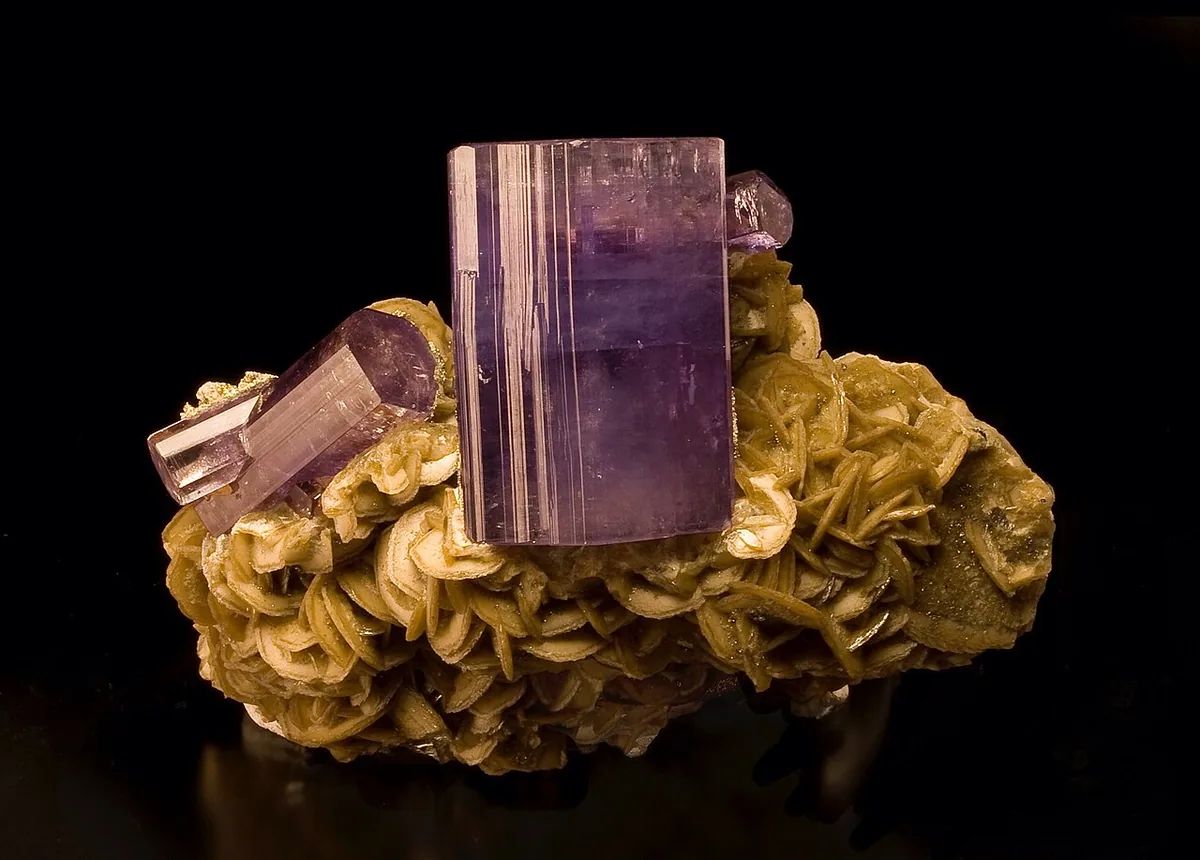
Apatite is the most abundant phosphate mineral — a calcium phosphate group prized by collectors for sharp hexagonal crystals in a wide range of colours, from neon blue and green to purple and yellow.
About Apatiteextended article
Apatite — the calcium phosphate group, dominated by fluorapatite — is the most abundant phosphate mineral and a popular collector species for its range of colours and sharp hexagonal prisms. Its name comes from the Greek apatáo (“to deceive”), for how readily it is mistaken for other minerals such as beryl or tourmaline.
Forms and colours
Gem apatite occurs in vivid blue, green, yellow, purple, and pink, often as transparent hexagonal prisms, and is a common accessory in granites, pegmatites, and skarns worldwide. It is a frequent associate on specimens of other species, perched on quartz, mica, or feldspar.
The Chinese angle
In China, apatite turns up across the Nanling W-Sn deposits and the rare-earth and skarn systems. At the Bayan Obo deposit fluorapatite is a major rare-earth-bearing phase, and crystallised apatite accompanies fluorite and cassiterite at localities in Hunan and Sichuan.
Collecting notes
Apatite is moderately soft (Mohs 5) and can be brittle, so undamaged terminations and saturated colour drive value. Gemmy, well-terminated single crystals and aesthetic associations on matrix are the most sought-after.
About Apatite
Apatite is classified as a phosphate mineral in the apatite supergroup and has the chemical formula Ca₅(PO₄)₃(F,Cl,OH). It crystallizes in the hexagonal system and is one of the most visually varied minerals in the collector market. Its combination of structural character and global distribution make it a recognized species in both systematic and aesthetic collections.
Identification & care
Specimens usually show prismatic, tabular hexagonal; massive, granular, botryoidal. Its color range is broad, including green, blue, yellow, purple (violet), pink, colorless, and brown. The luster is vitreous, sub-resinous, the streak is white, and specimens range from transparent to opaque. The cleavage is poor basal {0001} and prismatic {1010}. The fracture is conchoidal to uneven, which aids identification.
Collector context
How it forms
In terms of geology, Apatite forms in igneous, metamorphic, sedimentary; pegmatites; skarn; phosphate rock (sedimentary). It is commonly found in association with tourmaline, quartz, feldspar, calcite, fluorite.
Classic Chinese localities
Documented Chinese occurrences are recorded at Shangbao Mine, Jiama Cu-polymetallic deposit and Jinduicheng Mine, among others.
Why collectors care
Collectors pursue Apatite for the clarity of its crystal form and, in good material, saturated color that reads instantly across a display case. A well-terminated apatite on clean matrix photographs well, identifies quickly, and anchors a cabinet piece. Top Chinese specimens over the last two decades have reset the bar for what apatite looks like at collector grade.
What affects value
Value in Apatite is assessed, in typical order of weight, against: (1) locality provenance; (2) size relative to the species norm; (3) crystal form and termination sharpness; (4) color saturation and zoning; (5) transparency and internal clarity; (6) matrix quality and aesthetic balance; (7) condition (absence of damage, chips, or repair). Cleaning quality and verified locality documentation act as multipliers across the above.
Frequently asked questions
What is Apatite?
Apatite has the chemical formula Ca5(PO4)3(F,Cl,OH), crystallises in the Hexagonal system, has a Mohs hardness of 5. Apatite is a phosphate mineral prized by collectors for its exceptional color range, with several world-class Chinese localities.
What is the chemical formula of Apatite?
The chemical formula of Apatite is Ca5(PO4)3(F,Cl,OH).
What crystal system does Apatite belong to?
Apatite crystallises in the Hexagonal crystal system.
Where is Apatite found?
Notable localities for Apatite include Bayan Obo, Panasqueira.
Is Apatite rare?
As a collector mineral, Apatite is generally considered common.
Related minerals
Available Apatite specimens
External references
Apatite on Wikidata.