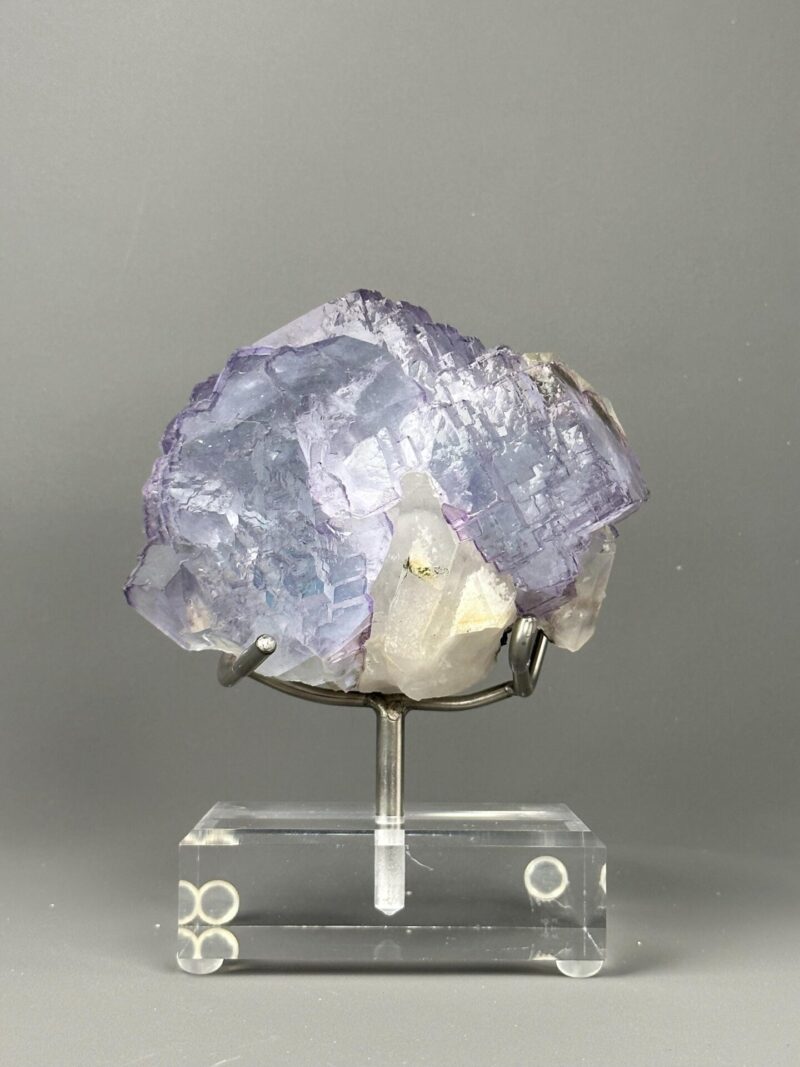
Leadhillite is a complex lead sulfate-carbonate-hydroxide that produces some of the most architecturally distinctive crystal forms of any lead secondary mineral — pseudo-hexagonal flat tabular plates and “Christmas-tree” stacks. It is named for the Leadhills district of Scotland.
Properties
- Formula: Pb4(SO4)(CO3)2(OH)2
- Crystal system: Monoclinic
- Hardness: 2.5 – 3
- Color: Colorless, white, pale yellow, sometimes pale green
- Streak: White
- Luster: Adamantine to resinous
- Cleavage: Perfect on {001}
- Density: 6.3 – 6.6 g/cm³
Occurrence
Type locality: Leadhills-Wanlockhead (Scotland). World-class specimens from Tsumeb (Namibia), Mammoth-Saint Anthony Mine (Arizona), and Cornwall (UK). Susannite is its trigonal polymorph from the same localities.
Identification
Hexagonal-tabular pseudohexagonal plates + extreme density (heavy in hand) + adamantine luster + Pb chemistry. Distinguish from cerussite (orthorhombic prisms, different habit) and susannite (trigonal polymorph, requires X-ray separation).
Collector Notes
Tsumeb leadhillite tabular crystals are top of class. Important for Pb-mineral specialists completing the Leadhills secondary suite (cerussite, anglesite, linarite, leadhillite, lanarkite).
Found at these Localities
- Tsumeb Mine (楚梅布矿)
- Cornwall Mining District (康沃尔矿区)