
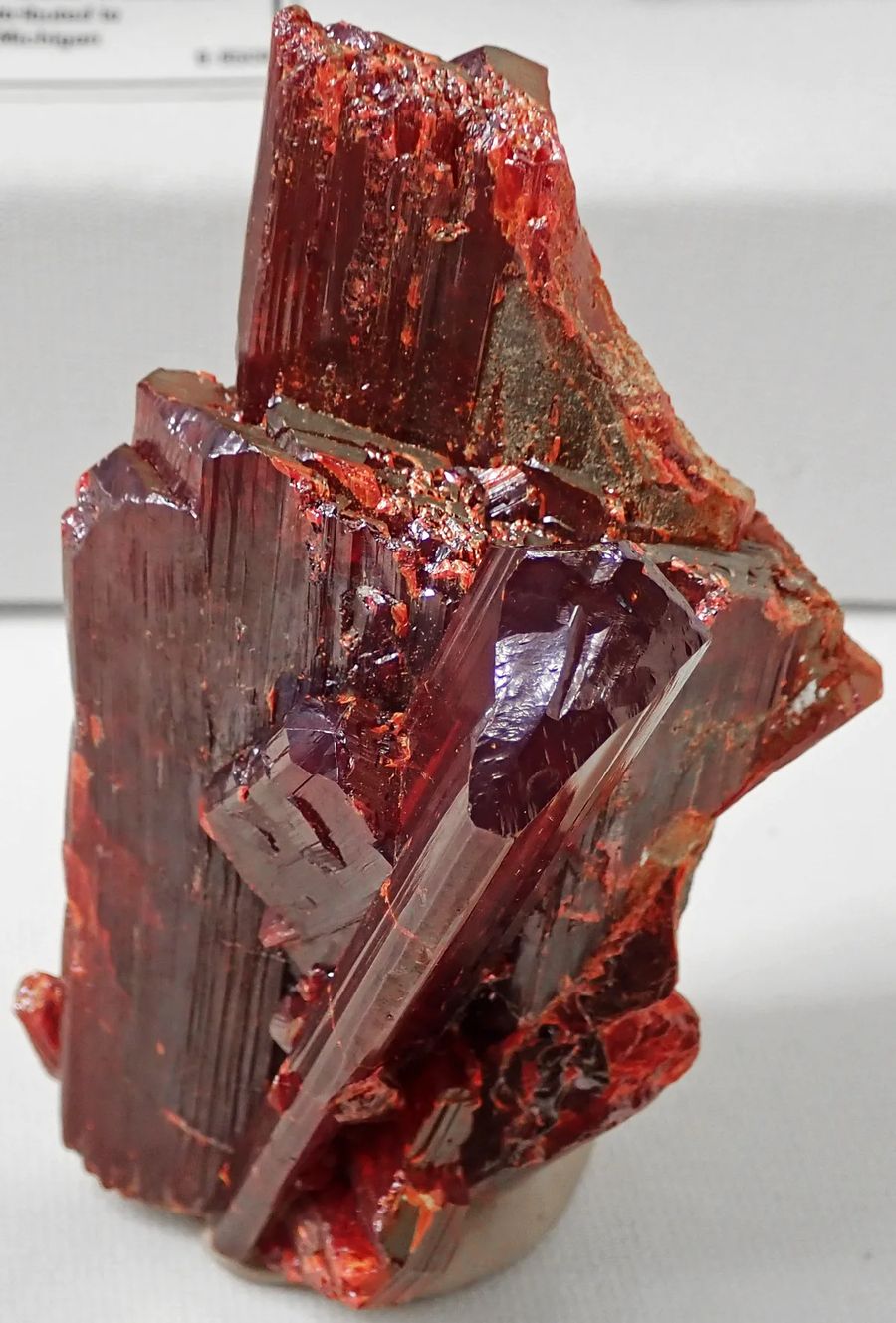
Identity: useful clues and firm limits
The Handbook of Mineralogy lists realgar as AsS, with red to yellow-orange color, and orpiment as As₂S₃, commonly lemon-yellow to golden or brownish yellow. These are reference properties, not a remote identification service. Matrix, coatings, alteration and camera color can make a photograph ambiguous.
A defensible listing separates four layers:
- Observed: color, luster, habit, matrix and dimensions.
- Label-reported: mineral and locality written on the original label.
- Reference-consistent: characteristics compatible with published mineral data.
- Analytically confirmed: an appropriate test tied to the exact specimen.
Light and condition
The Handbook of Mineralogy reports that realgar disintegrates after long light exposure into a powder containing alteration products. Keep realgar in dark or very low-light storage and use brief, cool lighting for inspection or photography.
Do not describe yellow surface material as orpiment without evidence; alteration products and mixtures require qualified identification.
Conservative handling
ATSDR names both realgar and orpiment as arsenic minerals. Keep either specimen enclosed, avoid dust-generating tests, do not place it in a child’s collection, and keep it away from food areas and pets. Wash hands after a necessary move.
Damaged or powdery material should be isolated and assessed by a qualified professional rather than swept, blown or placed into ordinary waste on generic advice.
Sources & evidence limits
These references support the specific points described below. A trade name, colour, photograph, price, or seller statement alone cannot prove treatment status or origin.
Frequently asked questions
Is red always realgar and yellow always orpiment?
No. Those are common colors, not proof. Mixed specimens, alteration, coatings and photography can mislead. Preserve the label and use qualified analytical identification when the distinction affects safety, value or a product claim.
Can I use a streak test?
Do not deliberately abrade an arsenic-bearing collectible. A streak test creates powder and damages the specimen. Use non-destructive documentation first and obtain professional advice if confirmation is necessary.
Why should realgar be kept dark?
Published mineral data describes degradation during prolonged light exposure. Dark or very low-light storage helps preserve condition and reduces formation of loose alteration powder.
Are realgar and orpiment safe for jewelry?
This page is for enclosed mineral specimens, not wearable products. Neither mineral should be marketed for skin-contact jewelry, children’s use or wellness use.