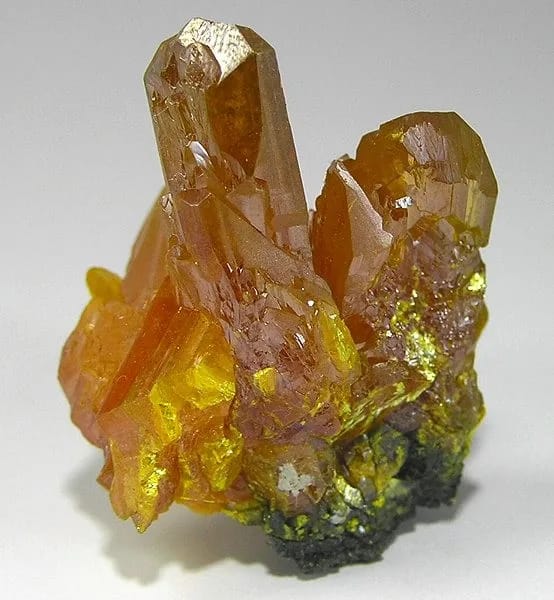
Computed from simplified end-member formula. Solid-solution series, water content, and trace substitutions cause real-world variation.
IMA Abbreviation (Whitney-Evans 2010)
Orp
→ Orpiment
As sulfide
Standard symbol from American Mineralogist (Whitney & Evans, 2010). Used in thin-section labeling, phase diagrams, and IMA-style species records.
⏳ Long-term Aging & Care Timeline
slow photodecompositionyears
Trigger: UV + visible light
Intervention: Slower than realgar. Yellow may pale and crystals may dust over decades. Limit light exposure.
Pronunciation
/ˈɔːrpɪmənt/
↔ OR-pih-munt
Latin auripigmentum (gold pigment)
⚠ Safety & Handling
☠toxichigh
Arsenic trisulfide — same hazard as realgar.
Handling: Same as realgar (toxicity).
☼light-sensitivemoderate
Less light-sensitive than realgar but still degrades over decades.
Handling: Dark storage preferred.
Information provided in good faith. Consult local hazmat regulations for transport and disposal. Severely hazardous specimens may require special storage cabinets.
Luster
resinous→pearly
Pearly on cleavage; bright yellow.
Diaphaneity (Transparency)
translucent
Yellow-gold translucent.
Diagnostic Field Tests
Smell test→ Garlic-arsenic smell when struck
Same diagnostic as realgar.
Light test→ Stable in light vs realgar
Less light-sensitive than realgar.
⚠ Use dilute HCl (~10%) only on inconspicuous spots; rinse promptly. Smell-tests should be brief and ventilated. Taste-test ONLY halite/sylvite — never lead, arsenic, or sulfur minerals.
Streak Test
pale yellow
Diagnostic for arsenic sulfides — pale lemon streak.
Streak = color of the powdered mineral. Drag specimen across unglazed white porcelain plate (Mohs 6.5). For minerals harder than the plate, crush a small flake into powder and observe color.
Orpiment sits at 1.5–2 on the Mohs scale —
soft enough to be scratched by a fingernail.
Colors:
Streak Pale yellow
Crystal system Monoclinic
Pronunciation/ˈɔːrpɪmənt/
Type localityŠumadija, Serbia (classical)
Sulfides & SulfosaltsSulfides
TL;DR · 1 min read
Orpiment (As₂S₃) is the bright lemon-yellow to golden arsenic sulfide companion of realgar. Its name comes from Latin "auripigmentum" — gold pigment — referencing its long historical use as a pigment in painting and manuscripts.
Orpiment (As₂S₃) is the bright lemon-yellow to golden arsenic sulfide companion of realgar. Its name comes from Latin “auripigmentum” — gold pigment — referencing its long historical use as a pigment in painting and manuscripts. It forms in low-temperature hydrothermal veins, hot springs, and as a sublimation product around volcanic fumaroles, often intergrown with realgar.
Notable Chinese Localities
Tengchong (Yunnan) produces orpiment as a fumarolic deposit. Shimen Realgar Mine (Hunan) supplied the world with golden orpiment specimens during peak production decades. Twin Creeks Mine (Nevada, USA) is the modern world standard.
Cite this entry
APA
MyMineralBox Editorial Team. (2026). Orpiment. My Mineral Box. Retrieved May 23, 2026, from https://mymineralbox.com/mineral-encyclopedia/minerals/orpiment/
MLA
MyMineralBox Editorial Team. "Orpiment." My Mineral Box, 2026, https://mymineralbox.com/mineral-encyclopedia/minerals/orpiment/. Accessed May 23, 2026.
Chicago
MyMineralBox Editorial Team. "Orpiment." My Mineral Box. Last modified May 4, 2026. https://mymineralbox.com/mineral-encyclopedia/minerals/orpiment/.
BibTeX
@misc{mmb_orpiment,
 author = {{MyMineralBox Editorial Team}},
 title = {{Orpiment}},
 year = {2026},
 publisher = {My Mineral Box},
 url = {https://mymineralbox.com/mineral-encyclopedia/minerals/orpiment/},
 urldate = {2026-05-23}
}
About Orpiment
Orpiment belongs to the sulfide class in the orpiment group and has the chemical formula As2S3. It crystallizes in the monoclinic system and is relatively soft, requiring careful handling. Its combination of structural character and global distribution make it a recognized species in both systematic and aesthetic collections.
Identification & care
Specimens usually show platy, foliated, columnar; massive, powdery, botryoidal; flexible cleavage plates. Its color is typically lemon-yellow to golden-yellow and orange-yellow. The luster is resinous, pearly (on cleavage surfaces), subadamantine, the streak is pale yellow, and specimens range from translucent to transparent. The cleavage is perfect on {010} — flexible but not elastic plates. The fracture is uneven, which aids identification.
Collector context
How it forms
The geological setting for Orpiment is typically low-temperature hydrothermal veins, hot spring sinters, fumarolic deposits; forms in reducing arsenic-rich environments. It is commonly found in association with realgar, stibnite, cinnabar, pyrite, calcite, native arsenic.
Classic Chinese localities
Shimen deposit is a benchmark source for orpiment.
Why collectors care
Orpiment is a frequently-sought species in serious collections because its habit is recognizable, its color often strong, and its best examples unmistakable even at a distance. Chinese material has driven much of the recent visual shift in the species — sharper crystals, deeper colors, cleaner matrix.
What affects value
Value in Orpiment is assessed, in typical order of weight, against: (1) locality provenance; (2) size relative to the species norm; (3) crystal form and termination sharpness; (4) color saturation and zoning; (5) transparency and internal clarity; (6) matrix quality and aesthetic balance; (7) condition (absence of damage, chips, or repair). Cleaning quality and verified locality documentation act as multipliers across the above.
Frequently asked questions
What is Orpiment?
Orpiment has the chemical formula As2S3, crystallises in the Monoclinic system, has a Mohs hardness of 1.5–2. Orpiment is a sulfide mineral recognized among collectors for its crystal form and distribution, with several world-class Chinese localities.
What is the chemical formula of Orpiment?
The chemical formula of Orpiment is As2S3.
What crystal system does Orpiment belong to?
Orpiment crystallises in the Monoclinic crystal system.
Where is Orpiment found?
Notable localities for Orpiment include Binntal.
Is Orpiment rare?
As a collector mineral, Orpiment is generally considered rare.
Our inventory is one-of-a-kind and turns over quickly. Tell us what you're after — species, size, budget — and we'll notify you when a matching Orpiment arrives from our sourcing network.
We use a small set of cookies (analytics, checkout, chat) to keep the site working and understand how visitors use it. Checkout-essential cookies are always loaded. Privacy policy