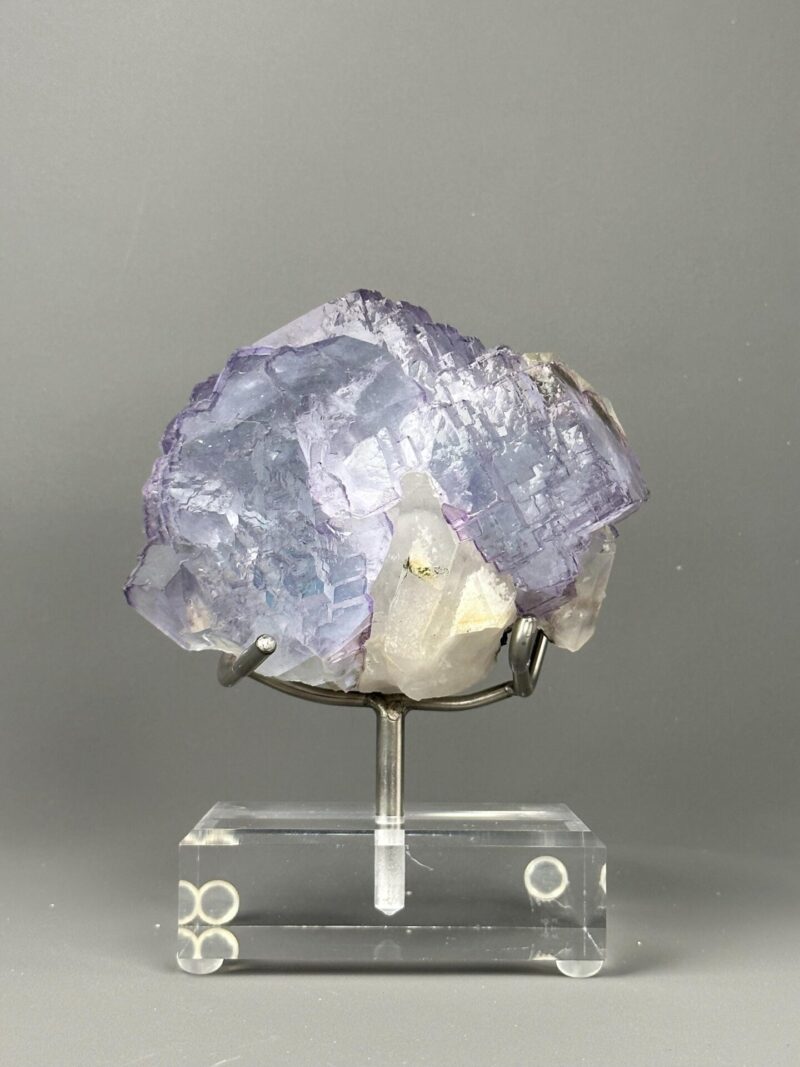
Anatase is one of the three TiO2 polymorphs (alongside rutile and brookite) and is the lowest-temperature, most metastable of the three. It crystallizes in distinctive sharp tetragonal bipyramids with a brilliant near-adamantine luster.
Properties
- Formula: TiO2
- Crystal system: Tetragonal
- Hardness: 5.5 – 6
- Color: Indigo-blue, blue-black, brown, yellow, sometimes near-colorless
- Streak: White to pale yellow
- Luster: Adamantine to splendent metallic-adamantine
- Cleavage: Perfect on {001} and {011}
- Density: 3.8 – 3.9 g/cm³
Occurrence
Classic alpine-cleft anatase comes from the Binntal and Hardanger (Switzerland) and Cavradi gorge — sharp dark-blue bipyramids on chlorite or quartz. Modern Brazilian anatase from Diamantina (Minas Gerais) reaches gem grade. Hagdal (Norway) yields large dull-brown crystals. China hosts minor metamorphic anatase but no notable collector localities.
Identification
Tetragonal bipyramids with very sharp pyramidal terminations + dark indigo color in fresh material. Distinguish from rutile (more equant prismatic, often reddish) and brookite (orthorhombic, tabular).
Collector Notes
Alpine anatase from Cavradi gorge and Brazilian crystals are the genre standards. Anatase + brookite + rutile thumbnail set is a classic TiO2 polymorph display.
Found at these Localities
- Kharan, Balochistan (卡兰板钛矿产地)
- Cavradi Gorge (卡瓦拉迪峡谷)
- Eastern Brazilian Pegmatite Province (巴西东部伟晶岩省)
- Swiss Alps (Alpine-Cleft Province) (瑞士阿尔卑斯高山裂隙矿物产地)