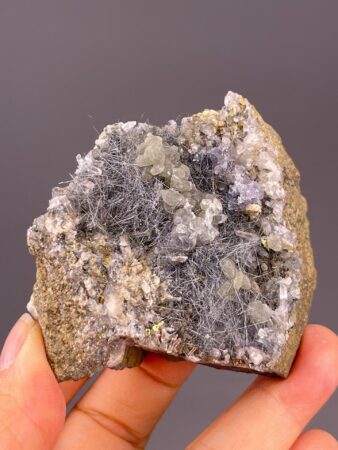
Boulangerite is a lead-antimony sulfosalt closely related to jamesonite — both species form fibrous metallic aggregates and commonly co-occur. Boulangerite typically appears as slightly stouter, more lustrous needles.
Properties
- Formula: Pb5Sb4S11
- Crystal system: Monoclinic
- Hardness: 2.5 – 3
- Color: Bluish lead-gray to silvery-gray
- Streak: Brownish-gray
- Luster: Metallic, often silky on fibers
- Cleavage: Good on {100}
- Density: 5.7 – 6.3 g/cm³
Occurrence in China
Xikuangshan (Hunan) — the world’s largest antimony deposit — and the broader Hunan W-Sn-Sb metallogenic belt produce boulangerite as a late-stage Sb-rich sulfosalt. The Yaogangxian mine also yields collector specimens. Globally noted at Trepča (Kosovo) and Boliden (Sweden).
Identification
Silky bluish-gray fibers, slightly stouter and more flexible than jamesonite. Fully reliable separation from jamesonite requires chemical analysis. Distinguish from stibnite (also bluish-gray but with brilliant cleavage and pencil-like prisms vs. matted fibers).
Collector Notes
Often labeled “feather ore” in old collections together with jamesonite. Hunan specimens with sharp needle aggregates are the modern collector standard.
Found at these Localities
- Xikuangshan Antimony Mine (锡矿山锑矿)
- Yaogangxian Mine (瑶岗仙矿)
- Hunan (湖南)
Available Products of Boulangerite
1 available specimen