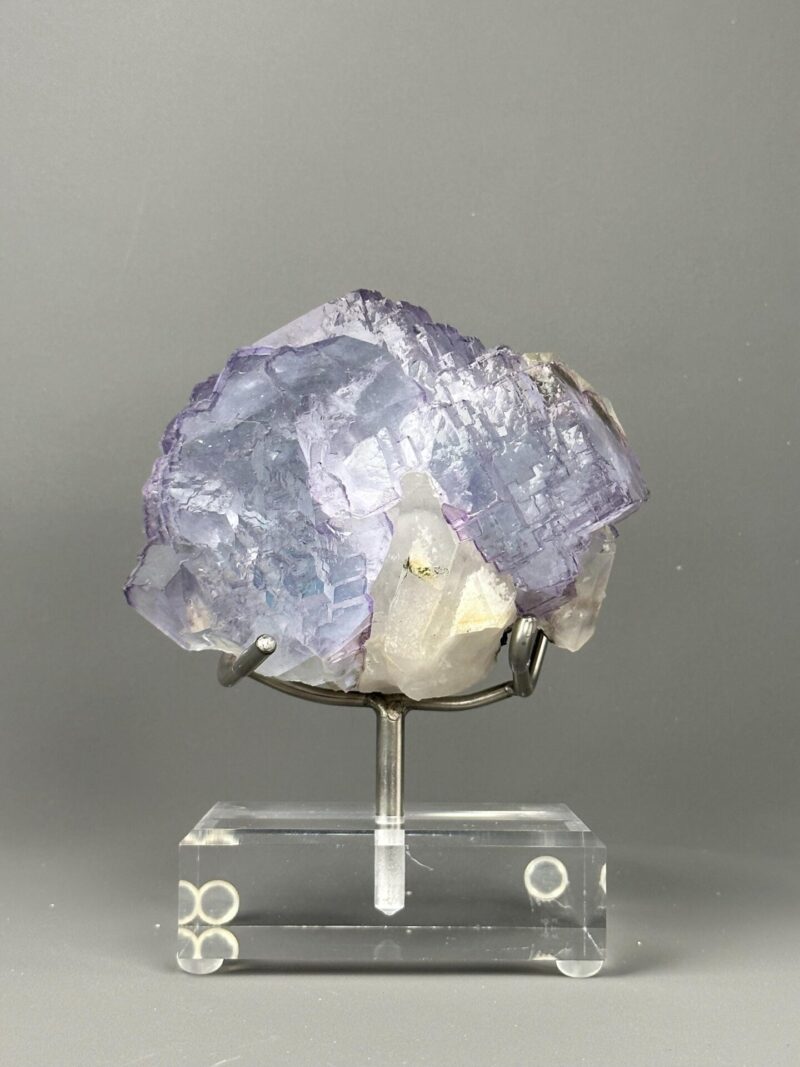
Covellite is a copper sulfide famous for its electric indigo-blue color and brilliant peacock iridescent tarnish — easily one of the most chromatically distinctive sulfides in nature. It is a common secondary mineral in the supergene-enriched zones of copper deposits.
Properties
- Formula: CuS
- Crystal system: Hexagonal
- Hardness: 1.5 – 2
- Color: Indigo-blue, often with red, purple and gold iridescence
- Streak: Lead-gray to black
- Luster: Sub-metallic to resinous
- Cleavage: Perfect on {0001}, sheet-like
- Density: 4.6 – 4.8 g/cm³
Occurrence in China
Covellite is widespread in oxidized zones of Dexing (Jiangxi), Tonglushan (Hubei) and Pulang/Lanping (Yunnan) Cu deposits. The world’s largest crystals come from Butte (Montana), where covellite tabular plates reached several centimeters. Calabona (Sardinia) is the historic European source.
Identification
Indigo-blue + iridescent peacock tarnish + perfect basal cleavage producing flexible thin sheets + extreme softness. Distinguish from chalcocite (lead-gray, no iridescence) and bornite (which also tarnishes peacock but is purple-gold from fresh bronze and is harder).
Collector Notes
Butte covellite tablets remain the species archetype. Italian and Sardinian specimens with intense iridescence on quartz are also classic. Care: easily abraded due to softness.
Found at these Localities
- Lanping Pb-Zn-Cu Field (兰坪铅锌铜矿田)
- Pulang Cu Porphyry Mine (普朗铜矿)
- Tonglüshan Bronze-Age Cu Mine (铜绿山古矿)
- Dexing Mine (德兴铜矿)
- Hubei (湖北)
- Yunnan (云南)
- Jiangxi (江西)
- Italian Volcanic Province (Vesuvius / Lipari / Etna) (意大利火山矿物产地)