
Adamite
Curated by Maggie Liu · Updated:
Adamite is an arsenate mineral prized by collectors for its exceptional color range, with notable Chinese occurrences.
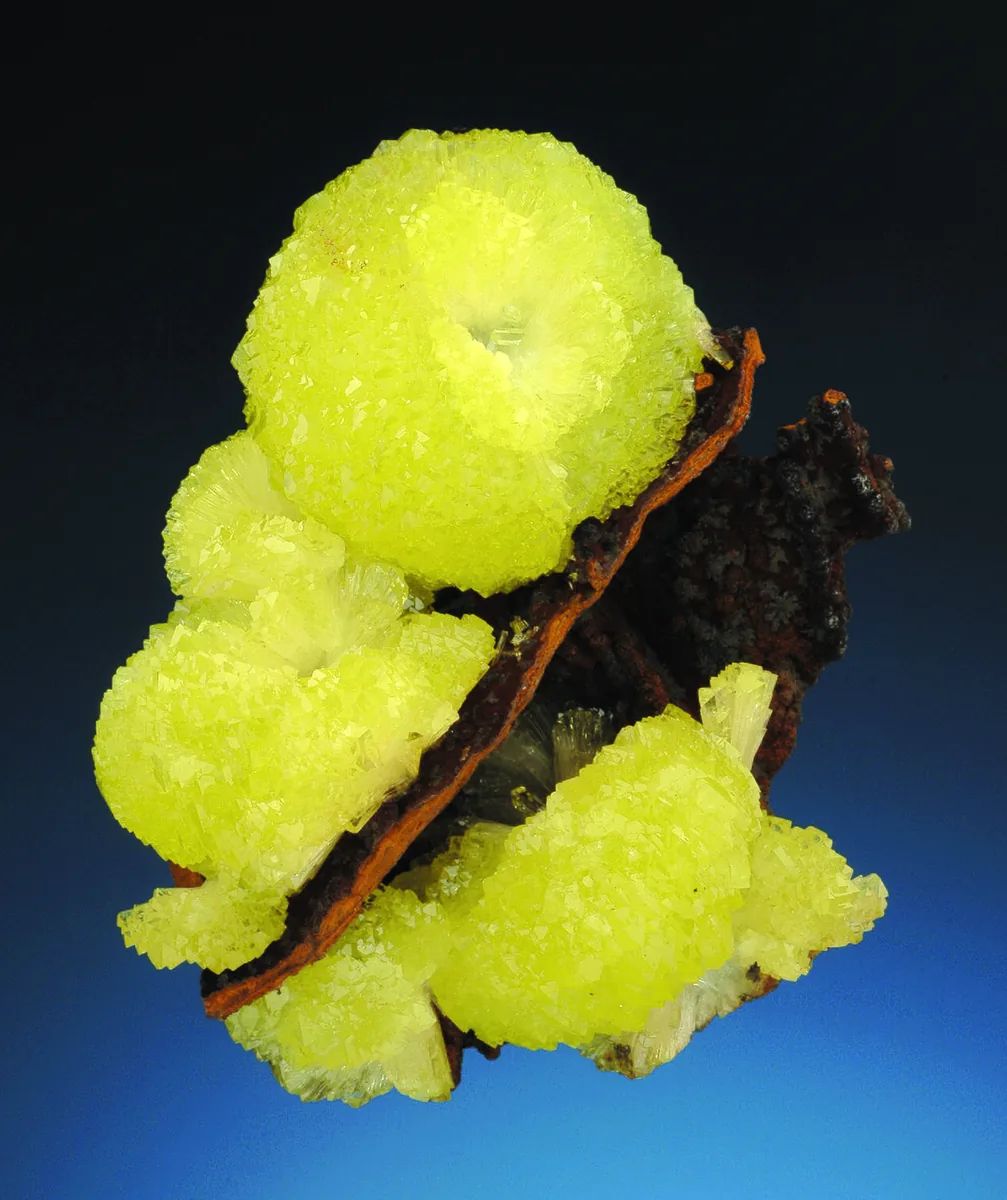
Adamite is a zinc arsenate prized by collectors for its bright yellow-green crystals, classic from the Ojuela Mine, Mapimí, Mexico.
About Adamiteextended article
Adamite is a zinc arsenate prized by collectors for its bright, glowing yellow-green crystals, most famously from the Ojuela mine in Mexico.
Identifying adamite
Adamite forms sparkling druses of small wedge-shaped crystals, typically vivid yellow-green to honey-yellow, on a brown limonite matrix; many specimens fluoresce a strong lime-green under ultraviolet light. Rarer varieties include purple cobaltoan adamite and green cuproadamite, coloured by traces of cobalt and copper.
The Ojuela connection
The Ojuela mine at Mapimí, Durango, Mexico is the classic locality, producing brilliant yellow-green adamite druses on limonite that set the standard for the species. Adamite also comes from Lavrion in Greece, Tsumeb in Namibia and other oxidised zinc deposits.
For collectors
Bright, lustrous yellow-green druses with strong fluorescence are the prize, along with the scarcer purple and green cobalt- and copper-bearing varieties.
About Adamite
Adamite is an arsenate mineral in the adamite group and has the chemical formula Zn2(AsO4)(OH). It crystallizes in the orthorhombic system and is one of the most visually varied minerals in the collector market. Its combination of structural character and global distribution make it a recognized species in both systematic and aesthetic collections.
Identification & care
Crystals commonly develop as prismatic wedge-shaped to tabular crystals; often in fan-shaped or drusy aggregates; reniform. Its color range is broad, including colorless, white, pale yellow, vivid yellow-green (common), green (cu-bearing: cuprian adamite), and pink/violet (co-bearing: cobaltian adamite). The luster is vitreous, adamantine (on crystal faces), the streak is white, and specimens range from transparent to translucent. The cleavage is good on {101}. The fracture is conchoidal, uneven, which aids identification.
Collector context
How it forms
The geological setting for Adamite is typically secondary mineral in oxidized zones of zinc-arsenic-bearing ore deposits; forms where zinc and arsenic-bearing solutions interact. It is commonly found in association with legrandite, paradamite, olivenite, limonite, hemimorphite, smithsonite, mimetite, wulfenite.
Classic Chinese localities
Documented Chinese occurrences are recorded at Dachang ore field, among others.
Why collectors care
Adamite is a frequently-sought species in serious collections because its habit is recognizable, its color often strong, and its best examples unmistakable even at a distance. Chinese material has driven much of the recent visual shift in the species — sharper crystals, deeper colors, cleaner matrix.
What affects value
Value in Adamite is assessed, in typical order of weight, against: (1) locality provenance; (2) size relative to the species norm; (3) crystal form and termination sharpness; (4) color saturation and zoning; (5) transparency and internal clarity; (6) matrix quality and aesthetic balance; (7) condition (absence of damage, chips, or repair). Cleaning quality and verified locality documentation act as multipliers across the above.
Frequently asked questions
What is Adamite?
Adamite has the chemical formula Zn2(AsO4)(OH), crystallises in the Orthorhombic system. Adamite is an arsenate mineral prized by collectors for its exceptional color range, with notable Chinese occurrences.
What is the chemical formula of Adamite?
The chemical formula of Adamite is Zn2(AsO4)(OH).
What crystal system does Adamite belong to?
Adamite crystallises in the Orthorhombic crystal system.
Where is Adamite found?
Notable localities for Adamite include Ojuela / Mapimí.
Related minerals
Looking for a Adamite specimen?
Our inventory is one-of-a-kind and turns over quickly. Tell us what you're after — species, size, budget — and we'll notify you when a matching Adamite arrives from our sourcing network.
Request this mineral