
Elemental Composition (by mass)
| Element | Mass % | Visual |
|---|---|---|
| Pb Lead | 68.33% | |
| O Oxygen | 21.10% | |
| S Sulfur | 10.57% |
Computed from simplified end-member formula. Solid-solution series, water content, and trace substitutions cause real-world variation.
Pseudomorph Relationships
Replaces — this mineral is often a pseudomorph after:
A pseudomorph (Greek "false form") is a mineral with the external shape of another species — the chemistry has changed but the crystal habit is inherited.
Mohs 2.5–3
Vickers (~) 170 HV
Knoop (~) 185 HK
Element composition by mass
Formula: PbSO₄ · molar mass: 303.26 g/mol
| Pb | 68.33% | |
| O | 21.1% | |
| S | 10.57% |
Computed from atomic weights (IUPAC 2021). Site-occupancy groups (Fe,Mn) split equally.
Mohs Hardness
2.5–3
Anglesite sits at 2.5–3 on the Mohs scale — can be scratched by a steel knife.
Colors:
Streak
White
White
Crystal system
Orthorhombic
Orthorhombic
SulfatesSulfates
TL;DR · 1 min read
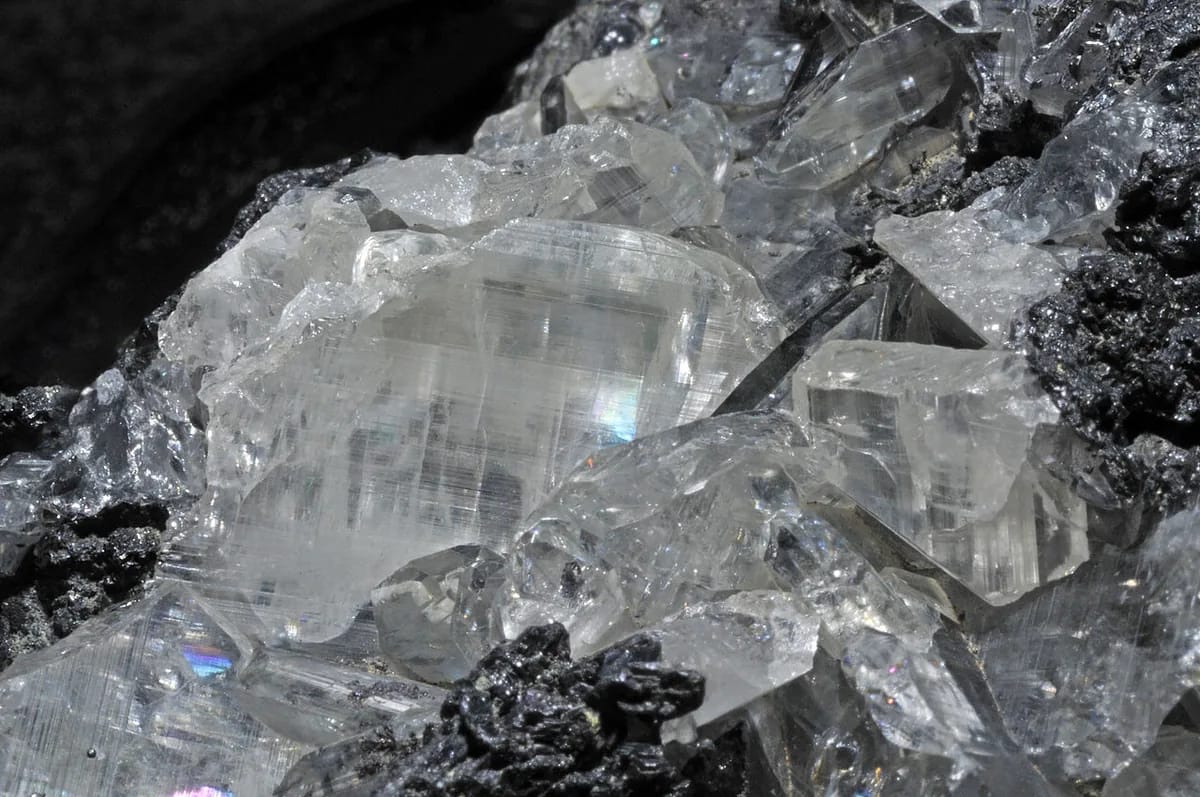
Anglesite (PbSO₄) is the secondary lead sulfate of the oxidized cap zones of galena-bearing Pb-Zn deposits. Named after Anglesey (Wales) where it was first described, Anglesite is famous for adamantine transparent crystals from Touissit (Morocco), Tsumeb (Namibia), and Sardinia.
Anglesite (PbSO₄) is the secondary lead sulfate of the oxidized cap zones of galena-bearing Pb-Zn deposits. Named after Anglesey (Wales) where it was first described, Anglesite is famous for adamantine transparent crystals from Touissit (Morocco), Tsumeb (Namibia), and Sardinia. It forms by oxidation of galena, often as paramorphic pseudomorphs preserving galena cube outlines.
More minerals to explore
Brochantite (水胆矾)
Monoclinic
Celestite (天青石)
Orthorhombic
Barite (重晶石)
Orthorhombic
Anhydrite (硬石膏)
Orthorhombic
Linarite (蓝铅矿)
Monoclinic