
Elemental Composition (by mass)
| Element | Mass % | Visual |
|---|---|---|
| O Oxygen | 47.01% | |
| Ca Calcium | 29.44% | |
| S Sulfur | 23.55% |
Computed from simplified end-member formula. Solid-solution series, water content, and trace substitutions cause real-world variation.
IMA Abbreviation (Whitney-Evans 2010)
Anh
→ Anhydrite
Anhydrous Ca sulfate
Standard symbol from American Mineralogist (Whitney & Evans, 2010). Used in thin-section labeling, phase diagrams, and IMA-style species records.
Pseudomorph Relationships
Replaced by — this mineral commonly becomes:
→ Gypsum hydration
Anhydrite (CaSO₄) hydrates to gypsum (CaSO₄·2H₂O) with ~63% volume increase — important in salt cap rock.
Salt dome cap rocks.
Replaces — this mineral is often a pseudomorph after:
A pseudomorph (Greek "false form") is a mineral with the external shape of another species — the chemistry has changed but the crystal habit is inherited.
Mohs 3–3.5
Vickers (~) 170 HV
Knoop (~) 185 HK
Geological setting
SedimentaryEvaporite
Element composition by mass
Formula: CaSO₄ · molar mass: 136.13 g/mol
| O | 47.01% | |
| Ca | 29.44% | |
| S | 23.55% |
Computed from atomic weights (IUPAC 2021). Site-occupancy groups (Fe,Mn) split equally.
Mohs Hardness
3–3.5
Anhydrite sits at 3–3.5 on the Mohs scale — can be scratched by a steel knife.
Colors:
Streak
White
White
Crystal system
Orthorhombic
Orthorhombic
SulfatesSulfates
TL;DR · 1 min read
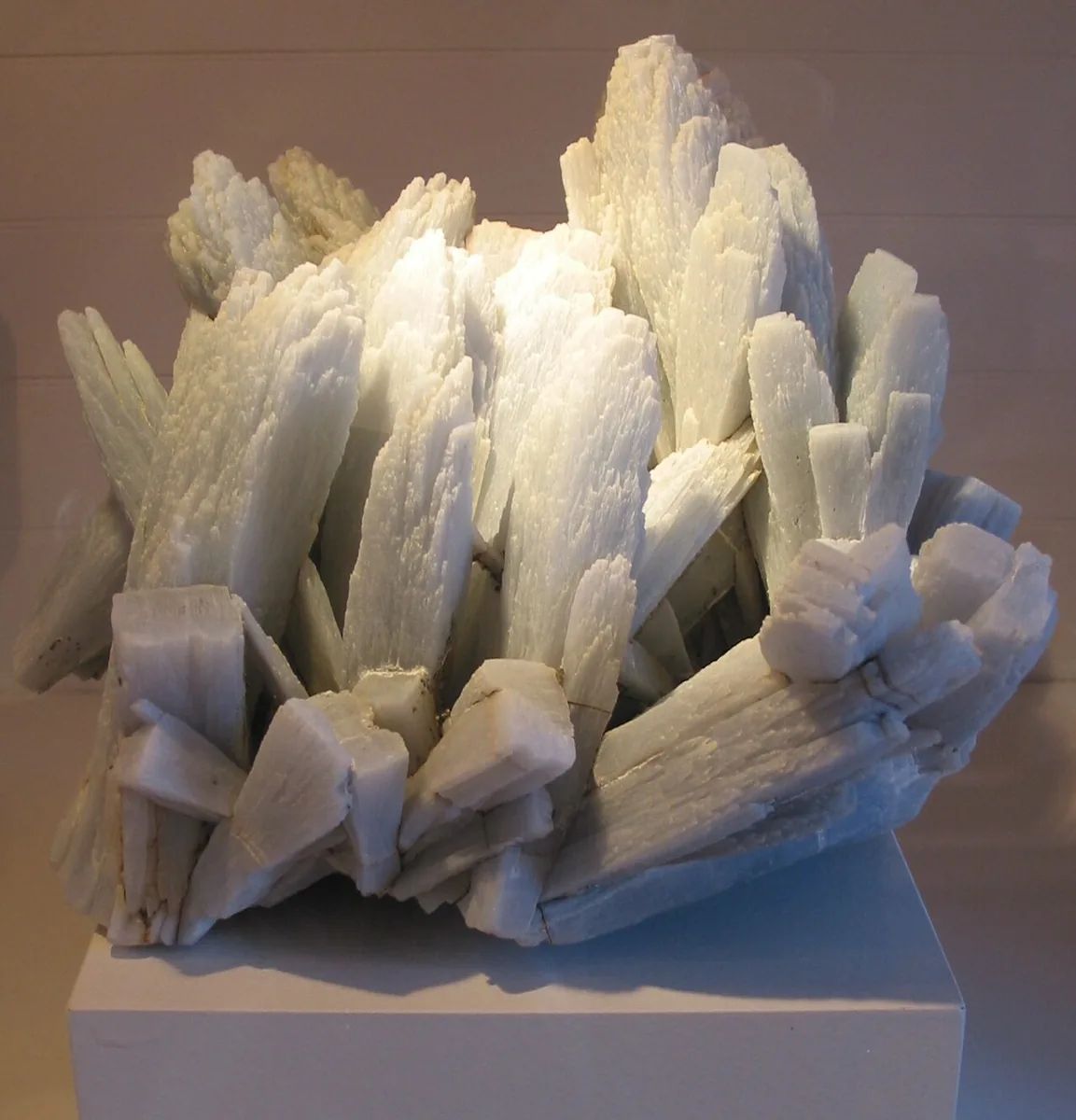
Anhydrite (CaSO₄) is the anhydrous calcium sulfate, the dehydration counterpart of gypsum (CaSO₄·2H₂O). It forms in evaporite basins by precipitation from saturated brines and as a primary phase in marine evaporite sequences.
Anhydrite (CaSO₄) is the anhydrous calcium sulfate, the dehydration counterpart of gypsum (CaSO₄·2H₂O). It forms in evaporite basins by precipitation from saturated brines and as a primary phase in marine evaporite sequences. Anhydrite hydrates to gypsum at the surface, expanding by ~63% — a problem in salt-mining and tunneling.
More minerals to explore
Celestite (天青石)
Orthorhombic
Anglesite (硫酸铅矿)
Orthorhombic
Brochantite (水胆矾)
Monoclinic
Barite (重晶石)
Orthorhombic
Linarite (蓝铅矿)
Monoclinic