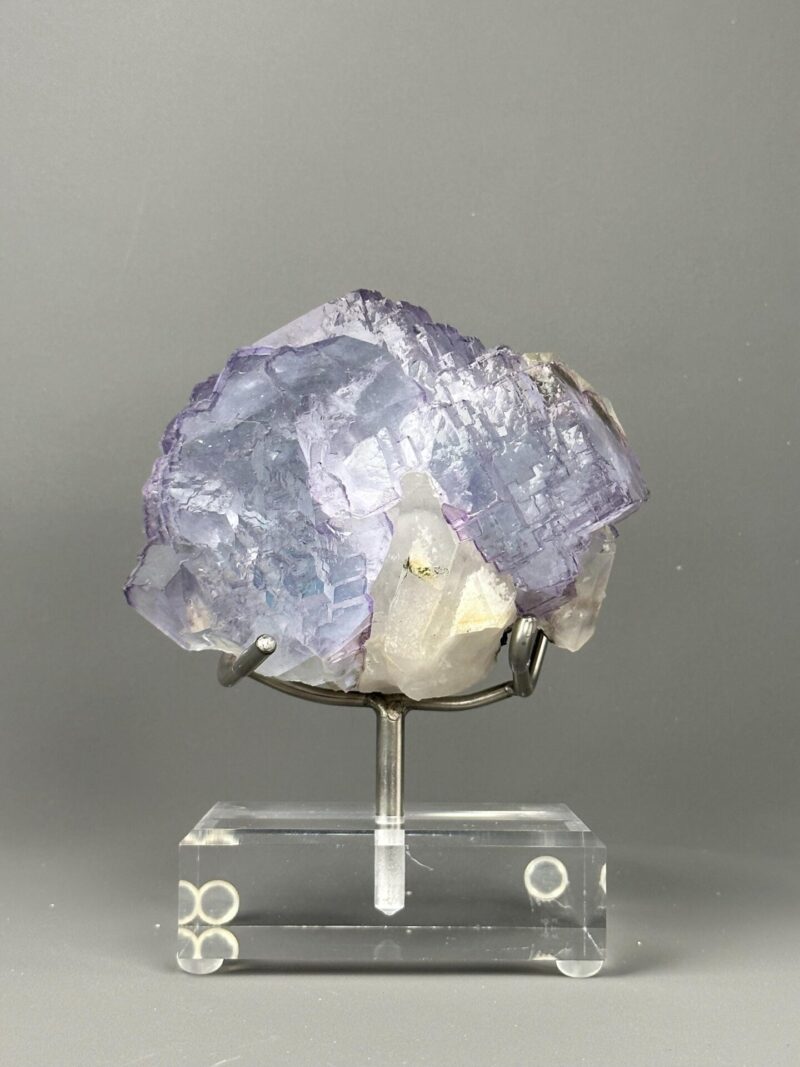
Apophyllite (KCa₄Si₈O₂₀(F,OH)·8H₂O) is a tetragonal phyllosilicate famous for its glassy, water-clear pyramidal crystals on chalcedony or stilbite matrix in basalt cavities. The Indian Deccan Traps — particularly the Pune and Jalgaon districts in Maharashtra — produce the world’s most prized Apophyllite specimens, with sharp single crystals reaching 10+ cm and complete pyramid terminations. The pearly luster on basal pinacoid surfaces is diagnostic.
Key Facts
- Mohs hardness 4.5–5.
- Tetragonal; classic pyramidal terminations on prismatic crystals.
- Perfect basal cleavage produces pearly luster on cleavage faces, vitreous on prism faces.
- Color most commonly colorless to white; rare pink, green, and yellow varieties known.
- Common companion to zeolite minerals (stilbite, heulandite, scolecite) in basalt cavities.
Notable Localities
Pune and Jalgaon (Maharashtra, India) are the world standard. Iceland, Trentino (Italy), and Nova Scotia (Canada) produce classic European/Atlantic specimens.
Found at these Localities
- Maharashtra Deccan Traprock Zeolites (马哈拉施特拉德干玄武岩沸石产地)
- Italian Volcanic Province (Vesuvius / Lipari / Etna) (意大利火山矿物产地)