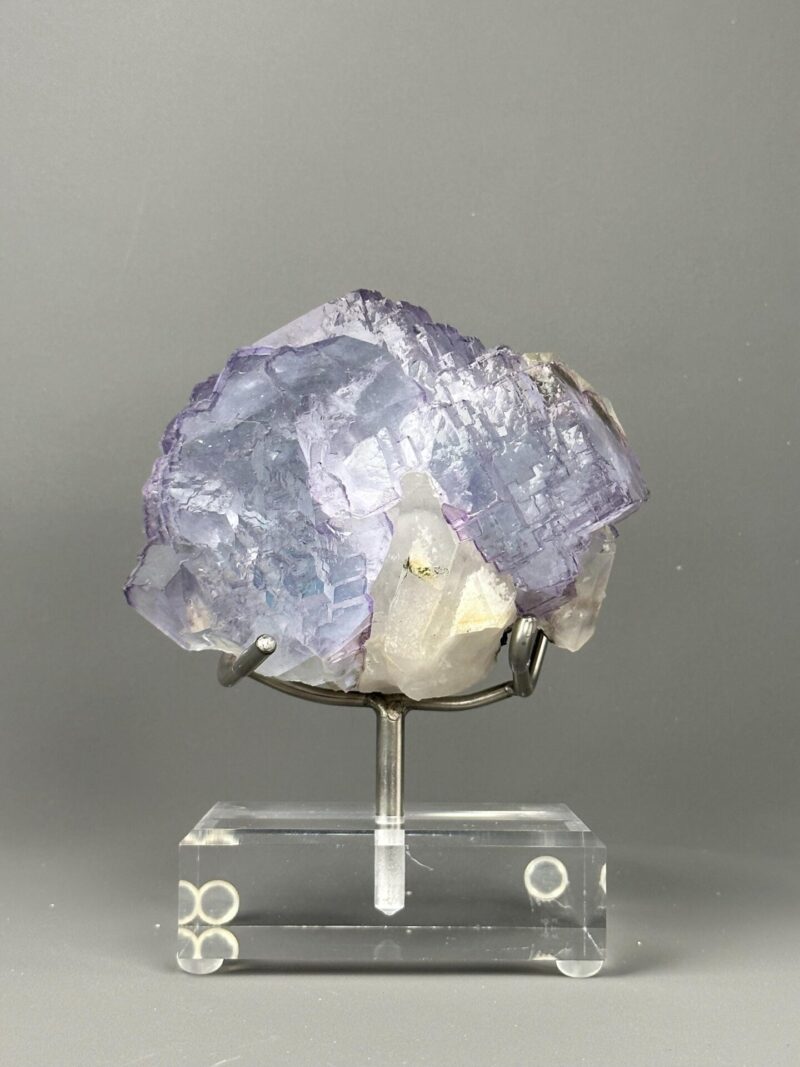
Heulandite ((Ca,Na)Al₂Si₇O₁₈·6H₂O) is a calcium-rich aluminosilicate of the zeolite group, famous for its tabular pearly crystals lining basalt cavities. Its name honors mineralogist Henry Heuland (1778–1856). Heulandite forms in low-temperature hydrothermal alteration of mafic volcanic rocks, where it grows as glassy “coffin-shaped” tabular crystals on chalcedony, prehnite, and apophyllite matrix. The Berufjordur basalts of Iceland and the Deccan Traps of India host the world’s finest specimens.
Key Facts
- Mohs hardness 3–4 — soft.
- Monoclinic; classic tabular “coffin-shaped” crystals with pearly luster on basal pinacoid.
- Color most commonly colorless to white; pink, salmon, green, and brown varieties also occur.
- Member of the zeolite group — molecular sieve framework holds reversible water.
- Common companion to apophyllite, stilbite, and prehnite in basalt vesicles.
Notable Localities
Berufjordur and Reydarfjordur (Iceland) produce world-class pink and salmon Heulandite. Pune basalts (Maharashtra, India) yield large tabular crystals. Andreasberg (Harz, Germany) is the historical European source.
Found at these Localities
- Maharashtra Deccan Traprock Zeolites (马哈拉施特拉德干玄武岩沸石产地)