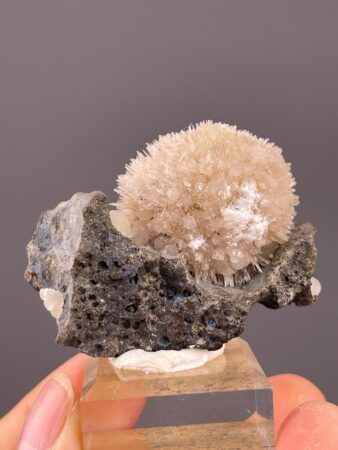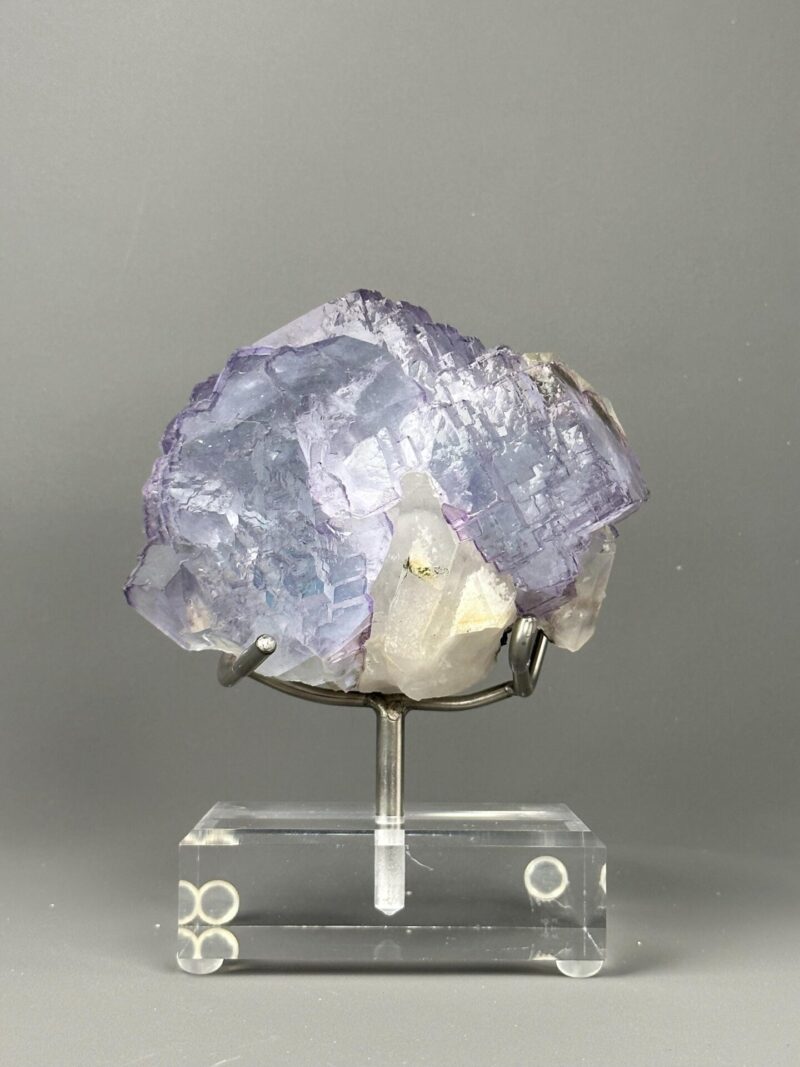
Stilbite (NaCa₄(Si₂₇Al₉)O₇₂·28H₂O) is one of the most readily recognizable zeolite-group minerals, famous for its diagnostic “wheat-sheaf” or “bowtie” aggregates of tabular crystals radiating from a common base. It is named from Greek “stilbein” (to glitter) for the pearly luster on its tabular cleavage faces. Indian Deccan basalt cavities are the world’s premier source — Pune and Nashik (Maharashtra) supply the iconic salmon-pink and apricot-orange specimens that define the species.
Key Facts
- Mohs hardness 3.5–4 — soft.
- Monoclinic; signature wheat-sheaf and bowtie aggregates.
- Color most commonly white, salmon pink, peach, cream; clear and brown also occur.
- Member of the zeolite group — molecular-sieve framework holds reversible water in channels.
- Common companion to apophyllite, heulandite, and prehnite in basalt vesicles.
Notable Localities
Pune basalts (Maharashtra, India) produce world-class wheat-sheaf aggregates. Berufjordur (Iceland) yields classic European specimens. Bay of Fundy (Nova Scotia, Canada) supplies salmon-pink Stilbite.
Found at these Localities
- Maharashtra Deccan Traprock Zeolites (马哈拉施特拉德干玄武岩沸石产地)