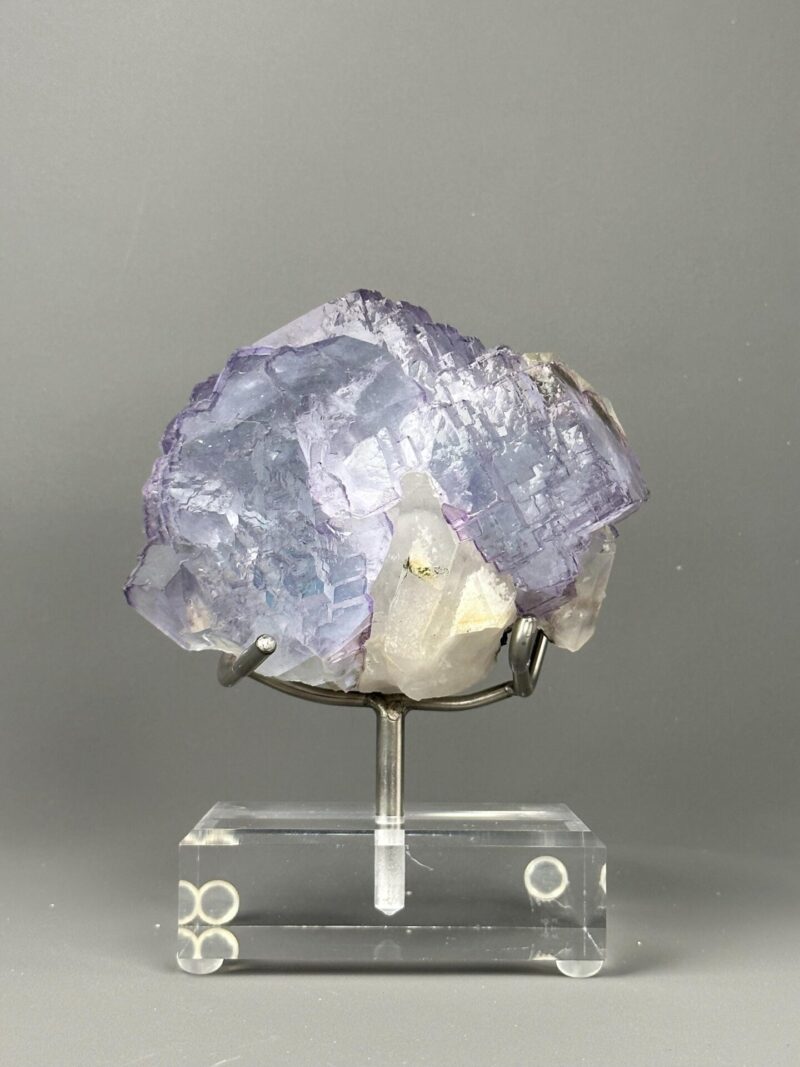
Hydrozincite is a hydrated zinc carbonate that occurs as white to gray earthy crusts and porcelain-like masses in oxidized zinc ores. It is the dominant secondary zinc mineral in many cave and mine environments and is famously brilliantly fluorescent under shortwave UV.
Properties
- Formula: Zn5(CO3)2(OH)6
- Crystal system: Monoclinic
- Hardness: 2 – 2.5
- Color: White, pale yellow, pale gray
- Streak: White
- Luster: Earthy to pearly
- Cleavage: Perfect on {010}
- Density: 3.6 – 3.8 g/cm³
Occurrence
Common in oxidized Zn deposits worldwide. Classic specimens from Bleiberg (Austria), Sardinia (Italy), Lavrion (Greece) and many Mexican Pb-Zn districts. China hosts hydrozincite in oxidized zones of Yunnan and Guangxi Pb-Zn ores.
Identification
White/pale yellow porcelaneous to earthy masses + brilliant SW UV fluorescence (sky-blue or white) + effervesces in dilute HCl + Zn chemistry. Diagnostic UV response separates from smithsonite (harder, glassier) and aragonite (different chemistry).
Collector Notes
Sardinian hydrozincite cave coatings producing brilliant blue UV fluorescence are showcase fluorescent specimens. Pair with willemite for a complete Zn-fluorescent display.
Found at these Localities
- Lavrion (Laurium) (拉夫里翁古铅锌银矿)
- Yunnan (云南)
- Guangxi (广西)
- Italian Volcanic Province (Vesuvius / Lipari / Etna) (意大利火山矿物产地)