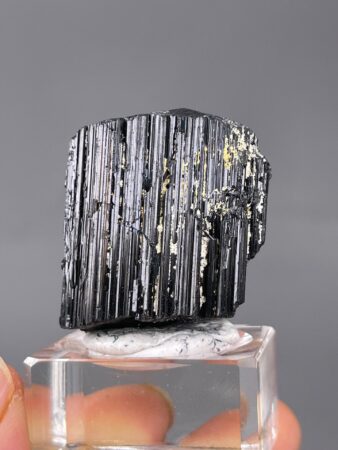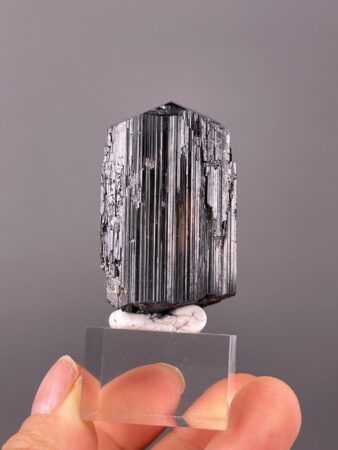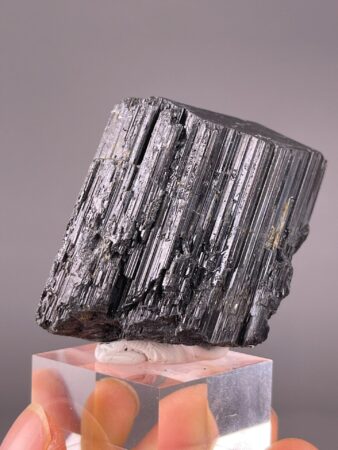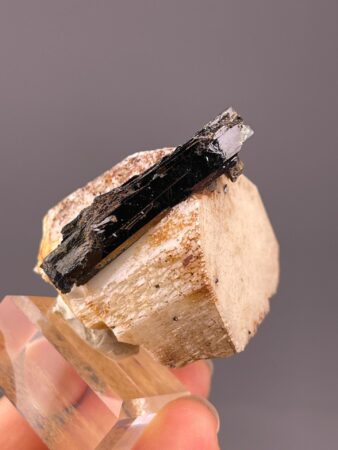
Schorl (NaFe₃Al₆(BO₃)₃Si₆O₁₈(OH)₄) is the iron-rich end-member of the tourmaline group and by far the most abundant tourmaline species. Its jet-black trigonal prisms, often striated lengthwise, are common in granitic pegmatites and are the most familiar collector form of tourmaline globally. While the colorful elbaite varieties (rubellite, indicolite, watermelon) capture gem markets, Schorl dominates specimen-grade tourmaline output by sheer volume.
Key Facts
- Mohs hardness 7–7.5.
- Trigonal symmetry; signature triangular cross-section visible at crystal terminations.
- Strong vertical striations along the prism faces.
- Black to brownish-black color from iron content.
- Strongly piezoelectric and pyroelectric — develops electrical charge under pressure or heat.
Notable Localities
Erongo Mountains (Namibia) produce world-class Schorl on aquamarine. Pakistan and Brazil yield large prismatic specimens. China has minor presence in Xinjiang and Yunnan pegmatite zones.
Found at these Localities
- Eastern Brazilian Pegmatite Province (巴西东部伟晶岩省)
- Skardu / Shigar Valley (斯卡都/希加尔峡谷)
- Madagascar Pegmatites (Sahatany / Antsirabe) (马达加斯加伟晶岩区)
- Erongo Mountains (埃龙戈山)
- Yunnan (云南)