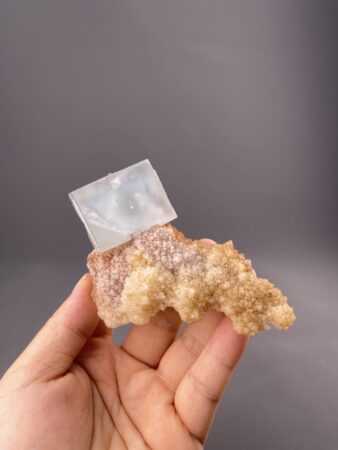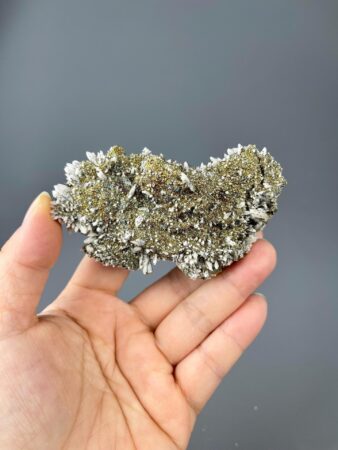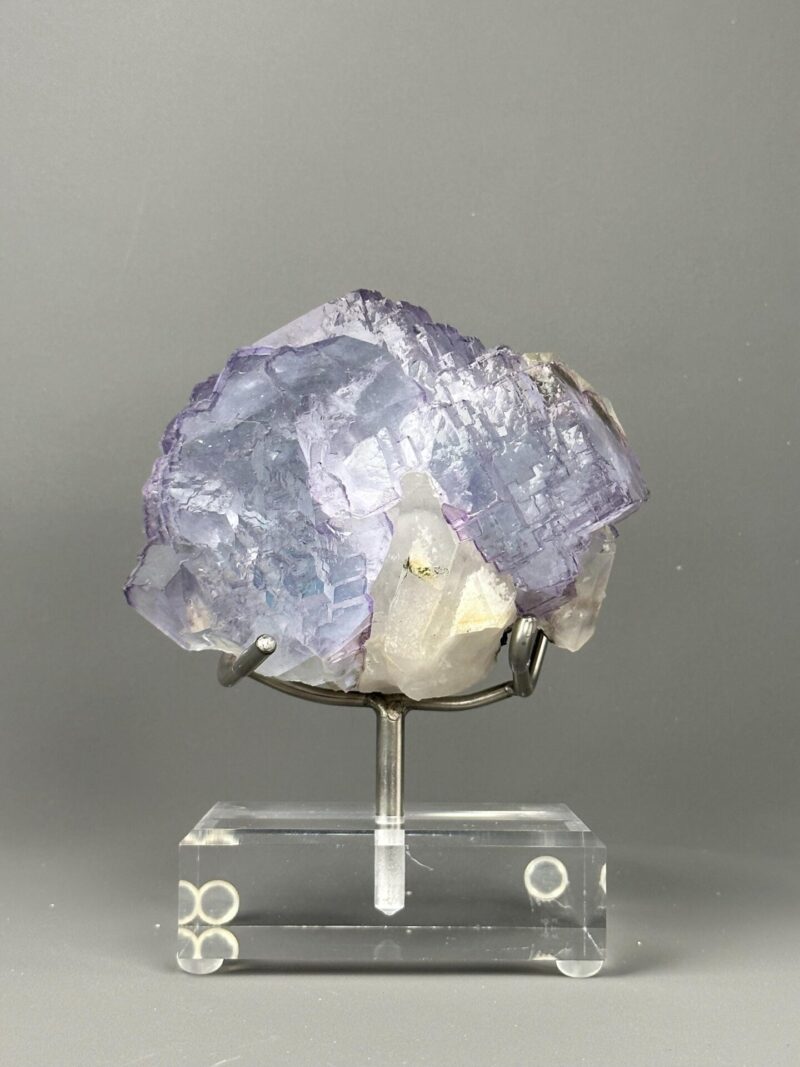
Dolomite (CaMg(CO₃)₂) is a calcium-magnesium carbonate and one of the most widespread minerals on Earth. It forms massive sedimentary rock units (the “Dolomites” of Italy bear its name), serves as the host for Mississippi Valley-type Pb-Zn ore deposits, and produces classic curved-saddle rhombohedral crystals on collector matrix. China hosts widespread Dolomite occurrences in carbonate provinces of Hunan, Guangdong, Guizhou, and Yunnan, often paired with sphalerite, galena, fluorite, and barite.
Key Facts
- Mohs hardness 3.5–4 — slightly harder than calcite.
- Trigonal; isostructural with calcite but Mg substitutes for half the Ca.
- Diagnostic curved/saddle-shaped crystal habit (“saddle dolomite”) is unique among carbonates.
- Effervesces only weakly and slowly in cold dilute HCl (vs. calcite’s vigorous reaction).
- Critical host rock for many ore deposits — gangue mineral in MVT Pb-Zn and Cu deposits.
Notable Chinese Localities
Hunan and Guangdong carbonate belts produce abundant Dolomite as gangue with sphalerite/galena. Trentino (Italy) is the type-region. Eugui (Spain) and Brumado (Brazil) are classic European/American sources for crystallized specimens.
Found at these Localities
- Oumjrane Mining Area (奥姆贾兰矿区)
- Bou Azzer District (布·阿扎尔钴矿区)
- Imiter Mine (伊米泰尔银矿)
- Tri-State Mining District (Joplin) (三州矿区(乔普林))
- Tunaberg (图纳贝里钴矿(瑞典))
- Trimouns Talc Mine (特里穆滑石矿(法国))
- Cobalt, Ontario (安大略科博尔特银矿)
- Guizhou (贵州)
- Yunnan (云南)
- Hunan (湖南)
- Italian Volcanic Province (Vesuvius / Lipari / Etna) (意大利火山矿物产地)
- Eastern Brazilian Pegmatite Province (巴西东部伟晶岩省)