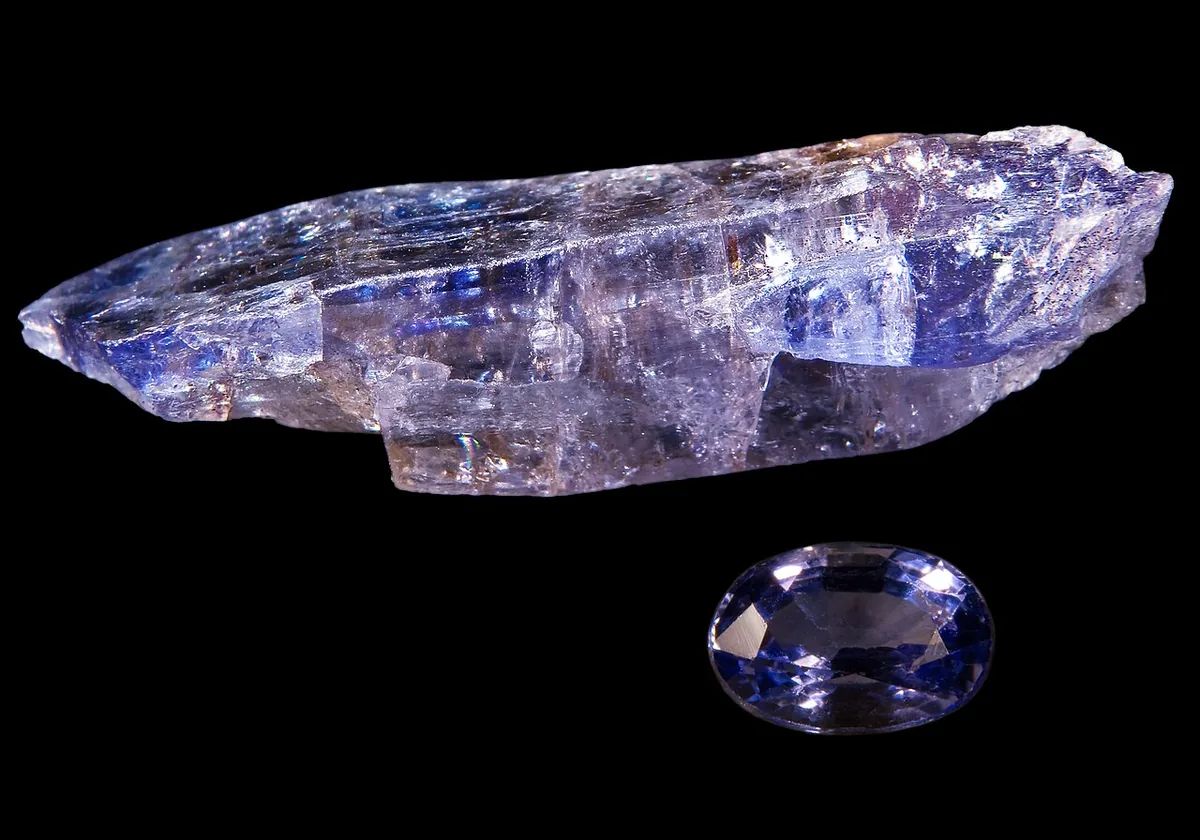
Tanzanite

Crystal system · Orthorhombic

Tanzanite is the trichroic blue-violet variety of zoisite, a calcium aluminum silicate. It was first identified in 1967 at Merelani, Tanzania, the only commercial source.

About Tanzaniteextended article

Save to favoritesview your list
Formation eraPan-African metamorphic 580 Ma; only locality globally (Merelani Hills).
Market availability: Rare
Sought after; limited supply. Major shows and specialist dealers only.
Often found withGraphite · Tremolite · Quartz
Geological setting
PegmatiteMetamorphic
GroupEpidote Group
Related members: Epidote · Clinozoisite · Zoisite
Crystal system
Orthorhombic

📇 Print ID card

Tanzanite is the trade name for the violet-blue gem variety of zoisite, found at exactly one locality on Earth: the Merelani Hills near Arusha, Tanzania. Discovered in 1967 and marketed worldwide by Tiffany & Co., tanzanite is one of the great gem stories of the late 20th century.

Occurrence #

Unique locality: Merelani Hills, Manyara Region, Tanzania. Tanzanite forms in graphite-rich pegmatite-hosted gem pockets within metamorphic gneisses of the Mozambique Belt. Most rough is heat-treated (~600°C) to enhance the violet-blue color from natural brown-yellow tones.

Identification #

Strong trichroism (blue, violet, brownish-yellow along crystal axes) + Tanzanian pedigree + perfect cleavage. Distinguish from sapphire (harder, no cleavage, isotropic blue) and iolite (lower density, weaker color).

Collector Notes #

The Tanzanian government has restricted rough exports since the early 2000s; supply tightening has driven tanzanite into top-tier gem rarity territory. Crystallized rough specimens (uncut crystals on matrix) are increasingly valuable.

Export:BibTeXRIS
Quality criteria — what to look for
A-grade: Untreated material is exceptional. Sharp violet-blue trichroism. Most are heat-treated to remove brown (industry standard).
Common quality: Heat-treated tanzanite is the norm — disclosure standard since 1980s.
Avoid: Composite/diffusion-treated faux tanzanite, dyed quartz substitutes.
External research links for Tanzanite
Gemological optical data
Refractive index
1.691–1.700
Birefringence
0.009
Dispersion
0.030
Published: May 6, 2026 · Last reviewed: May 6, 2026
Editorial standards & sources →
Recently viewed
Nothing in your history yet — this is your first mineral.

Identification & care

Tanzanite has Mohs hardness 6.5 to 7 and specific gravity 3.35. It crystallizes in the orthorhombic system, with prismatic crystals showing well-developed striations parallel to the c-axis. Cleavage is perfect in one direction, which makes the gem cuttable but somewhat fragile. Luster is vitreous, the streak is white, and the trichroism is diagnostic — rotating the crystal shows blue, violet, and burgundy depending on viewing angle.

Collector context

Collector notes

Tanzanite is geographically restricted to a single locality (Block D in the Merelani hills), making it inherently rarer than diamond on a tonnage basis. Mineral specimens with terminated crystals on graphite-rich matrix are highly collectible, with material from the original D-Block command premium pricing. Unheated rough showing the natural tri-color is rarer than heated stones and worth a meaningful premium when properly documented.