Elemental Composition (by mass)
| Element | Mass % | Visual |
|---|
| O Oxygen | 45.78% | |
| Si Silicon | 18.54% | |
| Al Aluminum | 17.82% | |
| Ca Calcium | 17.64% | |
| H Hydrogen | 0.22% | |
Computed from simplified end-member formula. Solid-solution series, water content, and trace substitutions cause real-world variation.
IMA Abbreviation (Whitney-Evans 2010)
Sorosilicate
Standard symbol from American Mineralogist (Whitney & Evans, 2010). Used in thin-section labeling, phase diagrams, and IMA-style species records.
Pronunciation
named for Sigmund von Zois
Diaphaneity (Transparency)
Massive zoisite (anyolite) opaque; tanzanite variety transparent.
Type Locality
Saualpe, Carinthia — Austria
Described 1805 by Werner (named for S. Zois)
› Browse all type localities
Mohs 6–7
Vickers (~) 820 HV
Knoop (~) 870 HK
Element composition by mass
Formula: Ca₂Al₃(SiO₄)(Si₂O₇)O(OH) · molar mass: 454.35 g/mol
| O |
45.78% |
|
| Si |
18.54% |
|
| Al |
17.82% |
|
| Ca |
17.64% |
|
| H |
0.22% |
|
Computed from atomic weights (IUPAC 2021). Site-occupancy groups (Fe,Mn) split equally.
Optical Effects
◐Pleochroic
Zoisite sits at 6–7 on the Mohs scale —
harder than glass; scratches steel.
Colors:
Crystal systemOrthorhombic
SilicatesSilicates (Sorosilicates)
TL;DR · 1 min read
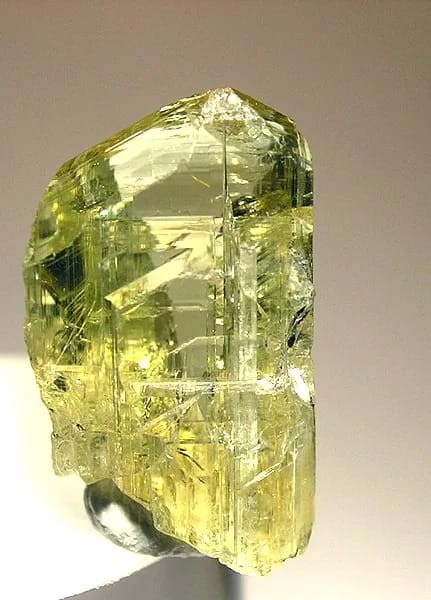
Zoisite (Ca₂Al₃(SiO₄)(Si₂O₇)O(OH)) is the orthorhombic sister to monoclinic epidote and a calcium-aluminum sorosilicate of major collector and gem importance. The species hosts three iconic gem varieties:
tanzanite (vivid blue-violet, V/Cr-bearing) from the Merelani Hills in Tanzania, thulite (vivid pink, Mn-bearing) from Norway, and anyolite ("ruby in zoisite," massive green Zoisite enclosing ruby crystals).
Zoisite (Ca₂Al₃(SiO₄)(Si₂O₇)O(OH)) is the orthorhombic sister to monoclinic epidote and a calcium-aluminum sorosilicate of major collector and gem importance. The species hosts three iconic gem varieties: tanzanite (vivid blue-violet, V/Cr-bearing) from the Merelani Hills in Tanzania, thulite (vivid pink, Mn-bearing) from Norway, and anyolite (“ruby in zoisite,” massive green Zoisite enclosing ruby crystals). Tanzanite is the second-most popular blue gem after sapphire and is mined exclusively from a small region of Tanzania.
More minerals to explore