
Elemental Composition (by mass)
| Element | Mass % | Visual |
|---|---|---|
| O Oxygen | 45.10% | |
| Si Silicon | 28.79% | |
| Mg Magnesium | 15.57% | |
| Ca Calcium | 10.27% | |
| H Hydrogen | 0.26% |
Computed from simplified end-member formula. Solid-solution series, water content, and trace substitutions cause real-world variation.
IMA Abbreviation (Whitney-Evans 2010)
Tr
→ Tremolite
Ca-Mg amphibole
Standard symbol from American Mineralogist (Whitney & Evans, 2010). Used in thin-section labeling, phase diagrams, and IMA-style species records.
Pronunciation
/ˈtrɛməlaɪt/
↔ TREM-uh-lite
from Tremola Valley
⚠ Safety & Handling
⚠asbestiformhigh (some)
Some habits asbestiform.
Handling: Avoid fibrous specimens. Solid bladed crystals are safe.
Information provided in good faith. Consult local hazmat regulations for transport and disposal. Severely hazardous specimens may require special storage cabinets.
Type Locality
Tremola, Val Leventina — Switzerland
Described 1789 by Saussure
› Browse all type localities
Cleavage & Fracture
Cleavage:
perfect 2 directions ~56°/124°
Fracture:
splintery
Asbestiform varieties can split fibrously.
Collector tier: Micromount / Niche
Best appreciated at thumbnail or smaller scale — often dull-colored, sub-millimeter, or radioactive. Specialist appeal.
Mohs 5–6
Vickers (~) 540 HV
Knoop (~) 620 HK
Geological setting
Metamorphic
Element composition by mass
Formula: Ca₂Mg₅Si₈O₂₂(OH)₂ · molar mass: 812.35 g/mol
| O | 47.27% | |
| Si | 27.66% | |
| Mg | 14.96% | |
| Ca | 9.87% | |
| H | 0.25% |
Computed from atomic weights (IUPAC 2021). Site-occupancy groups (Fe,Mn) split equally.
GroupAmphibole Group
Related members: Hornblende · Actinolite
Mohs Hardness
5–6
Tremolite sits at 5–6 on the Mohs scale — just hard enough to scratch glass.
Colors:
Streak
White
White
Crystal system
Monoclinic
Monoclinic
SilicatesSilicates (Inosilicates — Amphiboles)
TL;DR · 1 min read
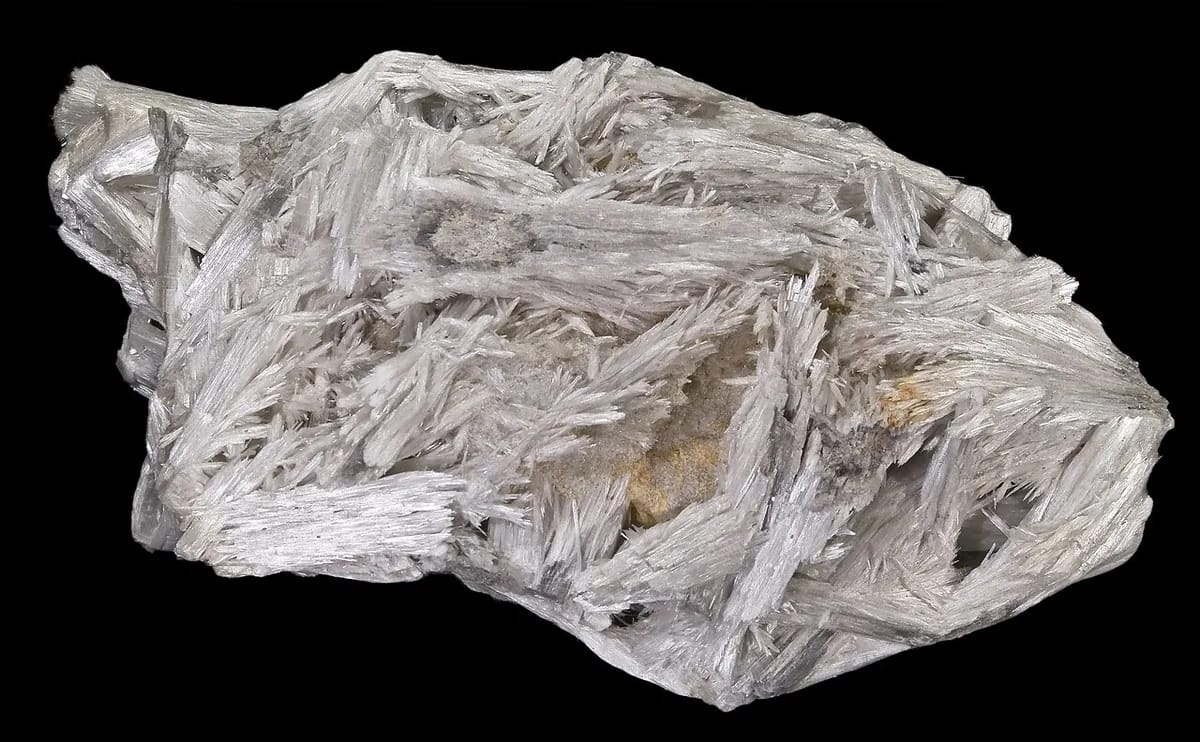
Tremolite (Ca₂Mg₅Si₈O₂₂(OH)₂) is the magnesium end-member of the calcic amphibole group and the principal mineral of nephrite jade. It forms in metamorphosed dolomitic carbonates as long fibrous to bladed crystals — the same Tremolite that constitutes the nephrite of Hetian (Xinjiang) and the historic European jade trade.
Tremolite (Ca₂Mg₅Si₈O₂₂(OH)₂) is the magnesium end-member of the calcic amphibole group and the principal mineral of nephrite jade. It forms in metamorphosed dolomitic carbonates as long fibrous to bladed crystals — the same Tremolite that constitutes the nephrite of Hetian (Xinjiang) and the historic European jade trade. Pure Tremolite is white to pale gray; iron substitution darkens it toward Actinolite.