
Elemental Composition (by mass)
| Element | Mass % | Visual |
|---|---|---|
| O Oxygen | 37.52% | |
| Fe Iron | 29.77% | |
| Si Silicon | 23.95% | |
| Ca Calcium | 8.54% | |
| H Hydrogen | 0.21% |
Computed from simplified end-member formula. Solid-solution series, water content, and trace substitutions cause real-world variation.
IMA Abbreviation (Whitney-Evans 2010)
Act
→ Actinolite
Ca-Fe amphibole
Standard symbol from American Mineralogist (Whitney & Evans, 2010). Used in thin-section labeling, phase diagrams, and IMA-style species records.
Pronunciation
/ækˈtɪnəlaɪt/
↔ ak-TIN-uh-lite
Greek "ray stone"
Cleavage & Fracture
Cleavage:
perfect 2 directions ~56°/124°
Fracture:
splintery
Nephrite jade is fibrous interlocked actinolite.
Collector tier: Micromount / Niche
Best appreciated at thumbnail or smaller scale — often dull-colored, sub-millimeter, or radioactive. Specialist appeal.
Mohs 5–6
Vickers (~) 540 HV
Knoop (~) 620 HK
Geological setting
Metamorphic
Element composition by mass
Formula: Ca₂(Mg,Fe)₅Si₈O₂₂(OH)₂ · molar mass: 891.2 g/mol
| O | 43.09% | |
| Si | 25.21% | |
| Fe | 15.67% | |
| Ca | 8.99% | |
| Mg | 6.82% | |
| H | 0.23% |
Computed from atomic weights (IUPAC 2021). Site-occupancy groups (Fe,Mn) split equally.
GroupAmphibole Group
Related members: Hornblende · Tremolite
Optical Effects
Cat\'s eye
Mohs Hardness
5–6
Actinolite sits at 5–6 on the Mohs scale — just hard enough to scratch glass.
Colors:
Streak
White
White
Crystal system
Monoclinic
Monoclinic
SilicatesSilicates (Inosilicates — Amphiboles)
TL;DR · 1 min read
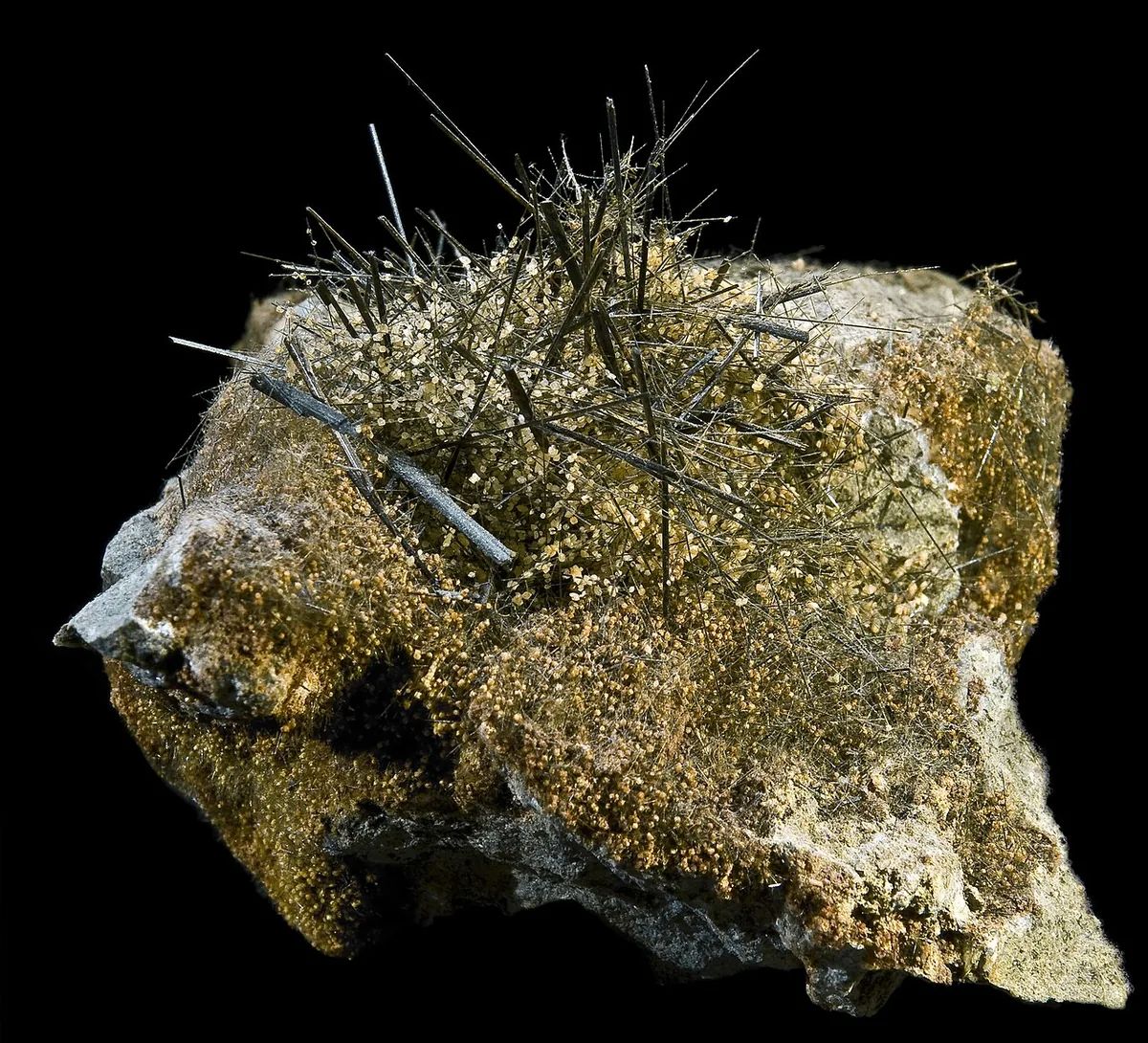
Actinolite (Ca₂(Mg,Fe)₅Si₈O₂₂(OH)₂) is the iron-bearing intermediate member of the tremolite-ferro-actinolite calcic amphibole series. Its name from Greek "aktinos" (ray) refers to its radiating fibrous habit.
Actinolite (Ca₂(Mg,Fe)₅Si₈O₂₂(OH)₂) is the iron-bearing intermediate member of the tremolite-ferro-actinolite calcic amphibole series. Its name from Greek “aktinos” (ray) refers to its radiating fibrous habit. Actinolite forms in greenschist-facies metamorphic rocks and serpentinized ultramafic bodies. Compact green Actinolite aggregates produce nephrite jade alongside Tremolite.