
Elemental Composition (by mass)
| Element | Mass % | Visual |
|---|---|---|
| O Oxygen | 45.10% | |
| Si Silicon | 28.79% | |
| Mg Magnesium | 15.57% | |
| Ca Calcium | 10.27% | |
| H Hydrogen | 0.26% |
Computed from simplified end-member formula. Solid-solution series, water content, and trace substitutions cause real-world variation.
IMA Abbreviation (Whitney-Evans 2010)
Hbl
→ Hornblende
Common amphibole
Standard symbol from American Mineralogist (Whitney & Evans, 2010). Used in thin-section labeling, phase diagrams, and IMA-style species records.
Pronunciation
/ˈhɔːrnblɛnd/
↔ HORN-blend
German "horn deceiver"
Diaphaneity (Transparency)
opaque
Dark color makes most hornblende opaque.
Type Locality
Hesse — Germany
Described 1789 by Werner (German "horn-stone")
› Browse all type localities
Magnetism
Category:
weakly paramagnetic
Test result:
Detectable
Fe-bearing complex amphibole.
Test with rare-earth magnet (N42 or N52 neodymium). Suspend specimen on thread for sensitive paramagnetic detection. Diamagnetic minerals are weakly repelled (visible only with strong magnets like bismuth).
Cleavage & Fracture
Cleavage:
perfect 2 directions ~56°/124°
Fracture:
uneven
Diagnostic 56° cleavage angle vs pyroxene 90°.
Collector tier: Micromount / Niche
Best appreciated at thumbnail or smaller scale — often dull-colored, sub-millimeter, or radioactive. Specialist appeal.
Mohs 5–6
Vickers (~) 540 HV
Knoop (~) 620 HK
Geological setting
VolcanicPlutonic igneousMetamorphic
Element composition by mass
Formula: Ca₂(Mg,Fe,Al)₅(Al,Si)₈O₂₂(OH)₂ · molar mass: 864.97 g/mol
| O | 44.39% | |
| Al | 17.68% | |
| Si | 12.99% | |
| Fe | 10.76% | |
| Ca | 9.27% | |
| Mg | 4.68% | |
| H | 0.23% |
Computed from atomic weights (IUPAC 2021). Site-occupancy groups (Fe,Mn) split equally.
GroupAmphibole Group
Related members: Tremolite · Actinolite
Mohs Hardness
5–6
Hornblende sits at 5–6 on the Mohs scale — just hard enough to scratch glass.
Colors:
Streak
Gray-green to brown
Gray-green to brown
Crystal system
Monoclinic
Monoclinic
SilicatesSilicates (Inosilicates — Amphiboles)
TL;DR · 1 min read
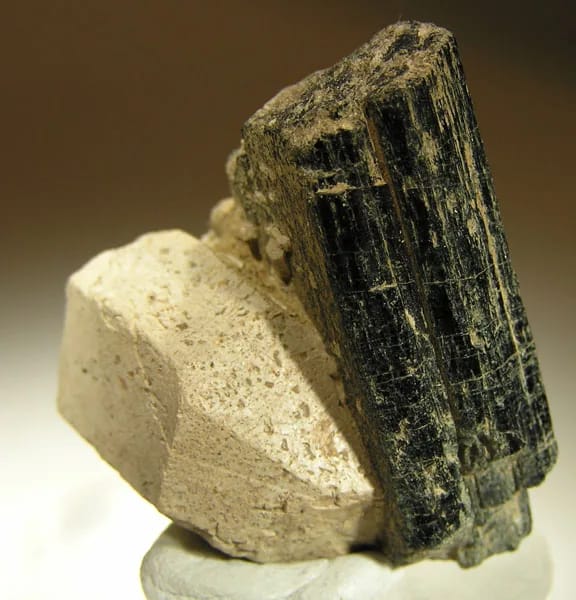
Hornblende is a complex calcic amphibole series — not a single species but a name historically applied to dark green-black amphiboles in igneous and metamorphic rocks. It is one of the most abundant rock-forming minerals on Earth.
Hornblende is a complex calcic amphibole series — not a single species but a name historically applied to dark green-black amphiboles in igneous and metamorphic rocks. It is one of the most abundant rock-forming minerals on Earth. Modern IMA classification splits Hornblende into magnesio-hornblende and ferro-hornblende endmembers, but the classical “Hornblende” name remains in widespread use.