
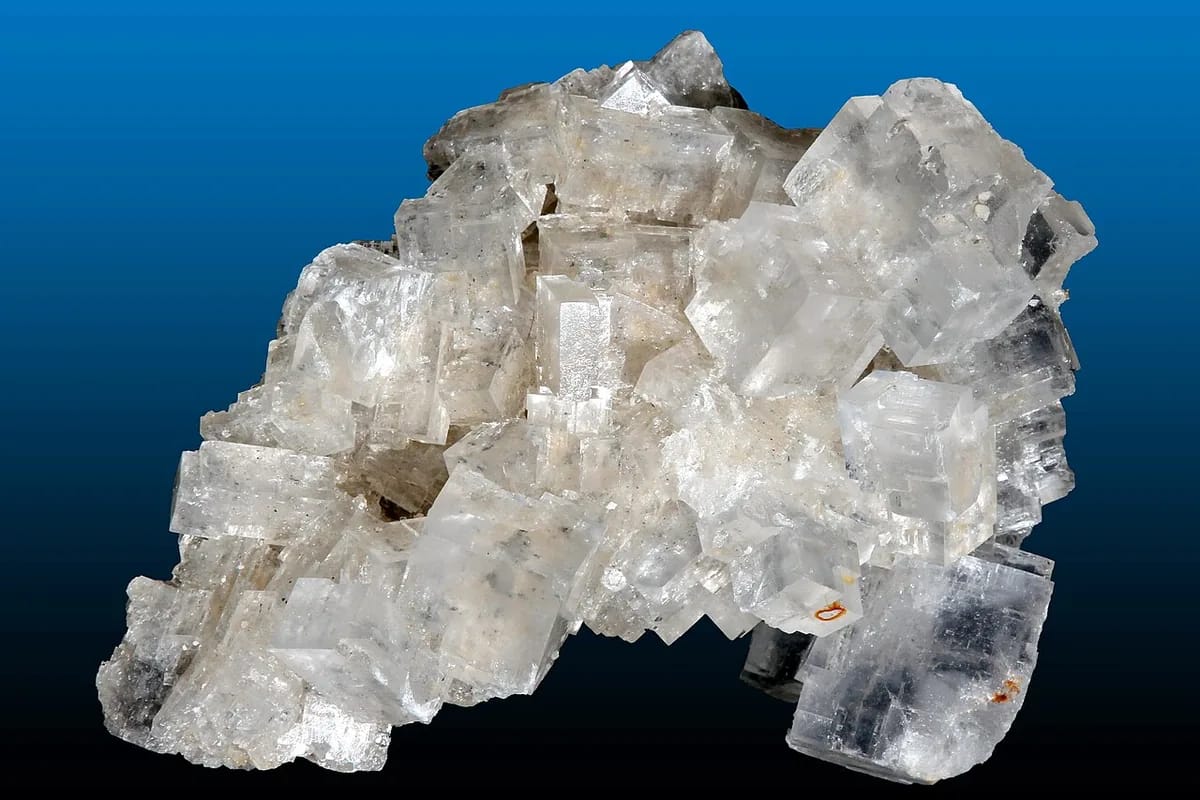
Crystal Structure
Cubic — Na⁺ and Cl⁻ in interpenetrating FCC arrays (rock-salt prototype).
Elemental Composition (by mass)
| Element | Mass % | Visual |
|---|---|---|
| Cl Chlorine | 60.66% | |
| Na Sodium | 39.34% |
Computed from simplified end-member formula. Solid-solution series, water content, and trace substitutions cause real-world variation.
IMA Abbreviation (Whitney-Evans 2010)
Hl
→ Halite
NaCl
Standard symbol from American Mineralogist (Whitney & Evans, 2010). Used in thin-section labeling, phase diagrams, and IMA-style species records.
⏳ Long-term Aging & Care Timeline
deliquescencedays to weeks
Trigger: humidity > 75%
Intervention: Absorbs atmospheric water, dissolving surface. Sealed case with silica gel below 50% RH.
Pronunciation
/ˈhælaɪt/
↔ HAL-ite
Greek hals (salt)
⚠ Safety & Handling
💧water-sensitivehigh
Highly soluble; also deliquescent (absorbs atmospheric moisture).
Handling: Sealed display case with desiccant. Never wash. Avoid humid storage.
Information provided in good faith. Consult local hazmat regulations for transport and disposal. Severely hazardous specimens may require special storage cabinets.
UV Fluorescence
SW (254 nm)
—
none
LW (365 nm)
—
none
Pure halite is inert. Some K-bearing halite shows minor response.
SW = shortwave (germicidal lamp). LW = longwave (blacklight). Response varies with locality, trace impurities, and treatment.
Diaphaneity (Transparency)
transparent-to-translucent
Fresh cleavage transparent; weathered surfaces translucent.
Type Locality
(ancient term) — Worldwide
Source: Glocker 1847
› Browse all type localities
Diagnostic Field Tests
Taste test→ Distinctly salty
The only safe taste-test in mineralogy. Touch tip of tongue briefly to fresh cleavage face.
Water solubility→ Slowly dissolves
Store dry — humid air will deliquesce.
⚠ Use dilute HCl (~10%) only on inconspicuous spots; rinse promptly. Smell-tests should be brief and ventilated. Taste-test ONLY halite/sylvite — never lead, arsenic, or sulfur minerals.
Specific Gravity
2.17
g/cm³
very light
Salty taste — only safe taste-test mineral.
For comparison: water = 1.00, glass ≈ 2.5, quartz = 2.65, corundum ≈ 4.00, galena ≈ 7.50, gold ≈ 19.3.
Geological Setting
Bedded marine evaporites — Wieliczka (Poland), Atacama (Chile).
Care notesDry storage only. Water dissolves it. Use desiccant in sealed display. Full cleaning guide →
Cleavage & Fracture
Cleavage:
perfect 3 directions {100} — cubic
Fracture:
conchoidal
Cubic cleavage produces perfect mini-cubes.
Market availability: Common
Widely available in most dealer stocks. Specimens span all price tiers.
Collector tier: Solid Display
Reliable mid-tier display species. Easy to find in well-formed examples; broad locality diversity.
Mohs 2
Vickers (~) 75 HV
Knoop (~) 85 HK
Nickel–Strunz
3.AA.20Dana
09.01.01.01Geological setting
VolcanicSedimentaryEvaporite
Element composition by mass
Formula: NaCl · molar mass: 58.44 g/mol
| Cl | 60.66% | |
| Na | 39.34% |
Computed from atomic weights (IUPAC 2021). Site-occupancy groups (Fe,Mn) split equally.
Mohs Hardness
2
Halite sits at 2 on the Mohs scale — soft enough to be scratched by a fingernail.
Colors:
Streak
White
White
Crystal system
Isometric (Cubic)
Isometric (Cubic)
Type localityWieliczka Salt Mine, Poland
HalidesHalides
TL;DR · 1 min read
Halite (NaCl) is rock salt — sodium chloride in crystalline form. It forms in evaporite basins by precipitation from seawater, in salt domes by diapiric flow, and in volcanic fumaroles.
Halite (NaCl) is rock salt — sodium chloride in crystalline form. It forms in evaporite basins by precipitation from seawater, in salt domes by diapiric flow, and in volcanic fumaroles. Cubic crystals are diagnostic. Wieliczka (Poland) and Searles Lake (California) produce iconic large cubic specimens. Halite is mined globally for industrial chemistry, food, and de-icing.