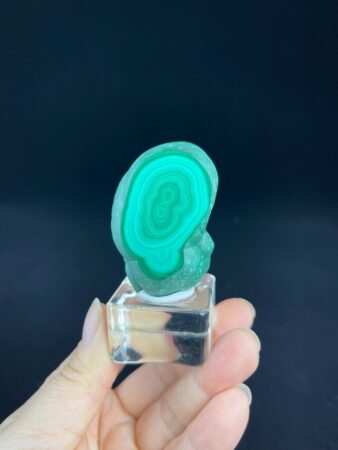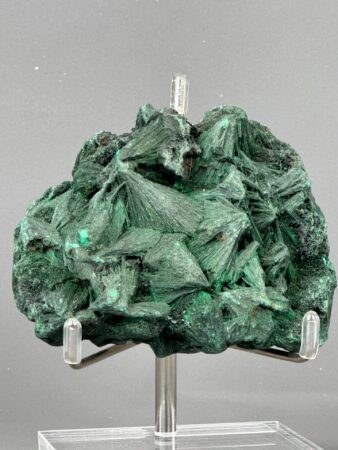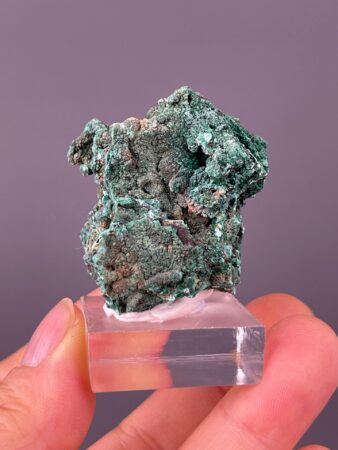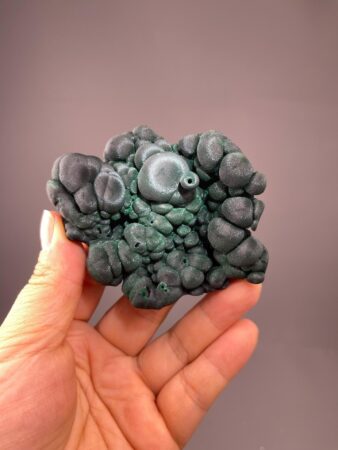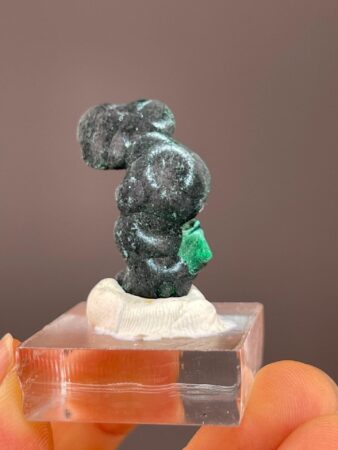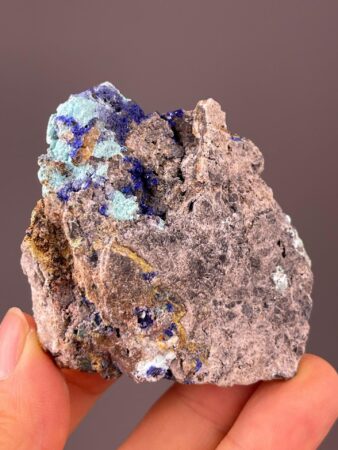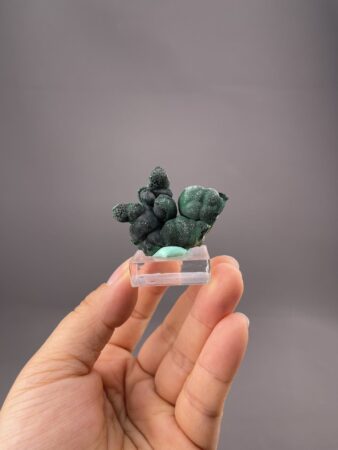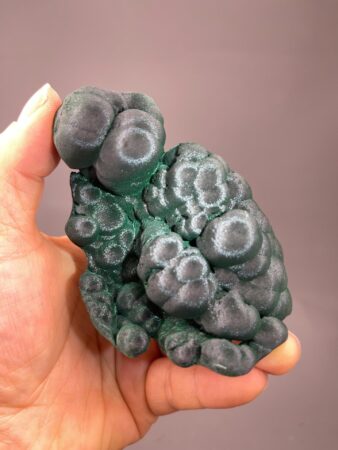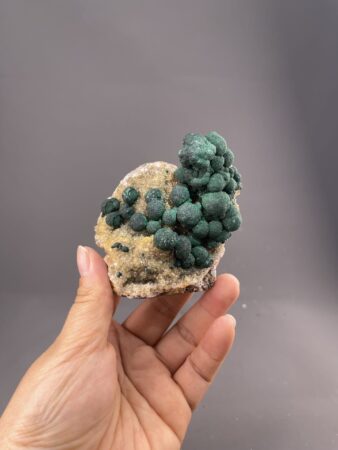
Malachite is a copper carbonate hydroxide and one of the most visually distinctive species in collecting – bright green botryoidal masses, banded slabs, and stalactitic clusters. It forms in the oxidized zone of copper deposits, almost always paired with its blue cousin Azurite (same elements, different hydration). Where Azurite is the upper-zone fresh signal, Malachite is the deeper-altered final phase. Russia's Tsar Hermitage carved entire columns from Ural malachite; ancient Egyptians ground it for green pigment.
Key Facts
- Mohs hardness 3.5-4 – softer than steel; will scratch with a knife.
- Specific gravity 3.6-4.0 – heavy for a non-metallic mineral due to copper content.
- Reacts with hydrochloric acid (effervesces) – diagnostic for carbonates.
- Almost always associated with Azurite (Cu3(CO3)2(OH)2) – chemically related.
- Russia's Hermitage Museum displays massive Ural-malachite columns from the Demidov mines.
Notable Varieties
- Botryoidal (most common collector form; "grape" textures)
- Stalactitic (cave-formed columns and pendants)
- Pseudomorph after Azurite (square crystals replaced by green – Tsumeb, Bisbee)
- Plumose (fibrous radiating sprays)
- "Azurmalach" (intergrowth with Azurite – dual color)
The Chinese Angle
Yangchun in Guangdong produces some of the finest botryoidal Chinese malachite, with deep saturated green and well-formed spherical structures. Hubei (the same Cu-Fe skarn districts that produce Daye galena and pyrite) also yields collector malachite. Both pair frequently with Azurite, and combination matrix specimens are characteristic. Outside China, Katanga (DRC) and Tsumeb (Namibia) remain the global references.
Found at these Localities
- Cornwall Mining District (康沃尔矿区)
- Chuquicamata (丘基卡马塔铜矿)
- Bisbee (Warren District) (比斯比铜矿)
- Tsumeb Mine (楚梅布矿)
- Daye District (大冶)
- Hubei (湖北)
Available Products of Malachite
9 available specimens