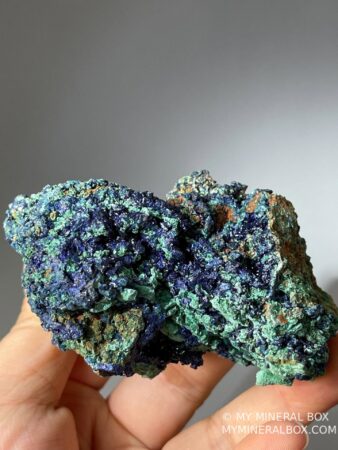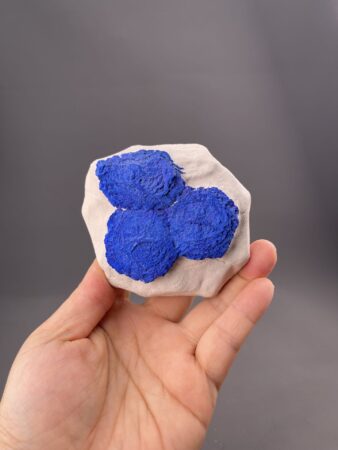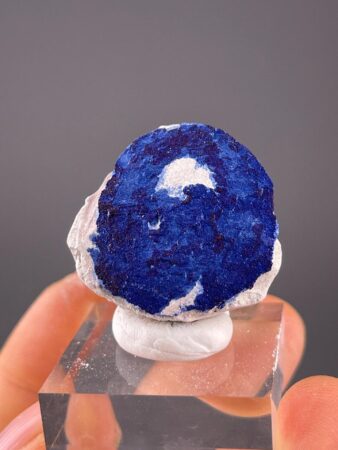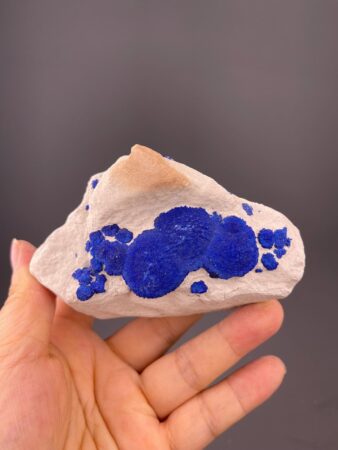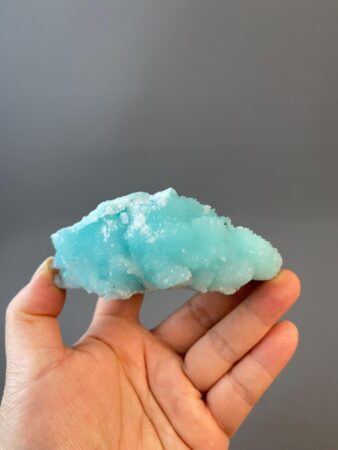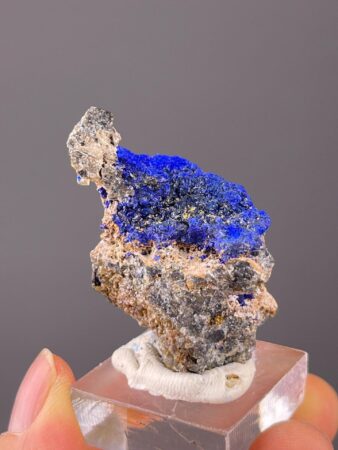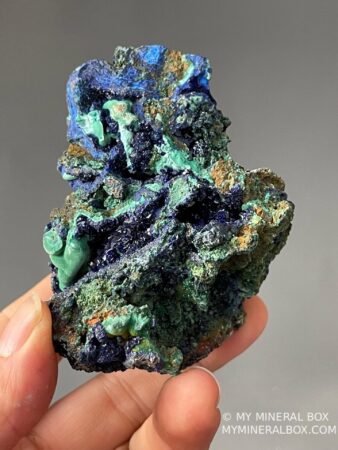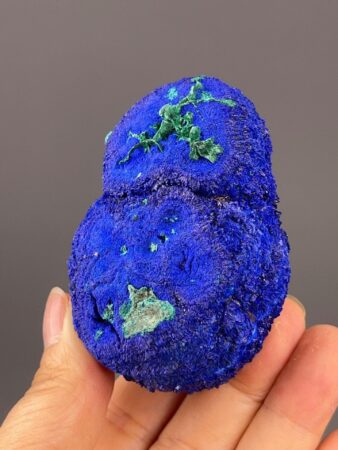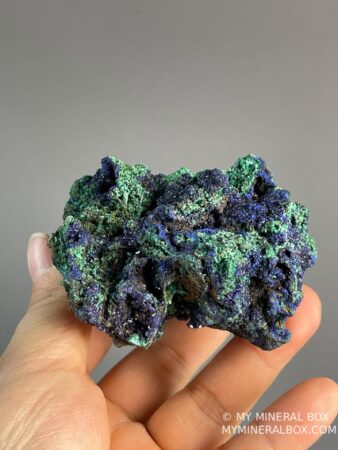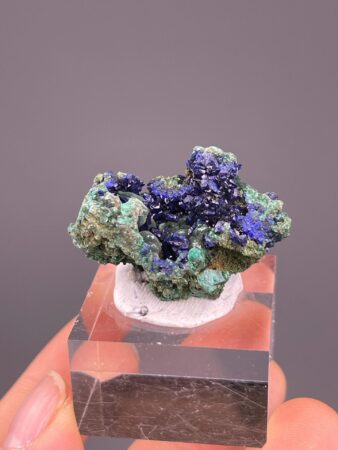
Azurite is the deep-blue companion to Malachite and one of the most visually iconic copper minerals. Like Malachite it is a copper carbonate, but with a different hydration ratio that gives it the diagnostic azure color. Azurite is the upper-oxidized-zone signal in copper deposits; over geological time it slowly weathers and pseudomorphs to Malachite, leaving square Azurite-shaped crystals colored green. Tsumeb (Namibia) produces the world's finest crystals; Chessy in France is the historical type locality.
Key Facts
- Mohs hardness 3.5-4 – same as Malachite; the two minerals share most physical properties.
- Specific gravity 3.77 – heavy due to copper content.
- Reacts with hydrochloric acid – diagnostic for carbonates.
- Almost always paired with Malachite; same Cu-CO3 chemistry, different OH content.
- Ancient pigment "azurro della magna" (German blue); used in medieval European painting.
Notable Varieties
- Tabular crystals (Tsumeb, Touissit)
- Spherical aggregates ("balls" – Liufengshan, Anhui)
- Massive (carving stone)
- "Azurmalach" (Azurite + Malachite intergrowth)
- Pseudomorphed by Malachite (square shapes, green color)
The Chinese Angle
Xitieshan in Qinghai produces fine Chinese azurite, often as deep-blue rosettes on matrix. Yunnan copper-skarn deposits yield azurite paired with malachite in classic combination specimens. Liufengshan (Anhui) is internationally noted for spherical "azurite balls." Combination Azurite-Malachite specimens from these districts are highly sought by collectors – the dual color (deep blue + bright green) is characteristic.
Found at these Localities
- Cornwall Mining District (康沃尔矿区)
- Lavrion (Laurium) (拉夫里翁古铅锌银矿)
- Chuquicamata (丘基卡马塔铜矿)
- Bisbee (Warren District) (比斯比铜矿)
- Tsumeb Mine (楚梅布矿)
- Yunnan (云南)
Available Products of Azurite
10 available specimens