
Roselite
Curated by Maggie Liu · Updated:
Roselite is an arsenate mineral recognized among collectors for its crystal form and distribution.
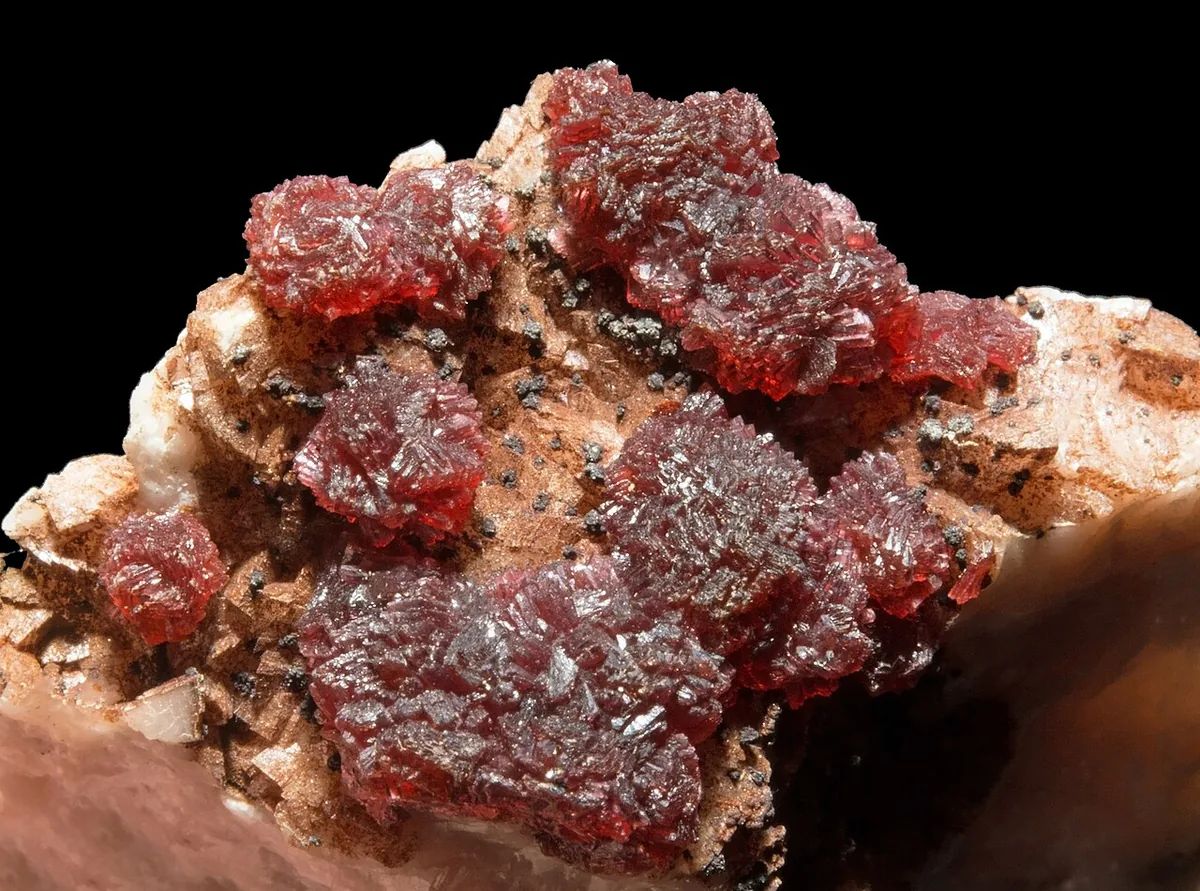
Roselite is a rose-pink cobalt-calcium arsenate, a sought-after collector species best known from the cobalt deposits of Bou Azzer, Morocco.
About Roseliteextended article
Roselite is a hydrated calcium-cobalt arsenate, prized by collectors for its intense rose-to-magenta pink colour and lustrous crystals.
The Bou Azzer connection
The Bou Azzer cobalt district in Morocco is a major source of fine roselite, where it forms sparkling pink crystal groups with other cobalt minerals.
What collectors look for
Saturated pink roselite crystal druses on matrix are the prize; colour and crystal sharpness drive value.
About Roselite
Roselite belongs to the arsenate class in the fairfieldite group and has the chemical formula Ca₂(Co,Mg)(AsO₄)₂·2H₂O. It crystallizes in the triclinic system and holds a steady position among arsenate species. Its combination of structural character and global distribution make it a recognized species in both systematic and aesthetic collections.
Identification & care
Crystals commonly develop as tabular to platy crystals; often in radial or fan-shaped aggregates. Its color is typically rose-red to dark red and carmine-pink. The luster is vitreous, the streak is pale pink, and specimens range from transparent to translucent. The cleavage is perfect on {001}. The fracture is uneven to conchoidal, which aids identification.
Collector context
How it forms
In terms of geology, Roselite forms in oxidized zones of cobalt-arsenic ore deposits; secondary arsenate with co giving the pink-red color; ca-co arsenate dihydrate. It is commonly found in association with erythrite, adamite, calcite, cobaltite, skutterudite, annabergite.
Why collectors care
Collectors pursue Roselite for the clarity of its crystal form and, in good material, saturated color that reads instantly across a display case. A well-terminated roselite on clean matrix photographs well, identifies quickly, and anchors a cabinet piece. Top Chinese specimens over the last two decades have reset the bar for what roselite looks like at collector grade.
What affects value
Value in Roselite is assessed, in typical order of weight, against: (1) locality provenance; (2) size relative to the species norm; (3) crystal form and termination sharpness; (4) color saturation and zoning; (5) transparency and internal clarity; (6) matrix quality and aesthetic balance; (7) condition (absence of damage, chips, or repair). Cleaning quality and verified locality documentation act as multipliers across the above.
Frequently asked questions
What is Roselite?
Roselite has the chemical formula Ca₂(Co,Mg)(AsO₄)₂·2H₂O, crystallises in the Triclinic system. Roselite is an arsenate mineral recognized among collectors for its crystal form and distribution.
What is the chemical formula of Roselite?
The chemical formula of Roselite is Ca₂(Co,Mg)(AsO₄)₂·2H₂O.
What crystal system does Roselite belong to?
Roselite crystallises in the Triclinic crystal system.
Where is Roselite found?
Notable localities for Roselite include Bou Azzer.
Related minerals
Looking for a Roselite specimen?
Our inventory is one-of-a-kind and turns over quickly. Tell us what you're after — species, size, budget — and we'll notify you when a matching Roselite arrives from our sourcing network.
Request this mineral