
Elemental Composition (by mass)
| Element | Mass % | Visual |
|---|---|---|
| O Oxygen | 51.72% | |
| Al Aluminum | 21.81% | |
| P Phosphorus | 16.69% | |
| Cu Copper | 8.56% | |
| H Hydrogen | 1.22% |
Computed from simplified end-member formula. Solid-solution series, water content, and trace substitutions cause real-world variation.
IMA Abbreviation (Whitney-Evans 2010)
Tq
→ Turquoise
Cu-Al phosphate
Standard symbol from American Mineralogist (Whitney & Evans, 2010). Used in thin-section labeling, phase diagrams, and IMA-style species records.
⏳ Long-term Aging & Care Timeline
color shift to greenyears
Trigger: oils + UV
Intervention: Cu-Al phosphate absorbs oils and UV-shifts toward green. Sealed dry case + no oil contact.
Pronunciation
/ˈtɜːrkwɔɪz/
↔ TUR-koyz
French "Turkish"
Lapidary & Faceting Recommendations
Recommended cut:
cabochon
Also seen:
inlay, free-form
Typical yield:
60% of rough
Always cabbed. Spider-web matrix material cut to display matrix lines. Stabilized material allows larger cabs.
Birthstone & Anniversary Gift Reference
January (zodiac) — zodiac: Capricorn / Aquarius
December (traditional, zodiac) — zodiac: Sagittarius / Capricorn
› Full birthstones registry
⚠ Safety & Handling
💧water-sensitivemoderate
Porous; absorbs oils and chemicals causing color change.
Handling: No water. No oils. No perfume. Wipe with soft dry cloth.
⚗acid-sensitivemoderate
Phosphate dissolves slowly in acids.
Handling: No acids.
Information provided in good faith. Consult local hazmat regulations for transport and disposal. Severely hazardous specimens may require special storage cabinets.
UV Fluorescence
SW (254 nm)
—
none
LW (365 nm)
—
none
Untreated inert. Polymer-stabilized may fluoresce blue-white LW.
SW = shortwave (germicidal lamp). LW = longwave (blacklight). Response varies with locality, trace impurities, and treatment.
Pseudomorph Relationships
Replaces — this mineral is often a pseudomorph after:
A pseudomorph (Greek "false form") is a mineral with the external shape of another species — the chemistry has changed but the crystal habit is inherited.
Tenacity
Behavior:
brittle
Under stress:
Crumbles if untreated
Chalky material very fragile — reason for routine stabilization.
Luster
waxy
Subdued waxy luster — diagnostic.
Color Cause (Chromophore)
Chromophore:
Cu²⁺ + Fe²⁺
Mechanism:
idiochromatic
Color produced:
blue-green
Cu dominates blue; Fe shifts toward green.
Diaphaneity (Transparency)
translucent-to-opaque
Most turquoise opaque; spider-web matrix shows through edges.
Type Locality
(French "Turkish stone") — Iran (Nishapur)
Source: Mined since 6000 BCE
› Browse all type localities
Diagnostic Field Tests
Hot needle→ No melt; faint chemical smell
Plastic/composite turquoise melts/smokes — diagnostic.
Acetone swab→ Removes dye if treated
White cotton swab + acetone reveals dye on dyed howlite imitation.
⚠ Use dilute HCl (~10%) only on inconspicuous spots; rinse promptly. Smell-tests should be brief and ventilated. Taste-test ONLY halite/sylvite — never lead, arsenic, or sulfur minerals.
Specific Gravity
2.60–2.80
g/cm³
light
Stabilized turquoise has slightly lower SG than natural.
For comparison: water = 1.00, glass ≈ 2.5, quartz = 2.65, corundum ≈ 4.00, galena ≈ 7.50, gold ≈ 19.3.
Streak Test
white / pale blue
Pale streak — confirms vs dyed howlite (pure white when scraped).
Streak = color of the powdered mineral. Drag specimen across unglazed white porcelain plate (Mohs 6.5). For minerals harder than the plate, crush a small flake into powder and observe color.
Synthetics & Imitations
Lab-grown methods
Gilson process 1972 · Pierre Gilson
Synthetic turquoise; lacks natural matrix and limonite spots.
Common imitations
Howlite (dyed)
White howlite dyed blue — very common imitation in tourist markets.
Magnesite (dyed)
White magnesite dyed; same trick.
Plastic / resin
Lightweight; melts under hot needle test.
Reconstituted turquoise
Powdered turquoise + polymer binder; sold as natural in tourist trade.
Geological Setting
Environment:
supergene
Host rock:
altered Cu-Al-rich volcanic / sedimentary
Companions:
Forms by groundwater alteration of aluminous host rock in arid copper districts.
Treatments & Enhancements
Stabilization (epoxy/wax)universalstable-care· detection: easy
Most natural turquoise is impregnated with polymer or wax to harden chalky material. Disclosure required.
Dyeingcommonstable-care· detection: moderate
Color enhancement of pale material. Often combined with stabilization.
Reconstitutedcommonstable· detection: easy
Powdered turquoise reformed with polymer binder. Not natural turquoise — must be disclosed.
As a buyer: request written disclosure of treatments and confirm whether the price reflects treated or untreated material.
Formation eraSupergene; recent weathering of Al-Cu-bearing rocks in arid climates.
Market availability: Uncommon
Found at major shows and select dealers. Quality varies by locality.
Collector tier: Cabinet Classic
Display species collected for cabinet presentation, with specimens recorded from named localities.
Mohs 5–6
Vickers (~) 540 HV
Knoop (~) 620 HK
Nickel–Strunz
8.DD.15Dana
42.09.03.01Element composition by mass
Formula: CuAl₆(PO₄)₄(OH)₈·4H₂O · molar mass: 759.39 g/mol
| O | 52.67% | |
| Al | 21.32% | |
| P | 16.32% | |
| Cu | 8.37% | |
| H | 1.33% |
Computed from atomic weights (IUPAC 2021). Site-occupancy groups (Fe,Mn) split equally.
Mohs Hardness
5–6
Turquoise sits at 5–6 on the Mohs scale — just hard enough to scratch glass.
Colors:
Streak
White
White
Crystal system
Triclinic
Triclinic
Pronunciation/ˈtɜːrkwɔɪz/
Type localitySinai Peninsula, Egypt (ancient)
Discovery First described 1546 by Georgius Agricola
PhosphatesPhosphates
TL;DR · 1 min read
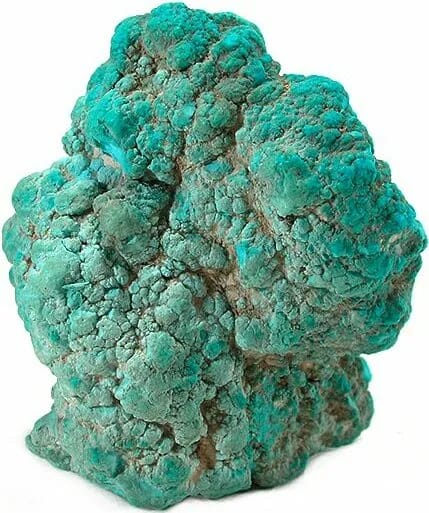
Turquoise (CuAl₆(PO₄)₄(OH)₈·4H₂O) is a hydrous copper aluminum phosphate, prized for its sky-blue to apple-green color since prehistoric times. Persia (Nishapur, Iran), Hubei (China), and the American Southwest (Sleeping Beauty Mine, Arizona) supply iconic gem-quality material.
Turquoise (CuAl₆(PO₄)₄(OH)₈·4H₂O) is a hydrous copper aluminum phosphate, prized for its sky-blue to apple-green color since prehistoric times. Persia (Nishapur, Iran), Hubei (China), and the American Southwest (Sleeping Beauty Mine, Arizona) supply iconic gem-quality material. Color depends on copper content (sky-blue) vs. iron (greenish).
More minerals to explore
Wavellite (银星石)
Orthorhombic
Libethenite (橄榄铜矿)
Orthorhombic
Xenotime (磷钇矿)
Tetragonal
Lazulite (天蓝石)
Monoclinic
Ludlamite (磷铁锰石)
Monoclinic
Pyromorphite (磷氯铅矿)
Hexagonal