
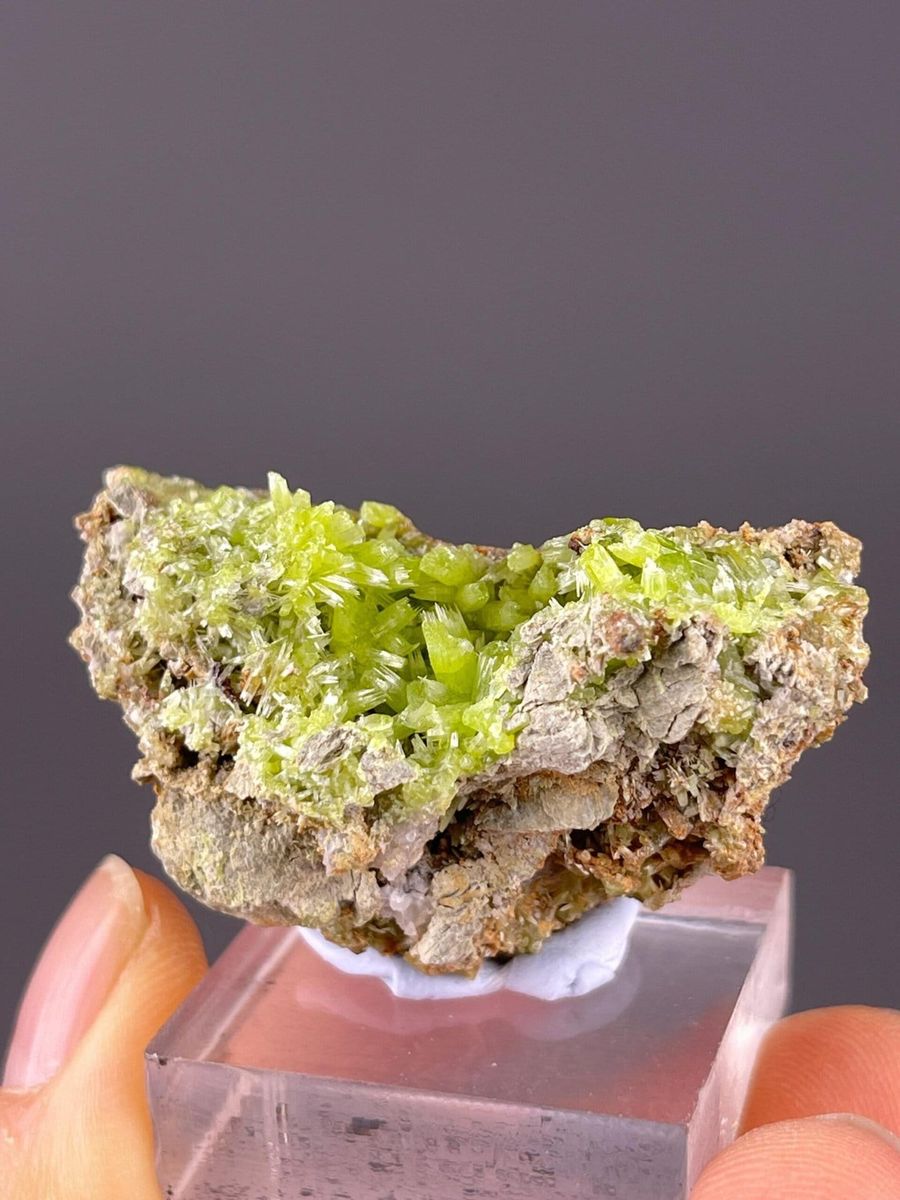
What pyromorphite is
Pyromorphite is a lead chlorophosphate and a member of the apatite group, crystallizing in the hexagonal system. It forms where lead ore bodies are weathered and oxidized near the surface, so it is a classic "secondary" mineral of the oxidized zone.
Its crystals are typically short hexagonal prisms — often barrel-shaped or hollow-ended — and grow in glittering druses. Colors range from grass-green and yellow-green to yellow, orange and brown, with a bright resinous to sub-adamantine luster.
Why Daoping is the benchmark
The Daoping Mine in Guangxi brought dense carpets of saturated grass-green crystals on contrasting brown gossan matrix to the modern specimen market. The Mineralogical Record describes the wider Daoping–Yangshuo area as probably the world's greatest modern locality for pyromorphite.
Green pyromorphite from other classic localities — Bad Ems and the Pyrenees, for example — is also prized. Daoping's particular reputation rests on vivid colour, sharp crystallisation, branching forms, and the volume of material that reached collectors after the late 1990s.
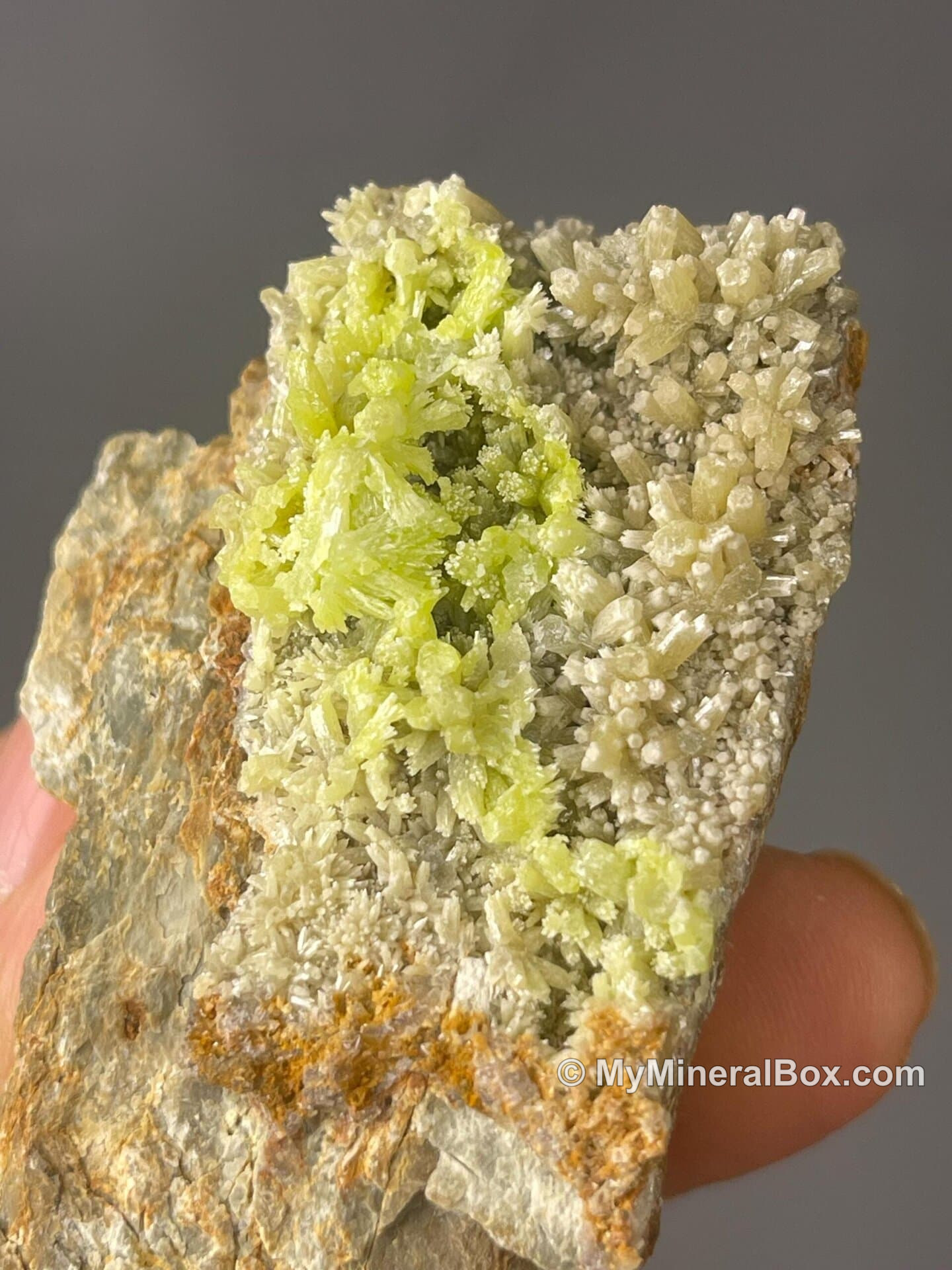
Judging pyromorphite quality
Color comes first: an even, saturated grass-green is the most sought-after, with luster a close second — the best crystals almost glow. Look for crisp, well-formed prisms rather than rounded blobs, good crystal coverage across the piece, and strong color-against-matrix contrast.
Condition matters because the crystals are soft and the druse is easily rubbed; check the high points for abrasion and the edges for contact damage.
Associations and forms
Daoping pyromorphite sits on iron-stained, oxidized lead matrix and is sometimes accompanied by other secondary lead minerals. The species also occurs as smooth botryoidal crusts and as "wheat-sheaf" parallel growths, not only as single prisms.
Mimetite, an arsenic analogue, can look almost identical; the two form a series, and only testing distinguishes look-alikes with certainty.
Care and stability
Pyromorphite is light-stable and does not tarnish, so it displays well for years. Because it is a lead mineral, wash your hands after handling and keep it away from children and food surfaces.
Clean only by gentle dusting with a soft brush; the soft crystals scratch easily and a sparkling druse loses its life if rubbed. Avoid ultrasonic cleaners. See our guide to cleaning mineral specimens.
Pyromorphite in a Chinese suite
Alongside fluorite and stibnite, pyromorphite is one of the species that made Chinese localities famous with collectors worldwide. A fine green Daoping plate is a showpiece in any cabinet.
Value tracks color saturation, luster, crystal size and form, coverage and condition — a brilliant, undamaged grass-green druse commands a strong premium over a dull or worn one.
Sources and further reading
The locality assessment above follows the Mineralogical Record's 2024 report on the Daoping–Yangshuo area and its earlier collector-history report. These sources support the area's modern global reputation; they do not make every specimen or colour variety an objective winner.
The new name on labels: Shizhuyuan
In recent years a second Chinese name has been appearing under green crystal druses at shows and in online listings: Shizhuyuan, in the Dongpo ore field near Chenzhou, Hunan. Industrially the deposit is a giant — a tungsten-tin-molybdenum-bismuth skarn so mineral-rich that Chinese geologists have called the district a natural museum of nonferrous metals. For collectors, the material marketed under this label is typically pyromorphite together with mimetite — pyromorphite's arsenate twin.
The two species form a continuous series: pyromorphite carries phosphate, mimetite carries arsenate, and real-world crystals often sit somewhere in between. Visually the Shizhuyuan-labeled material tends toward yellow-green to yellow hues and softer, rounded barrel forms, where classic Daoping runs saturated grass-green with crisper prisms. Without lab analysis, pyromorphite-mimetite is often the honest label for intermediate pieces — and we use it where the distinction isn't certain.
A buying note: because this material is newer to the market and locality labels in the trade can travel loosely, treat Shizhuyuan labels with the same healthy skepticism as any recently emerged Chinese locality name. Judge the specimen first — color, luster, coverage, condition — and the label second.
Frequently asked questions
Is pyromorphite valuable?
Fine grass-green pyromorphite, especially from Daoping, is highly collectable and commands strong prices for bright, undamaged, well-crystallized plates. Common dull or worn pieces are inexpensive.
Where is the best pyromorphite from?
Daoping in Guangxi, China is one of the great modern sources of grass-green pyromorphite; the Mineralogical Record describes the wider Daoping–Yangshuo area as probably the world's greatest modern locality for the species. Historic green material also came from Bad Ems in Germany and the Pyrenees.
Is pyromorphite toxic?
It is a lead-bearing mineral, so it is safe to display and handle but should not be ingested or handled by children; wash your hands after touching it and don't make dust.
What makes pyromorphite green?
Green is a characteristic color of the species; the exact shade varies with trace impurities and crystal chemistry, ranging from grass-green through yellow to orange and brown.
What is the difference between pyromorphite and mimetite?
They are twin species in the apatite group: pyromorphite is the lead chloro-phosphate, mimetite the lead chloro-arsenate, and natural crystals frequently fall between the two. Mimetite-rich material tends toward yellow and orange tones; pyromorphite toward greens. Intermediate Chinese specimens are often best labeled pyromorphite-mimetite.
Where is the Shizhuyuan mine?
Shizhuyuan lies in the Dongpo ore field near Chenzhou, in southern Hunan, China — one of the world's great tungsten-polymetallic skarn deposits. Collector specimens of pyromorphite and mimetite under this label are a relatively recent arrival in the market.
Is Shizhuyuan pyromorphite as good as Daoping?
They are different animals: Daoping set the world standard for saturated grass-green pyromorphite, while Shizhuyuan-labeled material is typically yellower pyromorphite-mimetite in softer crystal forms. Judge each piece on color, luster and condition rather than the label alone.