
How to think about a Chinese mineral collection
There is no single "best" mineral — the right choice depends on your taste, budget, and display space. A rewarding approach is to focus: pick one or two species or localities you find appealing and learn them deeply, rather than buying one of everything.
The species below are popular starting points because they are beautiful, well-documented, and available across a wide range of prices. For the general framework on judging any specimen, see the how-to-buy guide linked at the end.
Fluorite — the signature Chinese species
Chinese fluorite is the category that made the country famous with collectors: gemmy purple and green cubes, color zoning and phantoms, and aesthetic fluorite-on-quartz combinations. Hunan localities such as Yaogangxian, Shangbao, and Xianghualing lead the way.
Fluorite is an excellent first focus — colorful, widely available, and rewarding to compare across localities. Just remember it is soft and cleavable, so condition matters.
Scheelite — golden crystals from Xuebaoding
Xuebaoding in Sichuan is a world-class source of collector scheelite — warm honey-to-orange pseudo-octahedral crystals, often on a pale matrix with cassiterite and pink beryl. A Mineralogical Record deposit study describes it as famous for superb scheelite, beryl, and cassiterite specimens.
Scheelite appeals to collectors who like warm color and sharp geometry, and who appreciate a specimen that tells a story through its mineral associations.
Stibnite — Hunan’s metallic blades
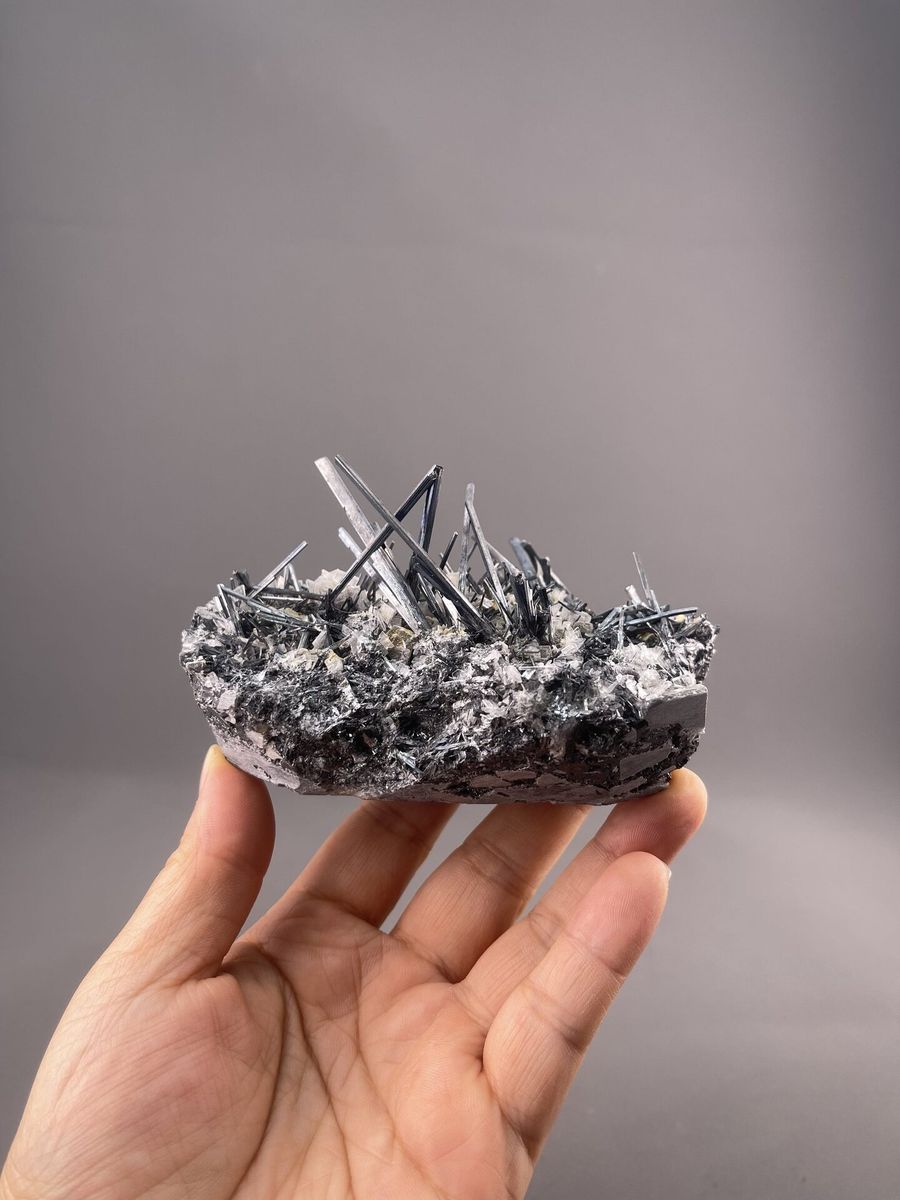
Hunan’s Lengshuijiang / Xikuangshan area produces world-class stibnite — striking silver-grey metallic blades and sprays. It is one of the most dramatic Chinese species and a long-standing favorite for its sculptural form.
Stibnite is more fragile than it looks; the slender crystals bend and damage easily, so condition and careful handling are especially important.
Cassiterite, pyrite, calcite and more
Beyond the headline species, China produces excellent cassiterite (notably at Xuebaoding and in Yunnan/Guangxi), pyrite and calcite from the Daye and Tonglushan skarns in Hubei, barite from Jiangxi, and a wide range of secondary copper minerals, beryl, and others.
These broaden a collection nicely once you have a focus, and many offer fine specimens at accessible prices. The encyclopedia hub lets you browse every Chinese species we catalogue.
Where the classic specimens come from
A few localities recur because they define their species: Yaogangxian, Shangbao, and Xianghualing (Hunan) for fluorite; Xuebaoding (Sichuan) for scheelite and cassiterite; Lengshuijiang (Hunan) for stibnite; and Daye (Hubei) for calcite and pyrite.
Learning a locality’s "style" is one of the most useful collecting skills — it helps you recognize material and judge whether a specimen fits its stated source. The links below go to detailed pages for each.
How to start
Pick a species or locality that appeals to you, read its page for context, and compare a few specimens side by side before buying. Buy the best condition you can afford rather than simply the largest piece, and keep the locality information with each specimen.
The links below take you to the key species and localities, the focused buying guides, and the specimens we currently have in stock.
The key Chinese species
The classic localities
The focused buying guides
Frequently asked questions
What is the best Chinese mineral to start collecting?
Fluorite is a popular first focus — colorful, widely available across price ranges, and rewarding to compare across Hunan localities like Yaogangxian, Shangbao, and Xianghualing. The best choice ultimately depends on your taste, budget, and display space.
Which Chinese minerals are most prized by collectors?
Fluorite (Hunan), scheelite and cassiterite (Xuebaoding, Sichuan), and stibnite (Lengshuijiang, Hunan) are among the most sought-after, along with pyrite and calcite from the Hubei skarns and barite from Jiangxi.
Should I collect by species or by locality?
Either works well — the key is to focus rather than buy one of everything. Many collectors pick a species (e.g. fluorite) or a locality (e.g. Yaogangxian) and learn it deeply, which makes it easier to judge quality and build a coherent collection.