
Elemental Composition (by mass)
| Element | Mass % | Visual |
|---|---|---|
| O Oxygen | 56.93% | |
| Mg Magnesium | 28.83% | |
| C Carbon | 14.25% |
Computed from simplified end-member formula. Solid-solution series, water content, and trace substitutions cause real-world variation.
IMA Abbreviation (Whitney-Evans 2010)
Mgs
→ Magnesite
Mg carbonate
Standard symbol from American Mineralogist (Whitney & Evans, 2010). Used in thin-section labeling, phase diagrams, and IMA-style species records.
Pronunciation
/ˈmæɡnɪsaɪt/
↔ MAG-nuh-site
from magnesium
Mohs 4–4.5
Vickers (~) 200 HV
Knoop (~) 220 HK
Geological setting
HydrothermalSedimentaryEvaporite
Element composition by mass
Formula: MgCO₃ · molar mass: 84.31 g/mol
| O | 56.93% | |
| Mg | 28.83% | |
| C | 14.25% |
Computed from atomic weights (IUPAC 2021). Site-occupancy groups (Fe,Mn) split equally.
Mohs Hardness
4–4.5
Magnesite sits at 4–4.5 on the Mohs scale — can be scratched by a steel knife.
Colors:
Streak
White
White
Crystal system
Trigonal
Trigonal
CarbonatesCarbonates
TL;DR · 1 min read
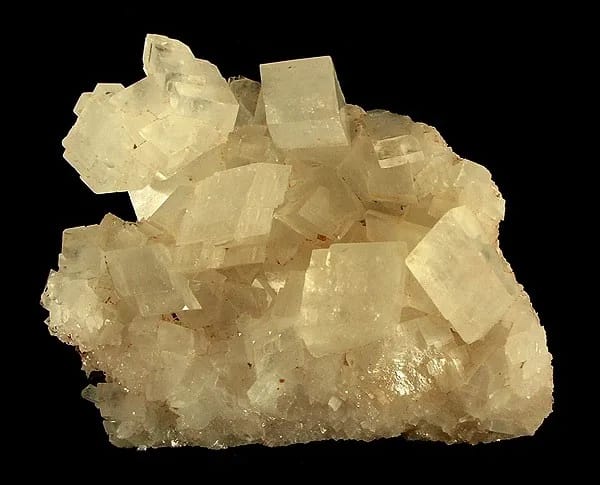
Magnesite (MgCO₃) is the magnesium end-member of the calcite-group carbonates. It forms by hydrothermal alteration of ultramafic rocks and as primary precipitate in evaporite basins.
Magnesite (MgCO₃) is the magnesium end-member of the calcite-group carbonates. It forms by hydrothermal alteration of ultramafic rocks and as primary precipitate in evaporite basins. Brumado (Brazil) supplies gem-quality transparent magnesite; massive cryptocrystalline “porcelain magnesite” from Liaoning (China) is the dominant industrial source for refractories.
More minerals to explore
Cerussite (白铅矿)
Orthorhombic
Rhodochrosite (菱锰矿)
Trigonal
Witherite (碳酸钡矿)
Orthorhombic
Aurichalcite (绿铜锌矿)
Monoclinic
Bastnäsite (氟碳铈矿)
Hexagonal
Rosasite (蓝绿铜锌矿)
Monoclinic