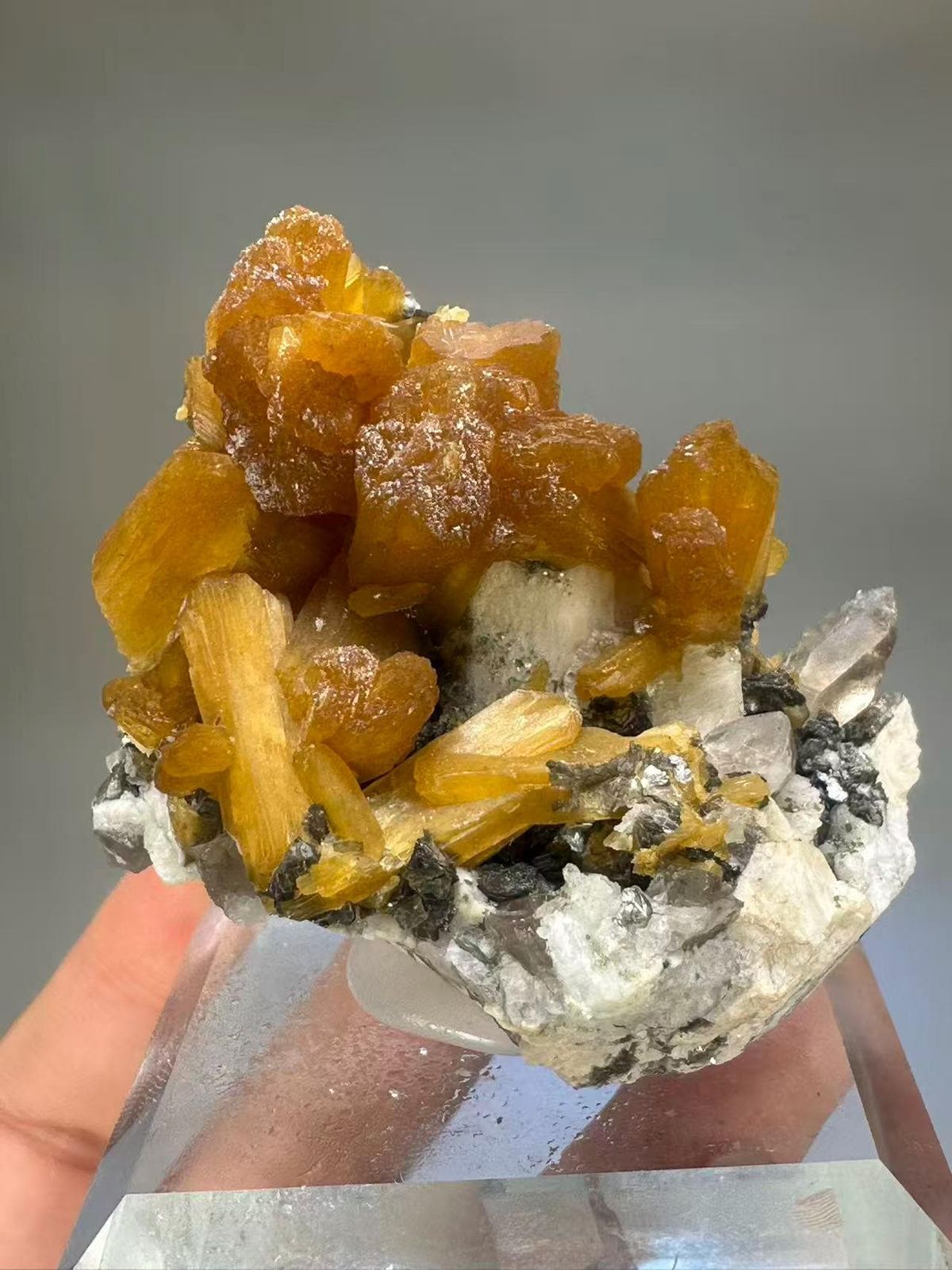
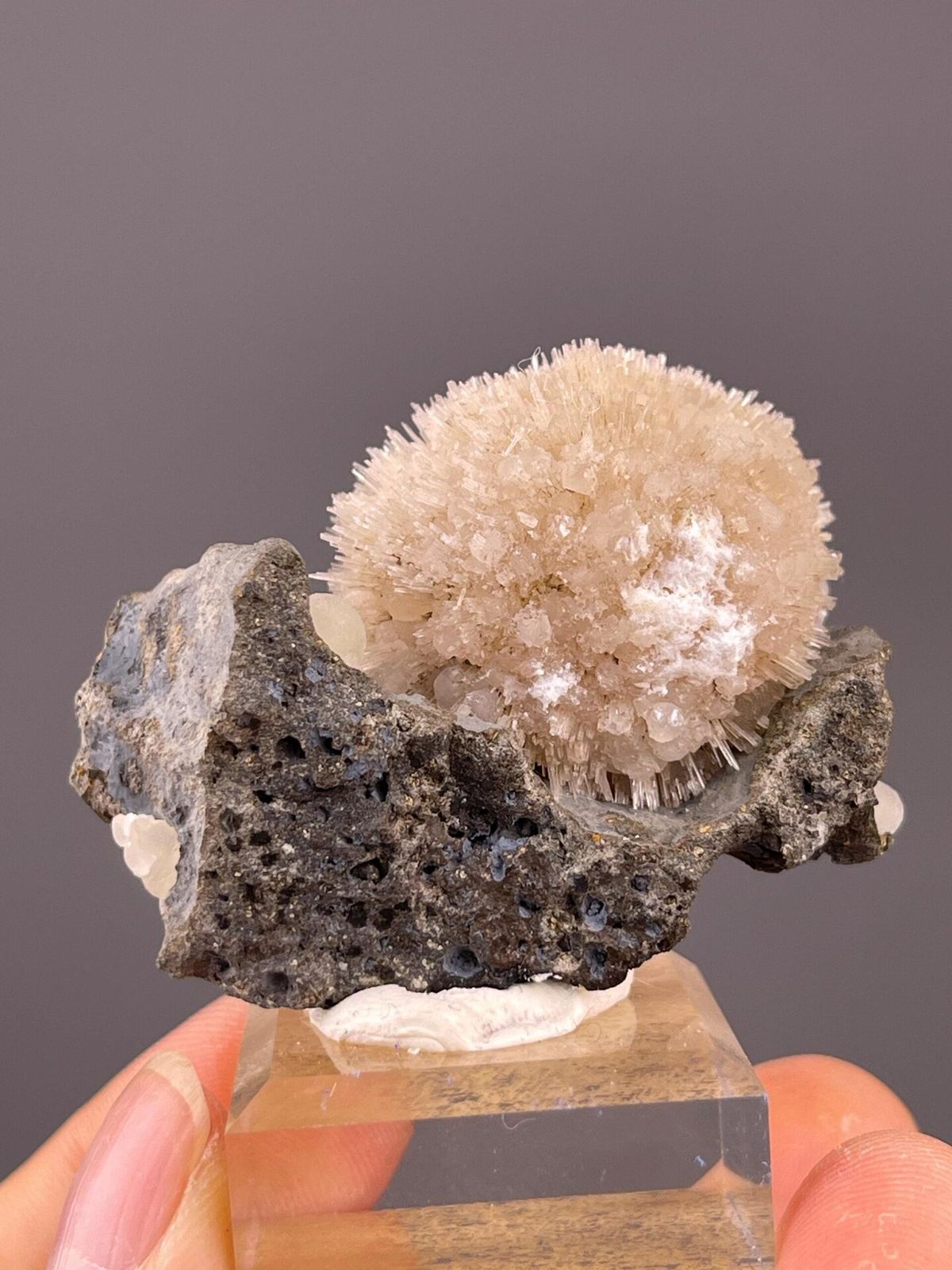
Stilbite
Curated by Maggie Liu · Updated:
Stilbite is a silicate mineral prized by collectors for its exceptional color range.
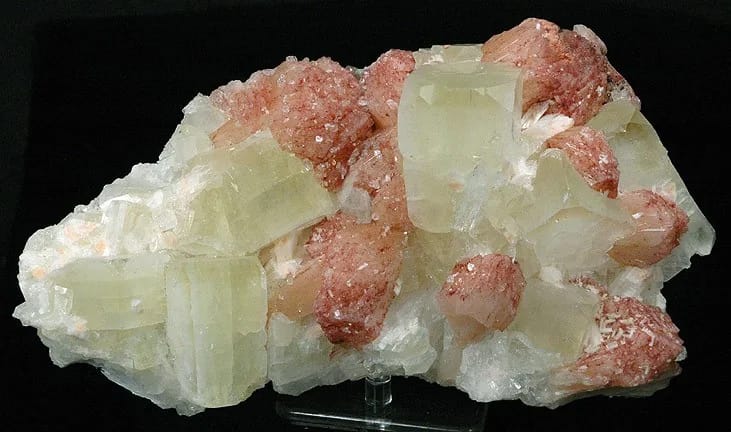
Stilbite is a zeolite mineral that grows as pearly, sheaf-like or bow-tie bundles of crystals in the gas cavities of volcanic basalt, usually alongside other zeolites.
About Stilbiteextended article
Stilbite is a hydrated calcium-sodium aluminosilicate of the zeolite group. It is best known for its distinctive habit — thin tabular crystals that fan out into sheaves and bow-tie or wheatsheaf bundles — and for the warm salmon, peach and cream colours that make it a favourite display zeolite.
Identifying stilbite
Look for the characteristic sheaf or bow-tie aggregates, a pearly to vitreous lustre, and a relatively low hardness (3.5–4). Stilbite forms in the vesicles (gas bubbles) of basalt and other volcanic rocks, typically with heulandite, apophyllite, and various other zeolites that crystallised from low-temperature fluids percolating through the lava.
Where it is found
Noted stilbite specimens come from the Deccan Trap basalts of Maharashtra, India, where huge salmon-pink sheaves occur with green apophyllite and white zeolites. Other notable sources include Iceland, the Faroe Islands, Scotland, and the basalt flows of the north-western United States. In China, zeolites including stilbite occur in several basaltic and volcanic terranes.
What collectors look for
Salmon to peach bow-tie sprays with a bright pearly lustre are the prize, and stilbite is especially valued in combination pieces with contrasting apophyllite or heulandite. Size, colour saturation and undamaged crystal tips drive value.
About Stilbite
Stilbite is a silicate mineral in the zeolite group (heulandite-stilbite subgroup) and has the chemical formula NaCa4(Si27Al9)O72·28H2O. It crystallizes in the monoclinic system and is one of the most visually varied minerals in the collector market. Its combination of structural character and global distribution make it a recognized species in both systematic and aesthetic collections.
Identification & care
Specimens usually show tabular sheaves (cruciform twins resembling wheat sheaves), bow-tie shaped aggregates. Its color range is broad, including white, colorless, pale yellow, pale orange-pink, peach, and salmon. The luster is vitreous to pearly on cleavage, the streak is white, and specimens range from transparent to translucent. The cleavage is perfect {010}. The fracture is uneven, which aids identification.
Collector context
How it forms
Stilbite forms in vesicular basalts, geothermal systems, low-grade metamorphic rocks. It is commonly found in association with heulandite, chabazite, natrolite, apophyllite, calcite, prehnite.
Why collectors care
Collectors pursue Stilbite for the clarity of its crystal form and, in good material, saturated color that reads instantly across a display case. A well-terminated stilbite on clean matrix photographs well, identifies quickly, and anchors a cabinet piece. Top Chinese specimens over the last two decades have reset the bar for what stilbite looks like at collector grade.
What affects value
Value in Stilbite is assessed, in typical order of weight, against: (1) locality provenance; (2) size relative to the species norm; (3) crystal form and termination sharpness; (4) color saturation and zoning; (5) transparency and internal clarity; (6) matrix quality and aesthetic balance; (7) condition (absence of damage, chips, or repair). Cleaning quality and verified locality documentation act as multipliers across the above.
Frequently asked questions
What is Stilbite?
Stilbite has the chemical formula NaCa4(Si27Al9)O72·28H2O, crystallises in the Monoclinic system. Stilbite is a silicate mineral prized by collectors for its exceptional color range.
What is the chemical formula of Stilbite?
The chemical formula of Stilbite is NaCa4(Si27Al9)O72·28H2O.
What crystal system does Stilbite belong to?
Stilbite crystallises in the Monoclinic crystal system.