
⏳ Long-term Aging & Care Timeline
dehydration to meta-torberniteyears
Trigger: low humidity
Intervention: Same as autunite — loses water.
⚠ Safety & Handling
☢radioactivehigh
Copper-uranium phosphate; less dense than autunite but still radioactive.
Handling: Same protocol as autunite. Sealed display case recommended.
Information provided in good faith. Consult local hazmat regulations for transport and disposal. Severely hazardous specimens may require special storage cabinets.
Care notesSame as autunite. Full cleaning guide →
Market availability: Very rare
Auction-tier rarity. Often single-locality or specimen-grade only.
Collector tier: Micromount / Niche
Best appreciated at thumbnail or smaller scale — often dull-colored, sub-millimeter, or radioactive. Specialist appeal.
Mohs 2–2.5
Vickers (~) 75 HV
Knoop (~) 85 HK
Geological setting
Plutonic igneousPegmatite
Diagnostic properties
Radioactive
Mohs Hardness
2–2.5
Torbernite sits at 2–2.5 on the Mohs scale — soft enough to be scratched by a fingernail.
Colors:
Streak
Green
Green
Crystal system
Tetragonal
Tetragonal
PhosphatesPhosphates (Uranyl)
TL;DR · 1 min read
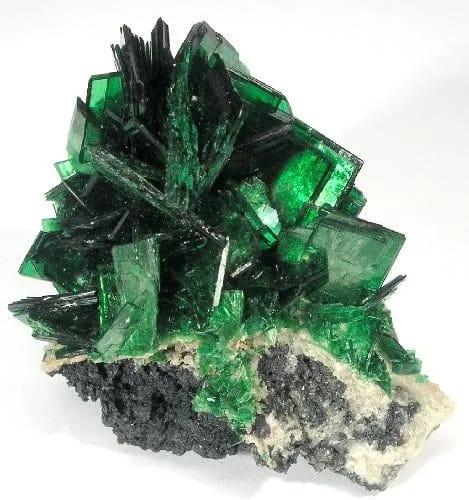
Torbernite (Cu(UO₂)₂(PO₄)₂·8–12H₂O) is the copper-uranyl phosphate — the radioactive companion of autunite (Ca-uranyl). Vivid green tabular crystals are diagnostic.
Torbernite (Cu(UO₂)₂(PO₄)₂·8–12H₂O) is the copper-uranyl phosphate — the radioactive companion of autunite (Ca-uranyl). Vivid green tabular crystals are diagnostic. Forms in oxidized cap zones of uranium-bearing pegmatites and granites. Highly radioactive — collector specimens require shielded storage and care.