
Elemental Composition (by mass)
| Element | Mass % | Visual |
|---|---|---|
| As Arsenic | 46.01% | |
| Fe Iron | 34.30% | |
| S Sulfur | 19.69% |
Computed from simplified end-member formula. Solid-solution series, water content, and trace substitutions cause real-world variation.
IMA Abbreviation (Whitney-Evans 2010)
Apy
→ Arsenopyrite
Fe-As sulfide
Standard symbol from American Mineralogist (Whitney & Evans, 2010). Used in thin-section labeling, phase diagrams, and IMA-style species records.
⚠ Safety & Handling
☠toxicmoderate
Iron arsenic sulfide — As releases via abrasion.
Handling: Wash hands. No grinding.
Information provided in good faith. Consult local hazmat regulations for transport and disposal. Severely hazardous specimens may require special storage cabinets.
Luster
metallic
Tin-white to steel-gray.
Magnetism
Category:
diamagnetic
Test result:
No response
FeAsS; diamagnetic despite Fe.
Test with rare-earth magnet (N42 or N52 neodymium). Suspend specimen on thread for sensitive paramagnetic detection. Diamagnetic minerals are weakly repelled (visible only with strong magnets like bismuth).
Streak Test
dark gray-black
Tin-white metallic; same streak as pyrrhotite.
Streak = color of the powdered mineral. Drag specimen across unglazed white porcelain plate (Mohs 6.5). For minerals harder than the plate, crush a small flake into powder and observe color.
Collector tier: Solid Display
Reliable mid-tier display species. Easy to find in well-formed examples; broad locality diversity.
Mohs 5.5-6
Vickers (~) 820 HV
Knoop (~) 870 HK
Nickel–Strunz
2.EB.20Dana
02.12.04.01Element composition by mass
Formula: FeAsS · molar mass: 162.83 g/mol
| As | 46.01% | |
| Fe | 34.3% | |
| S | 19.69% |
Computed from atomic weights (IUPAC 2021). Site-occupancy groups (Fe,Mn) split equally.
Mohs Hardness
5.5-6
Arsenopyrite sits at 5.5-6 on the Mohs scale — just hard enough to scratch glass.
Colors:
Streak
Black
Black
Crystal system
Monoclinic
Monoclinic
Pronunciation/ˌɑːrsɛnoʊˈpaɪraɪt/
Sulfides & SulfosaltsSulfides – Sulfarsenides
TL;DR · 1 min read
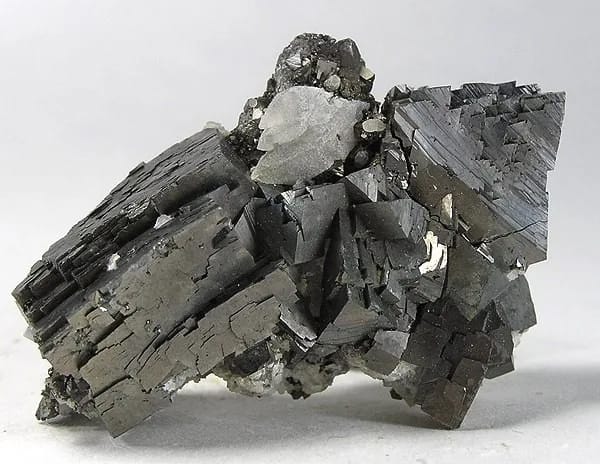
Arsenopyrite is the principal ore of arsenic and one of the great supporting species of the Hunan tungsten-fluorite belt. Sharp silvery prisms – needle-thin or stout, single or in radiating sprays – frequently appear with Yaogangxian fluorite and Xianghualing wolframite.
Arsenopyrite is the principal ore of arsenic and one of the great supporting species of the Hunan tungsten-fluorite belt. Sharp silvery prisms – needle-thin or stout, single or in radiating sprays – frequently appear with Yaogangxian fluorite and Xianghualing wolframite.
The Chinese Angle
Yaogangxian and Xianghualing in Hunan produce sharp arsenopyrite prisms (often 2-8 cm) on milky quartz, frequently in combination with green fluorite cubes. Specimen-grade material from these districts is the international reference for the species.
Cite this entry
APA
MyMineralBox Editorial Team. (2026). Arsenopyrite. My Mineral Box. Retrieved May 23, 2026, from https://mymineralbox.com/mineral-encyclopedia/minerals/arsenopyrite/
MLA
MyMineralBox Editorial Team. "Arsenopyrite." My Mineral Box, 2026, https://mymineralbox.com/mineral-encyclopedia/minerals/arsenopyrite/. Accessed May 23, 2026.
Chicago
MyMineralBox Editorial Team. "Arsenopyrite." My Mineral Box. Last modified May 4, 2026. https://mymineralbox.com/mineral-encyclopedia/minerals/arsenopyrite/.
BibTeX
@misc{mmb_arsenopyrite,
 author = {{MyMineralBox Editorial Team}},
 title = {{Arsenopyrite}},
 year = {2026},
 publisher = {My Mineral Box},
 url = {https://mymineralbox.com/mineral-encyclopedia/minerals/arsenopyrite/},
 urldate = {2026-05-23}
}