Elemental Composition (by mass)
| Element | Mass % | Visual |
|---|---|---|
| O Oxygen | 53.26% | |
| Si Silicon | 46.74% |
Computed from simplified end-member formula. Solid-solution series, water content, and trace substitutions cause real-world variation.
IMA Abbreviation (Whitney-Evans 2010)
Qz
→ Quartz
Variety of quartz
Standard symbol from American Mineralogist (Whitney & Evans, 2010). Used in thin-section labeling, phase diagrams, and IMA-style species records.
Pronunciation
/sɪˈtriːn/
↔ sit-REEN
two syllables; French origin
Birthstone & Anniversary Gift Reference
November (zodiac) — zodiac: Scorpio / Sagittarius
› Full birthstones registry
Luster
vitreous
Same as quartz parent.
Color Cause (Chromophore)
Chromophore:
Fe³⁺ + color center
Mechanism:
thermal alteration of Fe-bearing quartz
Color produced:
yellow
Natural or heat-induced; most market citrine is heated amethyst.
Diaphaneity (Transparency)
transparent
Gem-quality transparent.
Type Locality
—
Source: Variety of quartz
› Browse all type localities
Specific Gravity
2.65
g/cm³
light
Same as quartz.
For comparison: water = 1.00, glass ≈ 2.5, quartz = 2.65, corundum ≈ 4.00, galena ≈ 7.50, gold ≈ 19.3.
Synthetics & Imitations
Lab-grown methods
Hydrothermal 1970
Lab citrine produced by Brazilian doping; standard market alternative is heat-treated amethyst.
Common imitations
Heat-treated amethyst
Most market "citrine" is heated amethyst — same species but heat-altered.
Yellow glass
Lower RI.
Geological Setting
Natural citrine forms in similar settings to amethyst; most market citrine is heated amethyst.
Treatments & Enhancements
Heat-treated amethyst origincommonstable· detection: moderate
Most market citrine is heated amethyst (orange-brown tones). Natural citrine is rarer and more pale yellow.
As a buyer: request written disclosure of treatments and confirm whether the price reflects treated or untreated material.
Characteristic Inclusions
Tigerlike zoninggrowth-pattern★ diagnostic
Heat-treated amethyst-citrine shows zoned coloration; natural citrine is more evenly colored.
★ Diagnostic inclusions are characteristic enough to help identify origin or species under 10× loupe.
Pleochroism (dichroic)
Axis o
light yellow
Axis e
darker yellow
Strength: weak
Very subtle pleochroism; not a key ID feature.
Cleavage & Fracture
Cleavage:
none —
Fracture:
conchoidal
No cleavage; conchoidal fracture as in all quartz.
Market availability: Common
Widely available in most dealer stocks. Specimens span all price tiers.
Collector tier: Solid Display
Reliable mid-tier display species. Easy to find in well-formed examples; broad locality diversity.
Mohs 7
Vickers (~) 1400 HV
Knoop (~) 1100 HK
Element composition by mass
Formula: SiO₂ (quartz var.) · molar mass: 60.08 g/mol
| O | 53.26% | |
| Si | 46.74% |
Computed from atomic weights (IUPAC 2021). Site-occupancy groups (Fe,Mn) split equally.
GroupQuartz Group (silica)
Mohs Hardness
7
Citrine sits at 7 on the Mohs scale — harder than glass; scratches steel.
Colors:
Streak
White
White
Crystal system
Trigonal
Trigonal
Oxides & HydroxidesOxides (Silica Group)
TL;DR · 1 min read
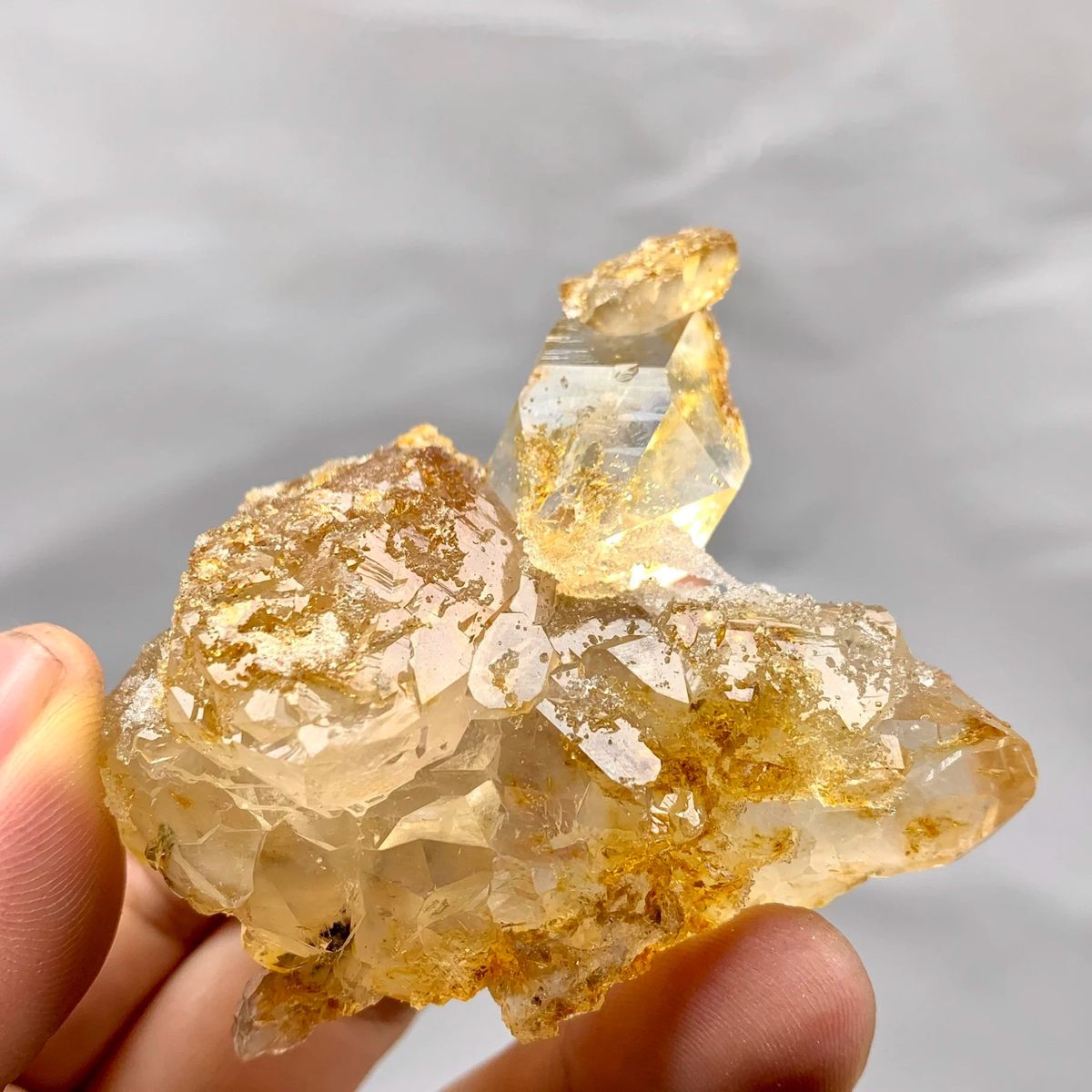
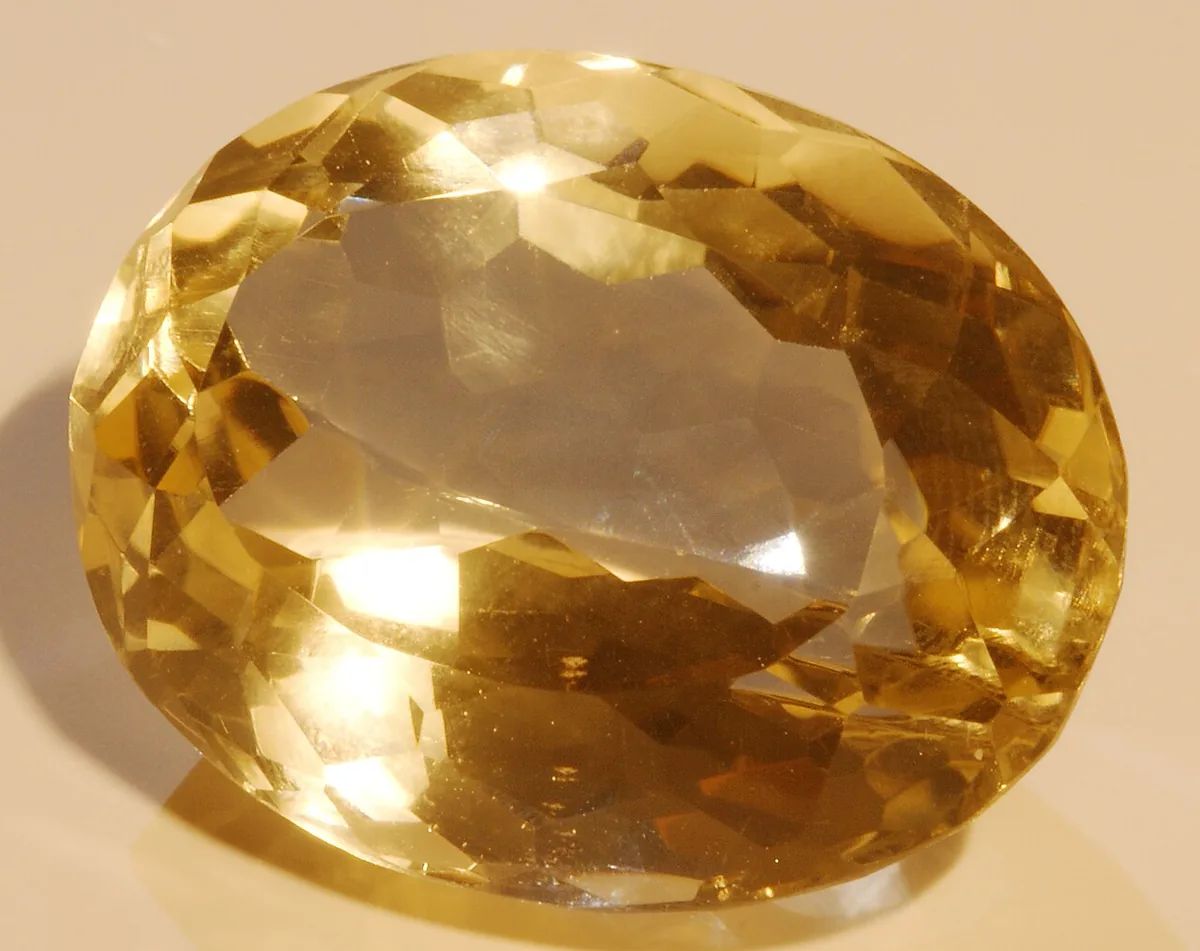
Citrine is the yellow to orange-brown variety of quartz, colored by Al³⁺ + Fe³⁺ + radiation defects. Most commercial citrine is heat-treated amethyst (the natural conversion is rare).
Citrine is the yellow to orange-brown variety of quartz, colored by Al³⁺ + Fe³⁺ + radiation defects. Most commercial citrine is heat-treated amethyst (the natural conversion is rare). Bahia and Minas Gerais (Brazil) produce iconic gem-quality citrine, often in bicolor “ametrine” zoned with amethyst from Bolivia.