
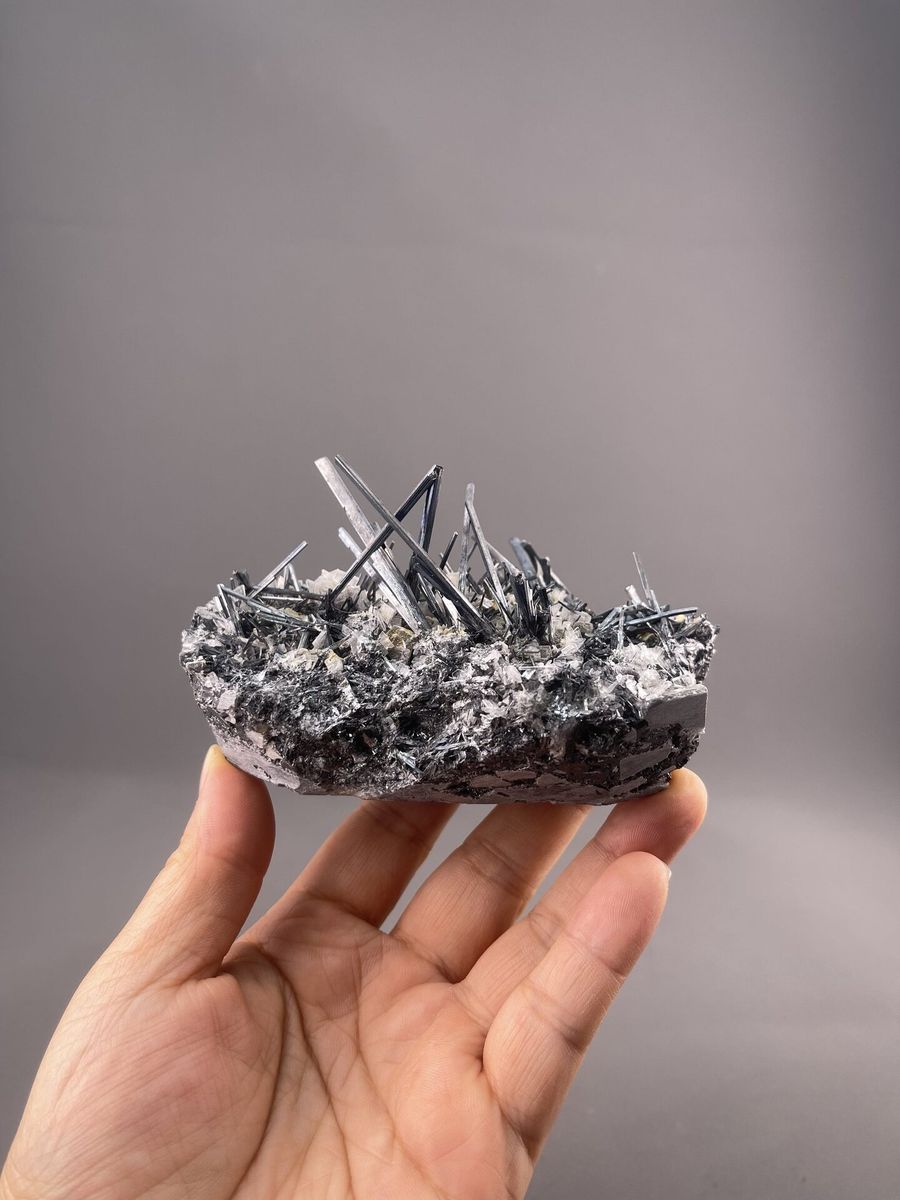
What stibnite is
Stibnite is antimony trisulfide (Sb2S3), the most important ore of antimony. It crystallizes in the orthorhombic system as long prismatic to bladed crystals that are deeply striated along their length, with a brilliant metallic lead-grey luster and a near-black streak.
It is very soft (about 2 on the Mohs scale) and has one perfect cleavage running down the blade, so crystals bend, cleave and snap easily. That fragility is the first thing every stibnite owner learns.
Why China leads the world
The Xikuangshan deposit at Lengshuijiang, Hunan, is one of the world's largest antimony deposits and has supplied antimony for over a century. Its name translates literally as "tin mountain," a historical misnomer — the ore is antimony, not tin.
The Mineralogical Record's Crystalline Treasures reports that major Chinese stibnite from Xikuangshan and Wuling surpassed older Japanese classics in collector reputation. That is a published historical assessment, not a claim that every Hunan specimen outranks every other locality.
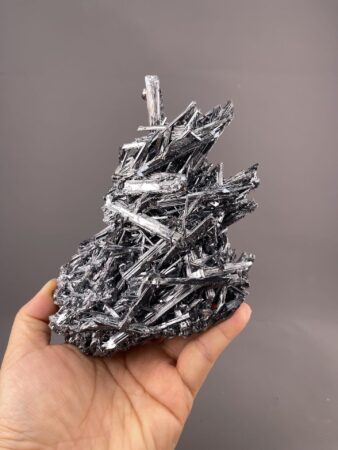
Reading locality labels honestly
One habit separates careful Chinese-stibnite collections from casual ones: matching the label to the real place hierarchy. "Lengshuijiang Mine" on old labels names the county-level city, not a mine — the deposit itself is the Xikuangshan Sb deposit, Lengshuijiang, Loudi, Hunan (older references filed Lengshuijiang under Shaoyang; the current record places it under Loudi).
The honest levels are simple: write <strong>Xikuangshan</strong> only when the original label states it, use <strong>Lengshuijiang, Hunan</strong> for area-level attributions, and fall back to <strong>Hunan, China</strong> when nothing narrower is supported — the province has other stibnite sources, so a bare province label must not borrow Xikuangshan's name. Locality structure follows the mindat records for the Xikuangshan Sb deposit and its stibnite occurrence record.
How to judge a stibnite specimen
Start with the blades: long, undamaged crystals with sharp, complete terminations are far rarer and more valuable than broken or cleaved ones, because the perfect cleavage means tips are usually the first casualty.
Next look at luster — a fresh, bright, mirror-like metallic shine beats a dull or tarnished surface. Aesthetic radiating sprays, good contrast against matrix, and an absence of repairs all add value. Always inspect blade tips and the back of a piece for cleaved or glued breaks.
Associations to look for
Chinese stibnite often perches on or beside milky to clear quartz and white calcite, and sometimes baryte, which set off the metallic blades beautifully.
In the oxidized zone stibnite alters to pale antimony oxides such as valentinite and kermesite; a dusting of these can be attractive but a heavy crust usually means a dulled, weathered specimen.
Handling and care — fragile and easily tarnished
Treat stibnite as one of the most delicate things in your cabinet. It is soft, sectile (it can be cut like soft metal) and brittle, so handle by the matrix, never the blades, and cushion it well in storage.
Keep it dry and out of strong light and humidity; skin oils, acids and prolonged display under hot lights can etch or tarnish the bright surface to a dull grey. Never put stibnite in an ultrasonic cleaner or under running water — dust gently with a soft brush only. See our guide to cleaning mineral specimens.
Stibnite in a Chinese collection
Stibnite is one of the four or five species — alongside fluorite, scheelite and cinnabar — that define modern Chinese mineralogy for collectors. A single fine silver spray makes an unforgettable centerpiece.
Value is driven by blade length and luster, the quality of terminations, overall aesthetics and condition. Even modest pieces are striking, which makes stibnite an accessible entry into Chinese specimens.
Frequently asked questions
Is "Lengshuijiang Mine" a real mine name?
No — Lengshuijiang is the county-level city; the deposit is the Xikuangshan antimony deposit near it. Honest labels use Xikuangshan only when the original label states it, Lengshuijiang, Hunan for area-level attributions, and Hunan, China when nothing narrower is supported.
What is stibnite used for?
Stibnite (Sb2S3) is the principal ore of antimony, a metal used in flame retardants, lead-acid batteries, and alloys. Fine crystallized specimens are also prized by collectors.
Where does the best stibnite come from?
China is the leading source of fine collector stibnite, above all the Xikuangshan field at Lengshuijiang in Hunan Province — the largest antimony deposit in the world. Japan's Ichinokawa mine produced legendary historic blades.
Is stibnite safe to handle?
Handle it with normal care and wash your hands afterward, as it is an antimony compound. The bigger practical risk is to the specimen, not you — the blades are soft and fragile and tarnish from skin oils.
Why have my stibnite blades gone dull?
Bright stibnite tarnishes over time from humidity, skin contact and strong light. Keep it dry, cool and lightly shaded; once etched, the original mirror luster cannot be restored.