
⏳ Long-term Aging & Care Timeline
efflorescenceyears
Trigger: humidity cycles
Intervention: Pink Co arsenate; surface powder may develop. Sealed case.
Streak Test
pale red / pink
"Cobalt bloom" — pink streak of hydrated Co arsenate.
Streak = color of the powdered mineral. Drag specimen across unglazed white porcelain plate (Mohs 6.5). For minerals harder than the plate, crush a small flake into powder and observe color.
Mohs 1.5–2.5
Vickers (~) 75 HV
Knoop (~) 85 HK
Element composition by mass
Formula: Co₃(AsO₄)₂·8H₂O · molar mass: 472.65 g/mol
| Co | 37.41% | |
| As | 31.7% | |
| O | 30.46% | |
| H | 0.43% |
Computed from atomic weights (IUPAC 2021). Site-occupancy groups (Fe,Mn) split equally.
Mohs Hardness
1.5–2.5
Erythrite sits at 1.5–2.5 on the Mohs scale — soft enough to be scratched by a fingernail.
Colors:
Streak
Pale red
Pale red
Crystal system
Monoclinic
Monoclinic
Phosphates / ArsenatesArsenates
TL;DR · 1 min read
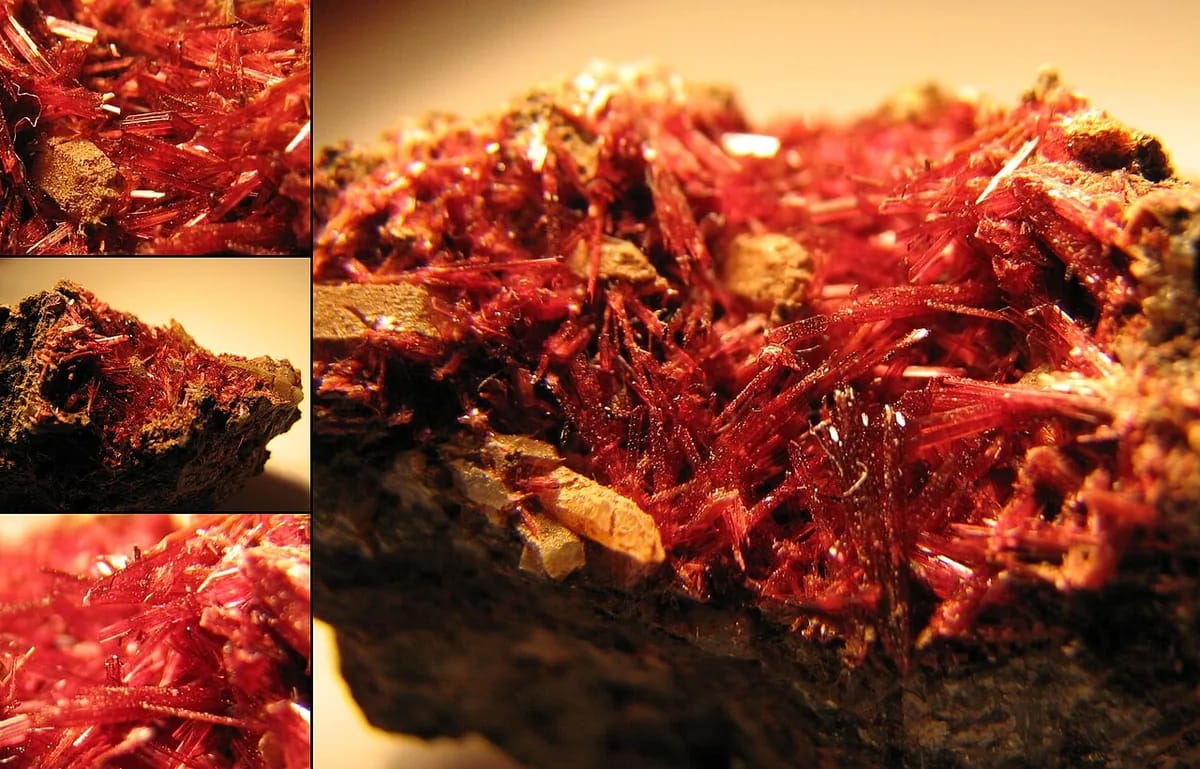
Erythrite (Co₃(AsO₄)₂·8H₂O) is a hydrous cobalt arsenate — the secondary "cobalt bloom" alteration product of primary cobalt arsenide ores (skutterudite, cobaltite). Its diagnostic crimson-pink to magenta color is unmistakable.
Erythrite (Co₃(AsO₄)₂·8H₂O) is a hydrous cobalt arsenate — the secondary “cobalt bloom” alteration product of primary cobalt arsenide ores (skutterudite, cobaltite). Its diagnostic crimson-pink to magenta color is unmistakable. Bou Azzer (Morocco) and Schneeberg (Germany) supply iconic specimens. Toxic — handle with gloves due to soluble arsenic content.
More minerals to explore
Adamite (橄榄铜砷石)
Orthorhombic
Olivenite (橄榄铜矿)
Monoclinic