
Elemental Composition (by mass)
| Element | Mass % | Visual |
|---|---|---|
| Zn Zinc | 52.14% | |
| O Oxygen | 38.28% | |
| C Carbon | 9.58% |
Computed from simplified end-member formula. Solid-solution series, water content, and trace substitutions cause real-world variation.
IMA Abbreviation (Whitney-Evans 2010)
Smt
→ Smithsonite
Zn carbonate
Standard symbol from American Mineralogist (Whitney & Evans, 2010). Used in thin-section labeling, phase diagrams, and IMA-style species records.
Pronunciation
/ˈsmɪθsənaɪt/
↔ SMITH-suh-nite
for J. Smithson
Collector tier: Solid Display
Reliable mid-tier display species. Easy to find in well-formed examples; broad locality diversity.
Mohs 4–4.5
Vickers (~) 200 HV
Knoop (~) 220 HK
Nickel–Strunz
5.AB.05Dana
14.01.01.07Element composition by mass
Formula: ZnCO₃ · molar mass: 125.39 g/mol
| Zn | 52.14% | |
| O | 38.28% | |
| C | 9.58% |
Computed from atomic weights (IUPAC 2021). Site-occupancy groups (Fe,Mn) split equally.
Mohs Hardness
4–4.5
Smithsonite sits at 4–4.5 on the Mohs scale — can be scratched by a steel knife.
Colors:
Streak
White
White
Crystal system
Trigonal
Trigonal
Type localityKelmis, Belgium / Tsumeb, Namibia
CarbonatesCarbonates
TL;DR · 1 min read
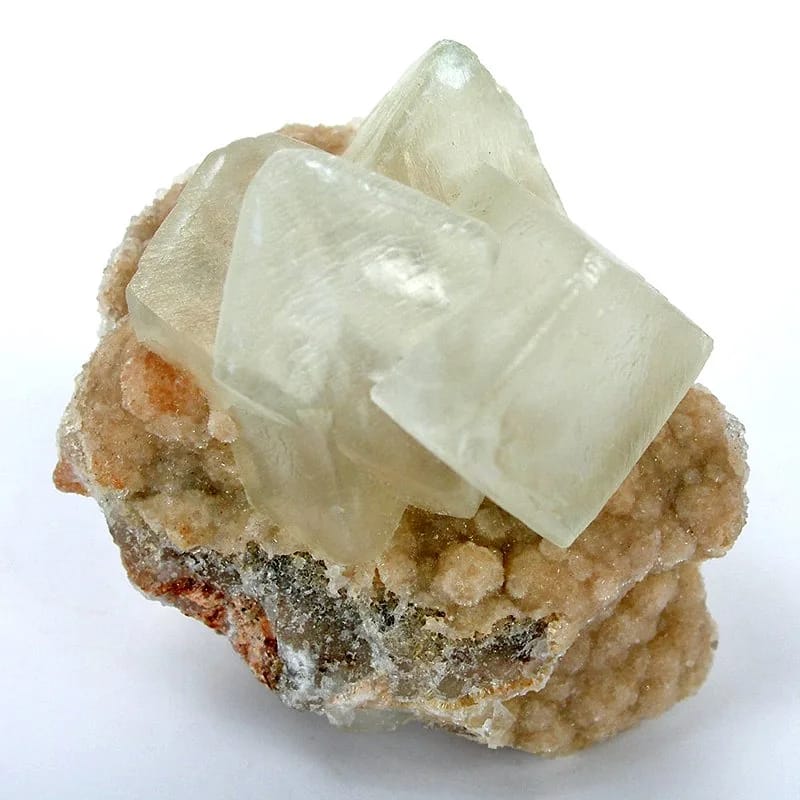
Smithsonite (ZnCO₃) is a secondary zinc carbonate that forms in the oxidized cap of zinc-lead deposits. It is famous for botryoidal, grape-like crystal habits in saturated colors — apple green, sky blue, lavender pink, and lemon yellow.
Smithsonite (ZnCO₃) is a secondary zinc carbonate that forms in the oxidized cap of zinc-lead deposits. It is famous for botryoidal, grape-like crystal habits in saturated colors — apple green, sky blue, lavender pink, and lemon yellow. Yunnan and Guangxi host significant Chinese deposits.
Notable Chinese Localities
Yunnan and Guangxi host pink and blue-green smithsonite. Hunan yields grayish-blue botryoidal specimens.
Cite this entry
APA
MyMineralBox Editorial Team. (2026). Smithsonite. My Mineral Box. Retrieved May 23, 2026, from https://mymineralbox.com/mineral-encyclopedia/minerals/smithsonite/
MLA
MyMineralBox Editorial Team. "Smithsonite." My Mineral Box, 2026, https://mymineralbox.com/mineral-encyclopedia/minerals/smithsonite/. Accessed May 23, 2026.
Chicago
MyMineralBox Editorial Team. "Smithsonite." My Mineral Box. Last modified May 4, 2026. https://mymineralbox.com/mineral-encyclopedia/minerals/smithsonite/.
BibTeX
@misc{mmb_smithsonite,
 author = {{MyMineralBox Editorial Team}},
 title = {{Smithsonite}},
 year = {2026},
 publisher = {My Mineral Box},
 url = {https://mymineralbox.com/mineral-encyclopedia/minerals/smithsonite/},
 urldate = {2026-05-23}
}