Crystal Structure
Li end-member of tourmaline.
Elemental Composition (by mass)
| Element | Mass % | Visual |
|---|---|---|
| O Oxygen | 49.38% | |
| Al Aluminum | 21.59% | |
| Si Silicon | 19.26% | |
| B Boron | 3.71% | |
| Na Sodium | 2.63% | |
| F Fluorine | 2.17% | |
| Li Lithium | 0.79% | |
| H Hydrogen | 0.46% |
Computed from simplified end-member formula. Solid-solution series, water content, and trace substitutions cause real-world variation.
IMA Abbreviation (Whitney-Evans 2010)
Elb
→ Elbaite
Li-tourmaline
Standard symbol from American Mineralogist (Whitney & Evans, 2010). Used in thin-section labeling, phase diagrams, and IMA-style species records.
Pronunciation
/ˈɛlbaɪt/
↔ EL-bite
named for Elba Island
Diaphaneity (Transparency)
transparent
Gem-grade Li-tourmaline.
Type Locality
Elba Island — Italy
Described 1913 by Vernadsky
› Browse all type localities
Specific Gravity
2.90–3.10
g/cm³
medium
Li-rich; lowest SG tourmaline.
For comparison: water = 1.00, glass ≈ 2.5, quartz = 2.65, corundum ≈ 4.00, galena ≈ 7.50, gold ≈ 19.3.
Mohs 7–7.5
Vickers (~) 1400 HV
Knoop (~) 1100 HK
Geological setting
Pegmatite
Element composition by mass
Formula: Na(Li,Al)₃Al₆(BO₃)₃Si₆O₁₈(OH)₄ · molar mass: 936.71 g/mol
| O | 52.95% | |
| Al | 21.6% | |
| Si | 17.99% | |
| B | 3.46% | |
| Na | 2.45% | |
| Li | 1.11% | |
| H | 0.43% |
Computed from atomic weights (IUPAC 2021). Site-occupancy groups (Fe,Mn) split equally.
Mohs Hardness
7–7.5
Elbaite sits at 7–7.5 on the Mohs scale — harder than glass; scratches steel.
Colors:
Streak
White
White
Crystal system
Trigonal
Trigonal
SilicatesSilicates (Cyclosilicates)
TL;DR · 1 min read
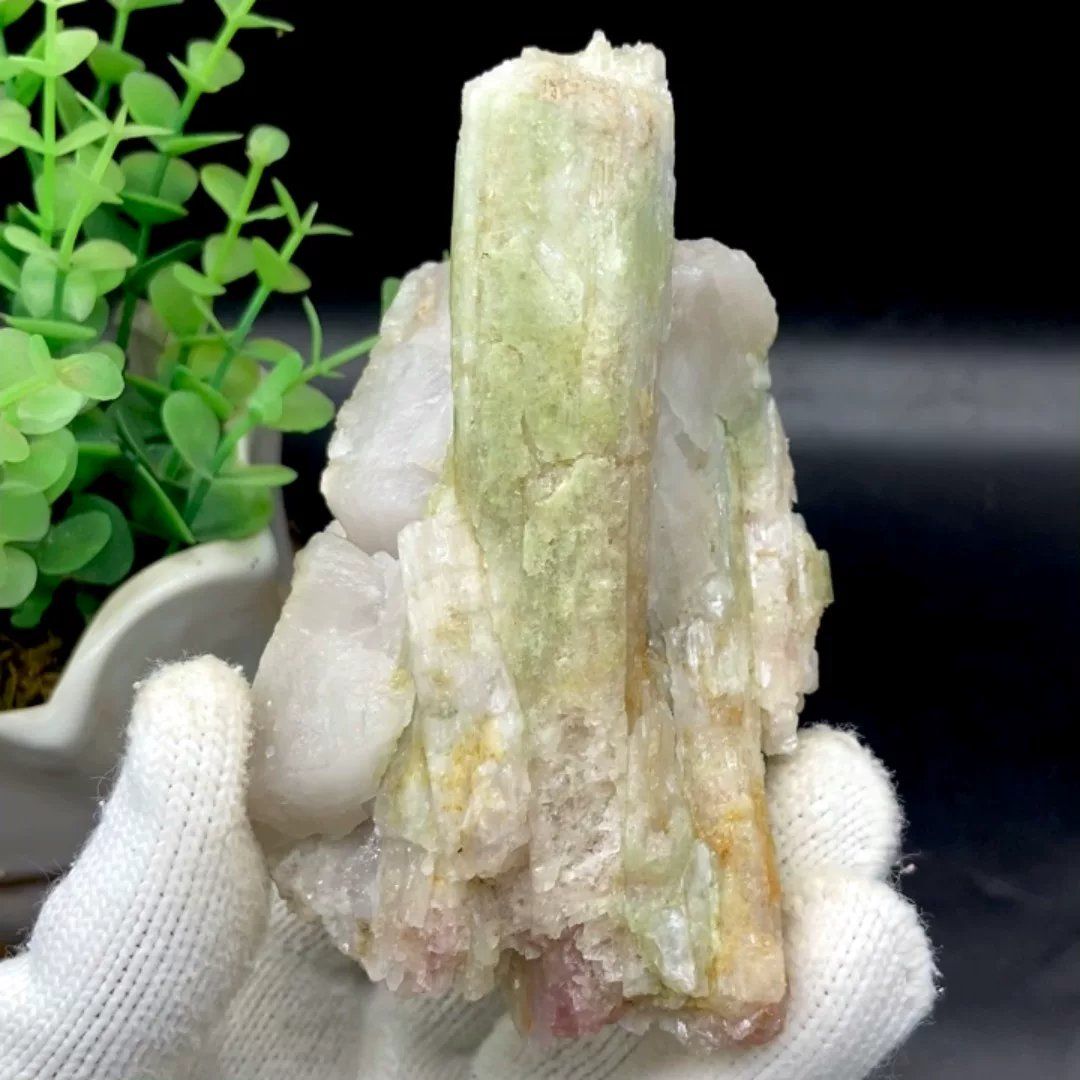
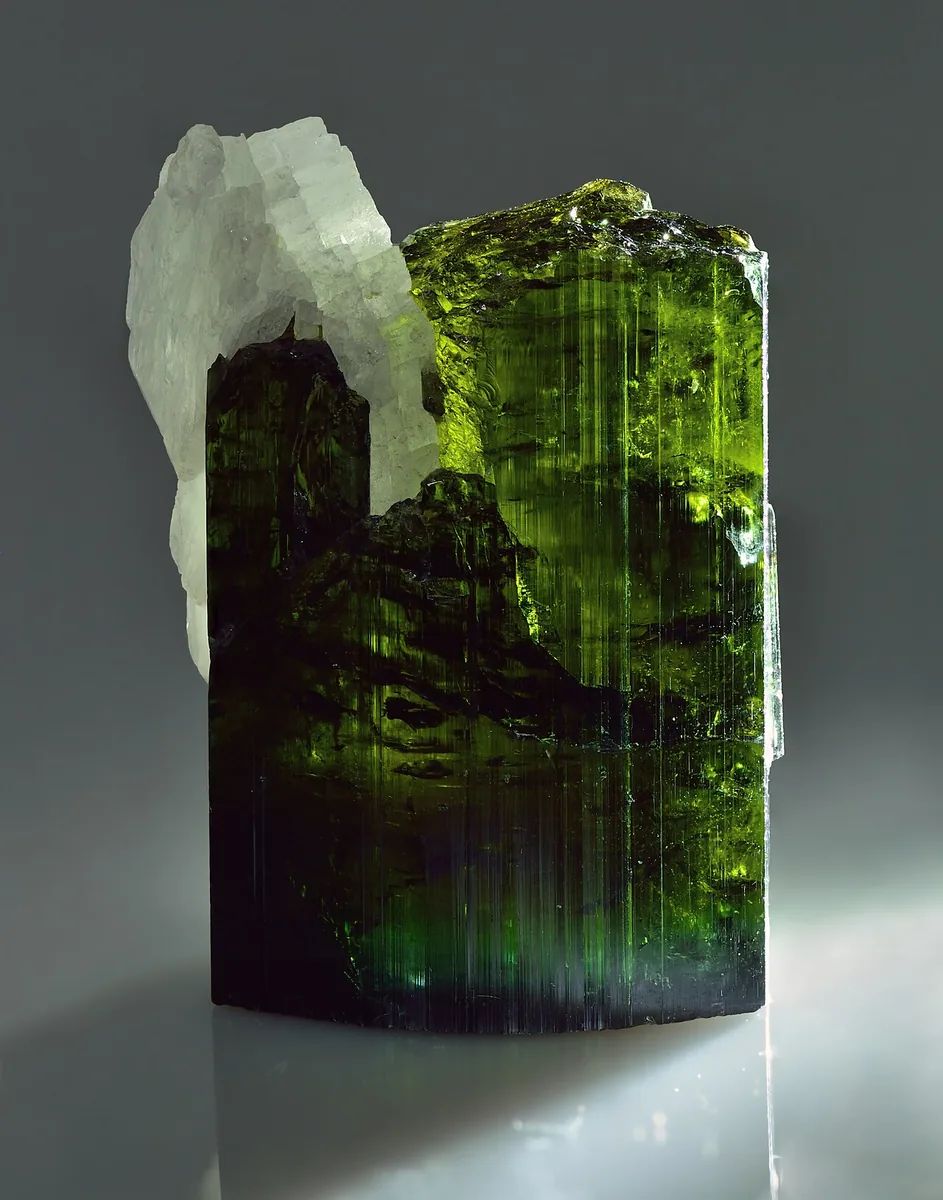
Elbaite (Na(Li,Al)₃Al₆(BO₃)₃Si₆O₁₈(OH)₄) is the lithium-bearing end-member of the tourmaline group and the species responsible for the iconic gem-color tourmalines. Different trace elements produce strikingly different varieties: rubellite (red-pink, manganese), indicolite (blue, iron), verdelite (green, iron+chrome), watermelon (zoned pink-green), and Paraíba (electric blue-green, copper).
Elbaite (Na(Li,Al)₃Al₆(BO₃)₃Si₆O₁₈(OH)₄) is the lithium-bearing end-member of the tourmaline group and the species responsible for the iconic gem-color tourmalines. Different trace elements produce strikingly different varieties: rubellite (red-pink, manganese), indicolite (blue, iron), verdelite (green, iron+chrome), watermelon (zoned pink-green), and Paraíba (electric blue-green, copper). Elbaite is named for Elba, Italy — its type locality.
More minerals to explore
Beryl (绿柱石)
Hexagonal
Dravite (镁电气石)
Trigonal
Uvite (钙镁电气石)
Trigonal
Benitoite (蓝锥矿)
Hexagonal
Sugilite (舒俱徕石)
Hexagonal
Dioptase (透视石)
Trigonal
Other Members of the Tourmaline Group
电气石族