
Elbaite

Crystal system · Trigonal

Elbaite is a silicate mineral prized by collectors for its exceptional color range, with known Chinese sources.

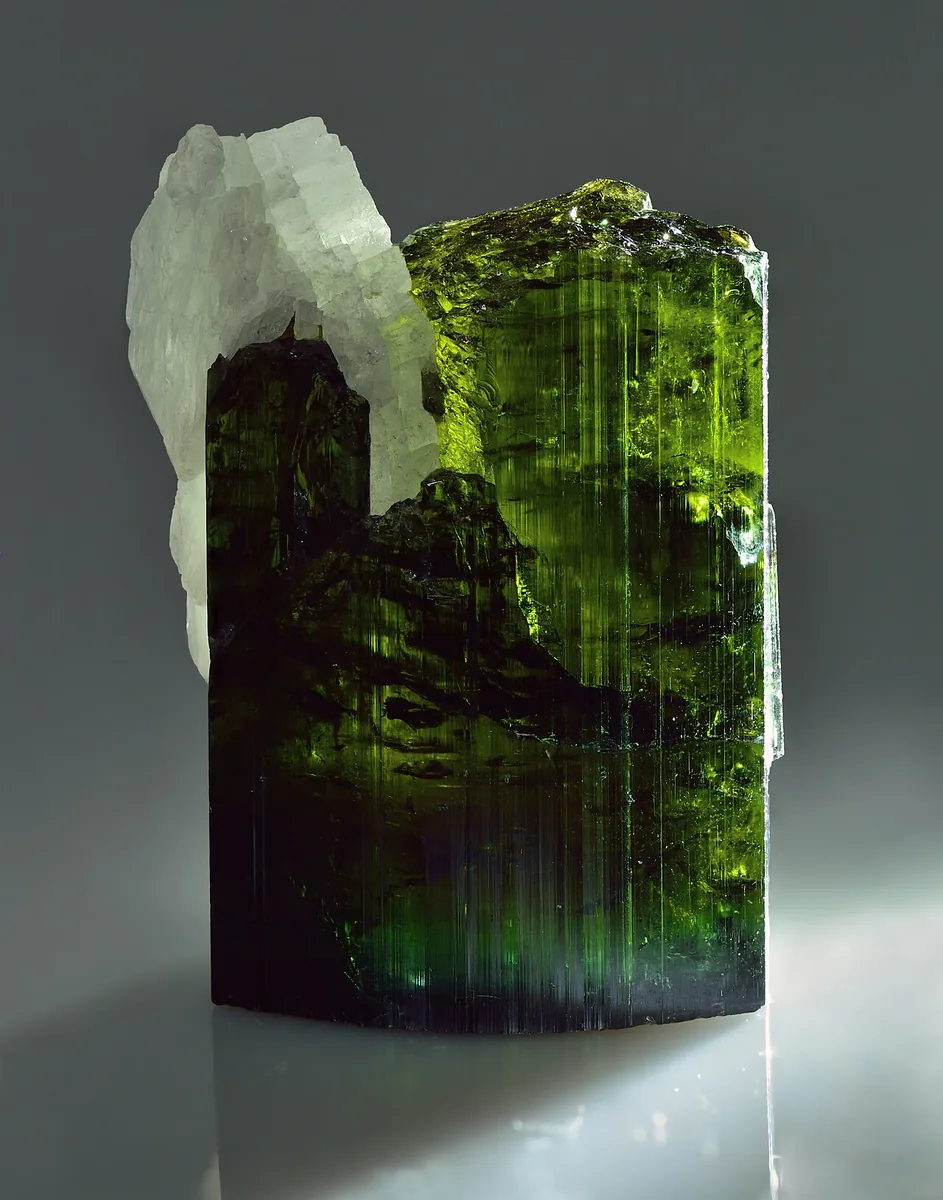
Elbaite specimen
Photo: Ivar Leidus · CC BY-SA 4.0 via Wikimedia Commons

About Elbaiteextended article

Crystal Structure
Li end-member of tourmaline.
Elemental Composition (by mass)
ElementMass %Visual
O Oxygen49.38%
Al Aluminum21.59%
Si Silicon19.26%
B Boron3.71%
Na Sodium2.63%
F Fluorine2.17%
Li Lithium0.79%
H Hydrogen0.46%
Computed from simplified end-member formula. Solid-solution series, water content, and trace substitutions cause real-world variation.
IMA Abbreviation (Whitney-Evans 2010)
Elb
→ Elbaite
Li-tourmaline
Standard symbol from American Mineralogist (Whitney & Evans, 2010). Used in thin-section labeling, phase diagrams, and IMA-style species records.
Pronunciation
/ˈɛlbaɪt/
EL-bite
named for Elba Island
Diaphaneity (Transparency)
transparent
Gem-grade Li-tourmaline.
Type Locality
Elba Island — Italy
Described 1913 by Vernadsky
Specific Gravity
2.90–3.10
g/cm³
medium
Li-rich; lowest SG tourmaline.
For comparison: water = 1.00, glass ≈ 2.5, quartz = 2.65, corundum ≈ 4.00, galena ≈ 7.50, gold ≈ 19.3.
Mohs 7–7.5
Vickers (~) 1400 HV
Knoop (~) 1100 HK
Geological setting
Pegmatite
Element composition by mass

Formula: Na(Li,Al)₃Al₆(BO₃)₃Si₆O₁₈(OH)₄ · molar mass: 936.71 g/mol

O 52.95%
Al 21.6%
Si 17.99%
B 3.46%
Na 2.45%
Li 1.11%
H 0.43%

Computed from atomic weights (IUPAC 2021). Site-occupancy groups (Fe,Mn) split equally.

GroupTourmaline Group
Related members: Schorl · Dravite
Mohs Hardness 7–7.5

Elbaite sits at 7–7.5 on the Mohs scale — harder than glass; scratches steel.

Colors:
Streak
White
Crystal system
Trigonal
SilicatesSilicates (Cyclosilicates)
TL;DR · 1 min read
Elbaite (Na(Li,Al)₃Al₆(BO₃)₃Si₆O₁₈(OH)₄) is the lithium-bearing end-member of the tourmaline group and the species responsible for the iconic gem-color tourmalines. Different trace elements produce strikingly different varieties: rubellite (red-pink, manganese), indicolite (blue, iron), verdelite (green, iron+chrome), watermelon (zoned pink-green), and Paraíba (electric blue-green, copper).

Elbaite (Na(Li,Al)₃Al₆(BO₃)₃Si₆O₁₈(OH)₄) is the lithium-bearing end-member of the tourmaline group and the species responsible for the iconic gem-color tourmalines. Different trace elements produce strikingly different varieties: rubellite (red-pink, manganese), indicolite (blue, iron), verdelite (green, iron+chrome), watermelon (zoned pink-green), and Paraíba (electric blue-green, copper). Elbaite is named for Elba, Italy — its type locality.

More minerals to explore

Other Members of the Tourmaline Group

电气石族

About Elbaite

Elbaite is a silicate mineral in the tourmaline group and has the chemical formula Na(Li₁.₅Al₁.₅)Al₆(Si₆O₁₈)(BO₃)₃(OH)₄. It crystallizes in the trigonal system and is one of the most visually varied minerals in the collector market. Its combination of structural character and global distribution make it a recognized species in both systematic and aesthetic collections.

Identification & care

Specimens usually show prismatic hexagonal, striated longitudinally; terminated with small rhombohedral or pyramidal faces. Its color range is broad, including all colors: blue (indicolite), green (verdelite), red/pink (rubellite), bicolor, watermelon (pink core + green rim), and colorless (achroite). The luster is vitreous, the streak is white, and specimens range from transparent to translucent. The fracture is conchoidal, which is one of its key identifying features.

Collector context

How it forms

In terms of geology, Elbaite forms in li-al-rich granitic pegmatites; hydrothermal veins in granitic rocks. It is commonly found in association with lepidolite, spodumene, cleavelandite, beryl, topaz.

Classic Chinese localities

Elbaite is widely represented across Chinese provinces, including Yunnan, Sichuan, Henan, Jiangxi.

Why collectors care

Collectors pursue Elbaite for the clarity of its crystal form and, in good material, saturated color that reads instantly across a display case. A well-terminated elbaite on clean matrix photographs well, identifies quickly, and anchors a cabinet piece. Top Chinese specimens over the last two decades have reset the bar for what elbaite looks like at collector grade.

What affects value

Value in Elbaite is assessed, in typical order of weight, against: (1) locality provenance; (2) size relative to the species norm; (3) crystal form and termination sharpness; (4) color saturation and zoning; (5) transparency and internal clarity; (6) matrix quality and aesthetic balance; (7) condition (absence of damage, chips, or repair). Cleaning quality and verified locality documentation act as multipliers across the above.

Naming history

The name Elbaite has a specific etymological and historical context — see Mindat's reference entry for provenance details. We have retained naming data at the record level; published prose is paraphrased from factual fields rather than copied from source.

Frequently asked questions

What is Elbaite?

Elbaite is a silicate mineral prized by collectors for its exceptional color range, with known Chinese sources.

What is the chemical formula of Elbaite?

The chemical formula of Elbaite is NaLiAl7B3Si6O27H4F.

What crystal system does Elbaite belong to?

Elbaite crystallises in the Trigonal crystal system.

References & databases

Mindat.org is the world’s largest open mineralogy database. Our descriptions are written independently and fact-checked.