Computed from simplified end-member formula. Solid-solution series, water content, and trace substitutions cause real-world variation.
IMA Abbreviation (Whitney-Evans 2010)
Mol
→ Molybdenite
Mo sulfide
Standard symbol from American Mineralogist (Whitney & Evans, 2010). Used in thin-section labeling, phase diagrams, and IMA-style species records.
Pronunciation
/məˈlɪbdənaɪt/
↔ muh-LIB-duh-nite
Greek molybdos (lead-like)
Tenacity
Behavior:
flexible (sheets)
Under stress:
Sheets bend
Like graphite.
Luster
metallic
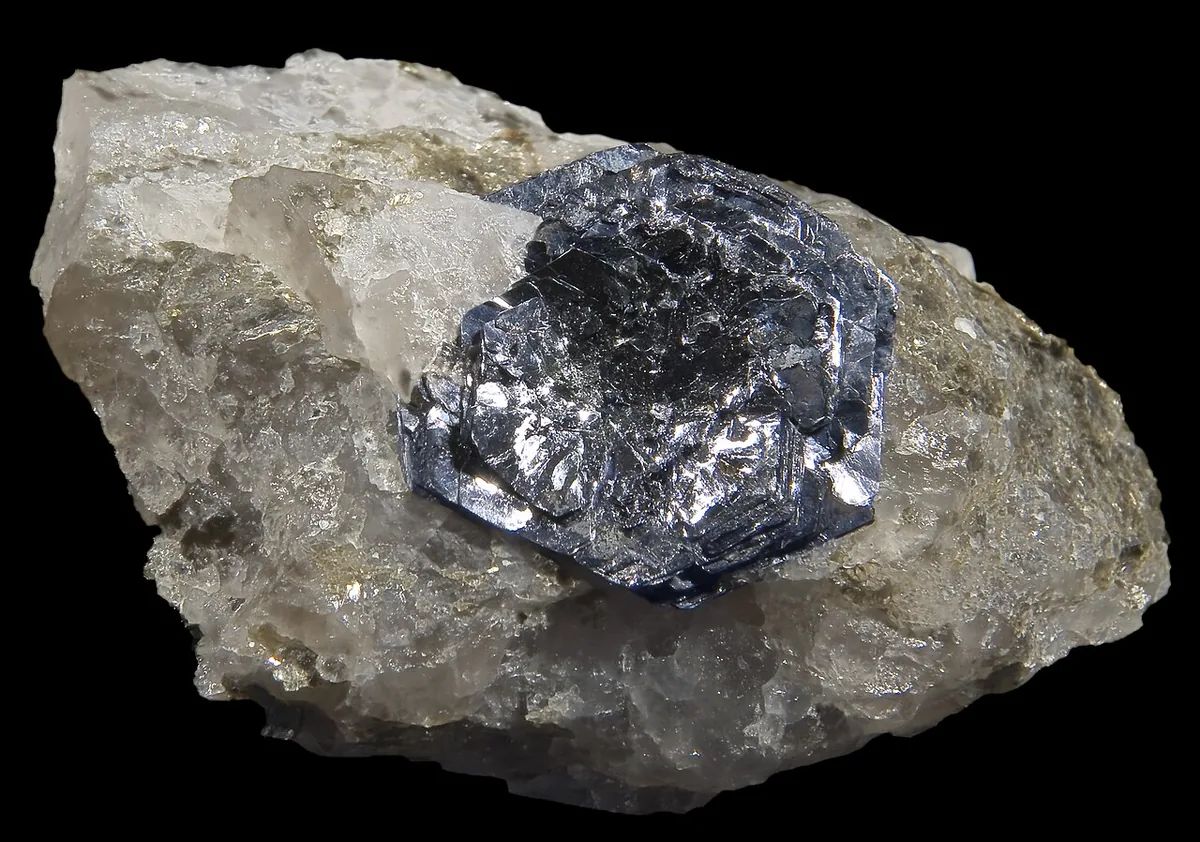
Blue-gray metallic, like graphite but bluer.
Diaphaneity (Transparency)
opaque
Blue-gray metallic.
Streak Test
bluish gray
Distinguishes from graphite (blacker streak) — important for mineral ID.
Streak = color of the powdered mineral. Drag specimen across unglazed white porcelain plate (Mohs 6.5). For minerals harder than the plate, crush a small flake into powder and observe color.
🟡
Market availability: Uncommon
Found at major shows and select dealers. Quality varies by locality.
🪨
Collector tier: Solid Display
Reliable mid-tier display species. Easy to find in well-formed examples; broad locality diversity.
Mohs1–1.5
Vickers (~)1 HV
Knoop (~)32 HK
Nickel–Strunz2.EA.30
Dana02.12.07.01
Geological setting
♨Hydrothermal
Element composition by mass
Formula: MoS₂ · molar mass: 160.07 g/mol
Mo
59.94%
S
40.06%
Computed from atomic weights (IUPAC 2021). Site-occupancy groups (Fe,Mn) split equally.
Molybdenite sits at 1–1.5 on the Mohs scale —
soft enough to be scratched by a fingernail.
Colors:
Streak Bluish-gray, greenish-gray on paper
Crystal system Hexagonal
Type localityBispberg, Dalarna, Sweden
Sulfides & SulfosaltsSulfides
TL;DR · 1 min read
Molybdenite (MoS₂) is the principal ore of molybdenum and one of the softest and most slippery sulfide minerals — its hexagonal layered structure produces a graphite-like feel and a metallic blue-gray sheen. While most molybdenite ends up in industrial hardening alloys, collector specimens with sharp hexagonal tabular crystals are prized, particularly from porphyry copper byproduct mines such as Dexing (Jiangxi) and Climax (Colorado).
Molybdenite (MoS₂) is the principal ore of molybdenum and one of the softest and most slippery sulfide minerals — its hexagonal layered structure produces a graphite-like feel and a metallic blue-gray sheen. While most molybdenite ends up in industrial hardening alloys, collector specimens with sharp hexagonal tabular crystals are prized, particularly from porphyry copper byproduct mines such as Dexing (Jiangxi) and Climax (Colorado).
Notable Chinese Localities
The Dexing Copper Mine (Jiangxi) is a major Chinese source — molybdenite occurs as a porphyry-copper byproduct, completing the Cu-Mo-Au chemistry of the deposit. Yangchaiyu (Shaanxi) and Jinduicheng (Shaanxi) host major Mo-only mines with collector-grade tabular crystals.
Cite this entry
APA
MyMineralBox Editorial Team. (2026). Molybdenite. My Mineral Box. Retrieved May 23, 2026, from https://mymineralbox.com/mineral-encyclopedia/minerals/molybdenite/
MLA
MyMineralBox Editorial Team. "Molybdenite." My Mineral Box, 2026, https://mymineralbox.com/mineral-encyclopedia/minerals/molybdenite/. Accessed May 23, 2026.
Chicago
MyMineralBox Editorial Team. "Molybdenite." My Mineral Box. Last modified May 4, 2026. https://mymineralbox.com/mineral-encyclopedia/minerals/molybdenite/.
BibTeX
@misc{mmb_molybdenite,
 author = {{MyMineralBox Editorial Team}},
 title = {{Molybdenite}},
 year = {2026},
 publisher = {My Mineral Box},
 url = {https://mymineralbox.com/mineral-encyclopedia/minerals/molybdenite/},
 urldate = {2026-05-23}
}
About Molybdenite
Molybdenite belongs to the sulfide class in the molybdenite group and has the chemical formula MoS2. It crystallizes in the trigonal system and is relatively soft, requiring careful handling. Its combination of structural character and global distribution make it a recognized species in both systematic and aesthetic collections.
Identification & care
Molybdenite typically forms foliated, scaly, platy hexagonal flakes; massive; lamellar; disseminated. Its color is typically lead gray with bluish tint. The luster is metallic, the streak is greenish gray (on paper — leaves a gray-green mark, diagnostic!), and specimens are typically opaque. The cleavage is perfect on {0001} — eminent basal cleavage. The fracture is not applicable (cleavage dominates), which aids identification.
Collector context
How it forms
The geological setting for Molybdenite is typically pneumatolytic and hydrothermal veins; contact metamorphic zones (greisens); disseminated in porphyry molybdenum and porphyry copper-molybdenum deposits. It is commonly found in association with quartz, wolframite, scheelite, pyrite, fluorite, topaz, chalcopyrite.
Classic Chinese localities
Dexing Cu-Mo-Au ore field is an important Chinese source for the species.
Why collectors care
Molybdenite is among the most visually dramatic sulfides and native metals a collector can own. Bright metallic faces, sharp crystal geometry, and good matrix contrast make a single well-selected piece carry an entire cabinet; luster integrity and termination sharpness ultimately define its collector value.
What affects value
Value in Molybdenite is assessed, in typical order of weight, against: (1) locality provenance; (2) crystal size; (3) termination quality and crystal completeness; (4) metallic luster integrity (absence of tarnish); (5) crystal habit elegance (parallel, radiating, or bladed); (6) matrix contrast and aesthetic balance; (7) condition and absence of re-attached crystals. Verified locality documentation and absence of cleaning residue act as strong multipliers across the above.
Frequently asked questions
What is Molybdenite?
Molybdenite has the chemical formula MoS2, crystallises in the Hexagonal system, has a Mohs hardness of 1–1.5. Molybdenite is a sulfide mineral known for its striking metallic crystals, with several world-class Chinese localities.
What is the chemical formula of Molybdenite?
The chemical formula of Molybdenite is MoS2.
What crystal system does Molybdenite belong to?
Molybdenite crystallises in the Hexagonal crystal system.
Where is Molybdenite found?
Notable localities for Molybdenite include Dexing Mine.
Is Molybdenite rare?
As a collector mineral, Molybdenite is generally considered uncommon.
Our inventory is one-of-a-kind and turns over quickly. Tell us what you're after — species, size, budget — and we'll notify you when a matching Molybdenite arrives from our sourcing network.
We use a small set of cookies (analytics, checkout, chat) to keep the site working and understand how visitors use it. Checkout-essential cookies are always loaded. Privacy policy