
Elemental Composition (by mass)
| Element | Mass % | Visual |
|---|---|---|
| O Oxygen | 37.48% | |
| Mn Manganese | 34.32% | |
| Si Silicon | 21.93% | |
| Ca Calcium | 6.26% |
Computed from simplified end-member formula. Solid-solution series, water content, and trace substitutions cause real-world variation.
Pronunciation
/ˈroʊdənaɪt/
↔ ROH-duh-nite
Greek "rose"
Lapidary & Faceting Recommendations
Recommended cut:
cabochon
Also seen:
free-form
Typical yield:
60% of rough
Pink with black Mn-oxide veining cabbed to display.
UV Fluorescence
SW (254 nm)
—
none
LW (365 nm)
—
none
Mn pyroxenoid — inert.
SW = shortwave (germicidal lamp). LW = longwave (blacklight). Response varies with locality, trace impurities, and treatment.
Tenacity
Behavior:
brittle
Under stress:
Cleaves
Pyroxenoid; cleaves but brittle.
Luster
vitreous
Bright pink-red vitreous.
Color Cause (Chromophore)
Chromophore:
Mn²⁺
Mechanism:
idiochromatic
Color produced:
pink
Mn-rich pyroxenoid.
Type Locality
Ural Mountains — Russia
Described 1819 by Jasche
› Browse all type localities
Magnetism
Category:
weakly paramagnetic
Test result:
Detectable
Mn-rich pyroxenoid.
Test with rare-earth magnet (N42 or N52 neodymium). Suspend specimen on thread for sensitive paramagnetic detection. Diamagnetic minerals are weakly repelled (visible only with strong magnets like bismuth).
Specific Gravity
3.40–3.76
g/cm³
medium
Pink Mn silicate.
For comparison: water = 1.00, glass ≈ 2.5, quartz = 2.65, corundum ≈ 4.00, galena ≈ 7.50, gold ≈ 19.3.
Streak Test
white
White streak — distinguishes pink rhodonite from rhodochrosite (also white) by hardness.
Streak = color of the powdered mineral. Drag specimen across unglazed white porcelain plate (Mohs 6.5). For minerals harder than the plate, crush a small flake into powder and observe color.
Cleavage & Fracture
Cleavage:
good 2 directions ~90°
Fracture:
conchoidal
Pyroxene-like cleavage.
Market availability: Uncommon
Found at major shows and select dealers. Quality varies by locality.
Collector tier: Solid Display
Reliable mid-tier display species. Easy to find in well-formed examples; broad locality diversity.
Mohs 5.5–6.5
Vickers (~) 820 HV
Knoop (~) 870 HK
Geological setting
MetamorphicSedimentary
Element composition by mass
Formula: CaMn₃Mn[Si₅O₁₅] · molar mass: 640.24 g/mol
| O | 37.48% | |
| Mn | 34.32% | |
| Si | 21.93% | |
| Ca | 6.26% |
Computed from atomic weights (IUPAC 2021). Site-occupancy groups (Fe,Mn) split equally.
Mohs Hardness
5.5–6.5
Rhodonite sits at 5.5–6.5 on the Mohs scale — just hard enough to scratch glass.
Colors:
Streak
White
White
Crystal system
Triclinic
Triclinic
SilicatesSilicates (Inosilicates)
TL;DR · 1 min read
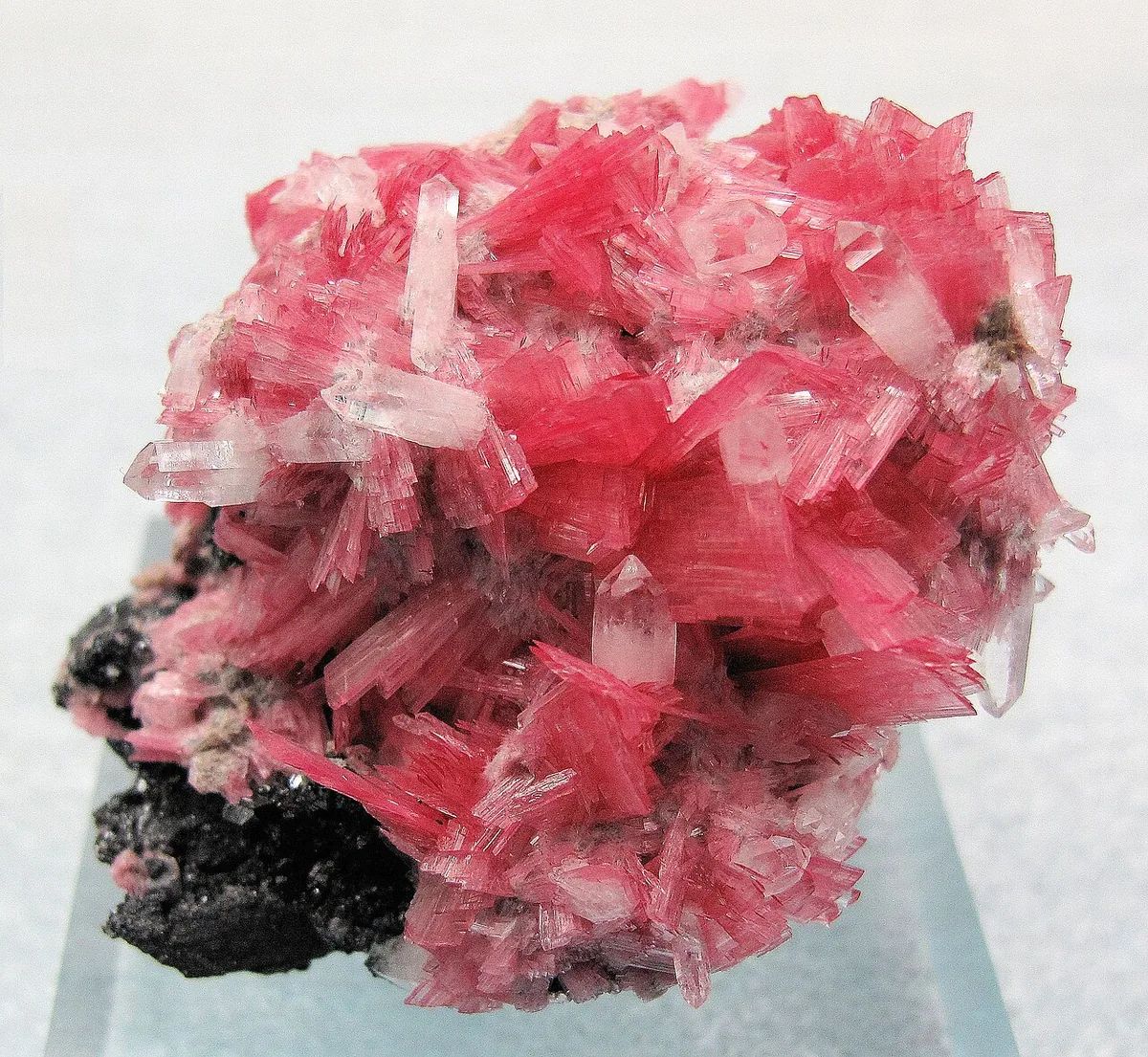
Rhodonite (Mn₂SiO₆… actually CaMn₃Mn[Si₅O₁₅]) is a manganese silicate forming pink to rose-red massive aggregates and rare prismatic crystals.
Rhodonite (Mn₂SiO₆… actually CaMn₃Mn[Si₅O₁₅]) is a manganese silicate forming pink to rose-red massive aggregates and rare prismatic crystals. Its name from Greek “rhodon” (rose) reflects the diagnostic pink color. Wuhua (Guangdong) and the Broken Hill (Australia) and Franklin (NJ) deposits supply iconic specimens. Often paired with black manganese-oxide veins for striking contrast.
More minerals to explore
Inesite (叶状硅锰钙石)
Triclinic
Pectolite (针钠钙石)
Triclinic
Larimar (拉利玛)
Triclinic
Charoite (紫龙晶)
Monoclinic