
Mohs 5–5.5
Vickers (~) 540 HV
Knoop (~) 620 HK
Geological setting
Volcanic
Element composition by mass
Formula: NaAlSi₂O₆·H₂O · molar mass: 220.15 g/mol
| O | 50.87% | |
| Si | 25.51% | |
| Al | 12.26% | |
| Na | 10.44% | |
| H | 0.92% |
Computed from atomic weights (IUPAC 2021). Site-occupancy groups (Fe,Mn) split equally.
Mohs Hardness
5–5.5
Analcime sits at 5–5.5 on the Mohs scale — can be scratched by a steel knife.
Colors:
Streak
White
White
Crystal system
Isometric (Cubic)
Isometric (Cubic)
SilicatesSilicates (Tectosilicates — Zeolites)
TL;DR · 1 min read
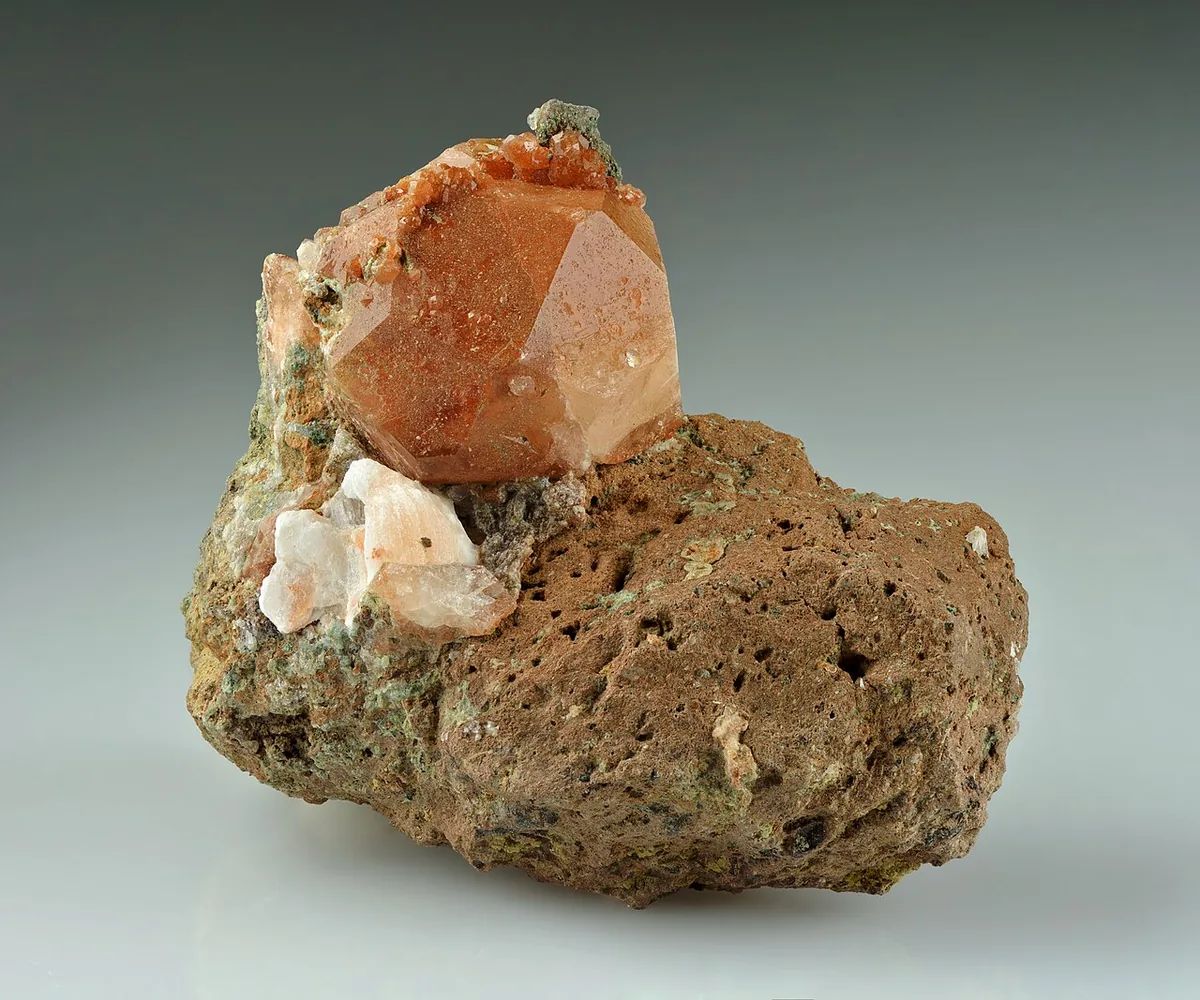
Analcime (NaAlSi₂O₆·H₂O) is a sodium zeolite forming distinctive trapezohedral (24-sided) crystals — one of the diagnostic "cube-like" zeolites. Named from Greek "analkis" (weak) for its pyroelectric properties.
Analcime (NaAlSi₂O₆·H₂O) is a sodium zeolite forming distinctive trapezohedral (24-sided) crystals — one of the diagnostic “cube-like” zeolites. Named from Greek “analkis” (weak) for its pyroelectric properties. Mt. Saint-Hilaire (Quebec) and Croft Quarry (England) yield iconic specimens. Forms in alkaline igneous rocks and basalt vesicles.
More minerals to explore
Natrolite (钠沸石)
Orthorhombic
Heulandite (钙沸石)
Monoclinic
Scolecite (钙沸石)
Monoclinic
Mesolite (中沸石)
Orthorhombic
Chabazite (菱沸石)
Trigonal
Stilbite (辉沸石)
Monoclinic